Automating routine workflows with AI agents reduces manual errors, cuts operational costs, and allows small teams to scale output without increasing headcount.
What’s AI agent automation and what changed?
AI agents have transitioned from making recommendations to taking prompt action and making decisions based on context.
Unlike basic automation tools that rely on predefined workflows, these agents process information and complete multi-step tasks with less human involvement. They’re powered by large language models and linked to real-world systems, including calendars, databases, CRMs, email platforms, and APIs. This integration allows businesses to manage daily workflows effectively and reduce routine manual work. The transition matters because legacy automation stops the moment a process changes, while agents adapt on the fly without requiring a developer to rewrite the rule.
AI agents now execute end-to-end workflows instead of merely suggesting next steps.
What’s the evidence behind AI agent automation?
Recent research from McKinsey and Gartner confirms that AI agents are actively deployed across core business functions.
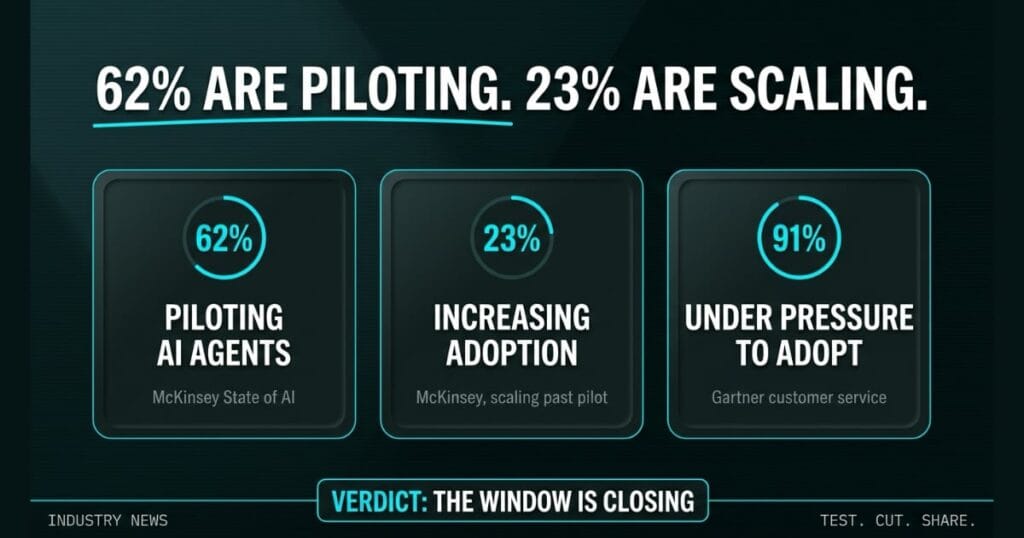
McKinsey’s State of AI research found that 62% of firms are already piloting AI agents, and 23% are increasing the adoption of agent-based systems in one or more core business functions. Separately, Gartner finds that 91% of customer service associates are under consistent pressure to adopt and use AI to achieve first-contact resolution and reduce customer effort. These systems handle tasks from automated refund processing to preliminary candidate assessments, demonstrating verified operational use beyond theoretical models. The McKinsey data also shows the gap between pilot programs and multi-departmental rollout, where 23% increasing adoption signals that early deployments are starting to stick.
Firms are piloting AI agents and actively increasing adoption across multiple departments.
How does AI agent automation compare to the alternatives, and what background do small business owners need?
Agentic systems operate dynamically, whereas traditional automation breaks when variables shift.
Fixed, predefined rules require manual updates whenever a process changes, but AI agents adapt to situations not explicitly programmed in advance. A single agent can manage a higher volume of workloads previously handled by multiple employees during peak periods. This allows a 2- or 3-person sales team to remain as organized as a much larger department by tackling follow-up work automatically. The shift matters because static rule-based systems break the moment a process changes, and someone has to manually rewrite the rule before work resumes.
Context-aware agents outperform rigid, rule-based automation by adapting to shifting business priorities.
The dispatcher’s radio crackles with 3 simultaneous calls, but the magnetic board on the wall still shows the same 2 trucks assigned to morning routes. A stranded driver on the highway cancels within 4 minutes of being put on hold. Your 3-truck towing operation just lost a $180 tow because the static board couldn’t see that one truck finished its job 12 minutes ago. McKinsey notes 62% of firms are already piloting AI agents, and 23% are increasing adoption to solve this exact bottleneck. An agent reads live truck GPS, evaluates the stranded driver’s location, and reroutes the closest truck in under 30 seconds. The job gets logged, the supplier gets notified, and the customer gets an instant ETA before you even put the phone down.
How does AI agent automation affect day-to-day operations for small businesses?
AI agents directly reduce manual errors, cut operational costs, and allow small teams to scale output without increasing headcount.
In sales, agents manage pipeline prioritization, update CRM records, and draft personalized outreach emails. In finance, automated invoice matching and account reconciliation complete month-end processes that previously took days overnight. Customer support teams use instant ticket triage and routing to handle large volumes of queries consistently, escalating only complex cases to humans. HR departments utilize automated CV screening at high volume and interview scheduling without manual coordination to increase hiring speed. IT teams use agents for monitoring system health, triaging internal support requests, and drafting routine code changes. The 91% Gartner figure is not abstract pressure, it shows up as finance teams skipping month-end overtime, support teams closing tickets before morning coffee, and sales reps leaving meetings with follow-ups already drafted. You can map these use cases against your own stack using the operational AI rollout playbooks in the signals archive.
Small business owners achieve continuous operational capacity without adding administrative staff.
What’s the final verdict on AI agent automation?
AI agents provide a compounding operational advantage by maintaining continuity around the clock.
A customer complaint raised on a Monday morning can be logged, categorized, responded to, escalated if unresolved, and followed up on all before a human reviews the morning queue. This level of operational continuity runs without breaks or handoff delays. The gap between businesses that have embedded AI agents in their operations and those that have not is widening and will continue to do so. The McKinsey 62% piloting figure suggests the early-mover window is still open, but the 23% increasing adoption shows the window is closing fast.
Early adopters gain an insurmountable efficiency advantage over businesses relying on manual handoffs.
Source: AutoGPT Blog
