Choosing the right AI memory tool can save small business owners hours of repeated setup time and prevent context loss across team projects and client communications.
What are the best AI tools for persistent memory in 2026?
The best AI tools for persistent memory in 2026 are divided into consumer apps for individual users and developer infrastructure for building agents.
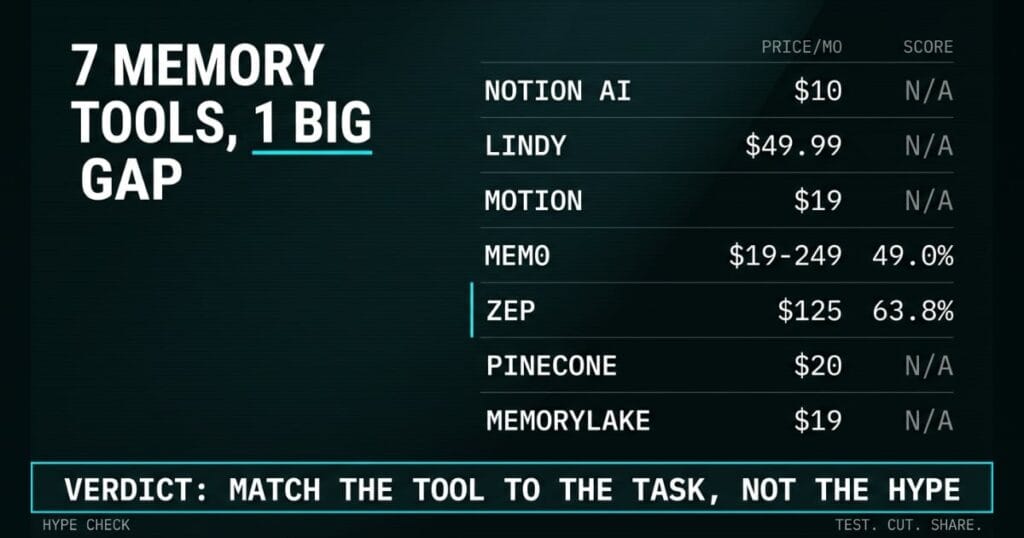
The market splits cleanly between 3 consumer apps and 4 developer tools. Notion AI costs $10 per user per month for structural workspace memory, while Lindy costs $49.99 per month for selective task automation. On the developer side, Mem0 starts at $19 per month but scales up to $249 per month for graph features. In contrast, Zep costs $125 per month and Pinecone starts at $20 per month for zero-ops vector storage. MemoryLake rounds out the developer side at $19 per month with cross-agent governance and GDPR deletion controls for regulated environments.
Choosing the right category prevents wasted budget and lost context.
What’s the evidence behind Zep and Mem0 benchmark scores?
The evidence behind Zep and Mem0 benchmark scores comes from independent LongMemEval testing for temporal retrieval tasks.
Zep scored 63.8% on the LongMemEval benchmark, while Mem0 scored 49.0%. Mem0 holds 48,000+ GitHub stars and benchmarks 26% higher response quality with 90% fewer tokens compared to OpenAI built-in memory. The free tier for Mem0 includes 10,000 memories per month, but the leap to graph features at $249 per month catches teams off guard. Zep operates asynchronously with sub-50ms retrieval latency, which means memory processing happens in the background without slowing the user-facing response. The 15-point gap matters any time an agent needs to reason about when a fact was true, not just what the fact was.
Zep provides a 15-point benchmark advantage for agents tracking evolving situations.
How do AI memory tools compare to alternatives, and what background do small business owners need?
AI memory tools compare to alternatives by offering dynamic personalization across sessions, whereas RAG only searches static document databases.
Notion AI provides structural memory across pages and databases, but its memory doesn’t extend outside the Notion ecosystem. Lindy offers per-agent selective memory, meaning an email triage agent doesn’t share memory with a scheduling agent unless explicitly connected. Motion costs $19 per month and learns calendar patterns, like adding a 30% time buffer for editing tasks. MemoryLake starts at $19 per month and provides cross-agent governance with GDPR deletion controls. The Pinecone vector database starts at $20 per month and functions as the storage backend that memory layers like Mem0 or Zep run on top of, which means a serious build may need both.
Small business owners must map their workflow scope before selecting a memory tool.
You’re on the phone with a furious client because the solar panel installation scheduled for Tuesday was pushed to Friday without notice. Your scheduling software remembered the installation date, but it failed to remember that the municipal permitting office updated their inspection rules last week. The agent looked at a flat fact and missed the timestamp. This is the exact operational failure Zep prevents with its temporal knowledge graph. When a client changes their budget on a Tuesday, your sales agent needs to know that the old budget is no longer valid. If you rely on flat memory infrastructure like Mem0, which scores 49.0% on LongMemEval, your system will feed your team outdated information. You end up sending a crew to an unpermitted job site, burning a full day of labor and destroying client trust, because your AI forgot to check when the facts changed.
How do AI memory tools affect day-to-day operations for small businesses?
AI memory tools affect day-to-day operations by eliminating repetitive context setup and preventing information loss across team projects.
A freelancer using Lindy for email triage sees sorting improvements over 2 weeks as the agent learns VIP contacts and escalation preferences. A developer building a support chatbot can use Mem0 to maintain state across thousands of user sessions. A team operating across 5 different apps will find that Notion AI only remembers 20% of their context. For enterprise teams running 5 different AI agents, MemoryLake prevents siloed memory pools by providing a shared, governed infrastructure. You can explore more operational AI analysis in our signals archive. The operational cost of picking wrong is concrete: a $249 per month Mem0 Pro tier buys graph features a knowledge worker in Notion will never touch, while a $10 Notion AI add-on collapses the moment a developer tries to use it for a multi-agent customer support build.
Deploying the correct memory infrastructure saves hours of manual reconfiguration every week.
What’s the final verdict on AI memory tools in 2026?
The final verdict on AI memory tools in 2026 is that selection depends entirely on whether you need a consumer assistant or developer infrastructure.
Knowledge workers should start with Motion for $19 per month or Notion AI for $10 per user per month. Developers building personalized assistants should start with the Mem0 free tier, while those needing temporal reasoning should evaluate Zep at $125 per month. Enterprise teams running multiple agents should deploy MemoryLake at $19 per month to avoid a 3 to 6 month custom build for multi-agent coordination. The 15-point Zep over Mem0 gap on LongMemEval is the single most decisive data point in the entire market, and it should drive the choice for any agent that needs to reason about when facts changed, not just what the facts are.
Matching the memory scope to the specific operational need dictates the ROI of the tool.
Source: AutoGPT Blog
