Saves time editing AI-generated marketing copy by instantly flagging robotic cliches that hurt brand trust.
What’s the LLM Cliche Highlighter and what changed?
Simon Willison built a free browser tool that flags 10 common robotic phrases generated by language models.
The application runs entirely in your browser, avoiding server uploads and saving data via localStorage. Willison used Fable 5 to vibe code this application after reading yet another article crammed with LLM-generated writing. The tool is part of his long-running weblog covering AI tools, and the project itself is a working example of how fast a single developer can ship a focused utility with frontier models. The launch matters because AI copy is now pervasive in marketing channels, and most small teams have no fast way to scan drafts for the most obvious tells before publishing.
This tool highlights the exact cliches in your text.
What’s the evidence behind the LLM Cliche Highlighter?
Willison specifically targeted 10 common patterns that dominate AI-generated text outputs.
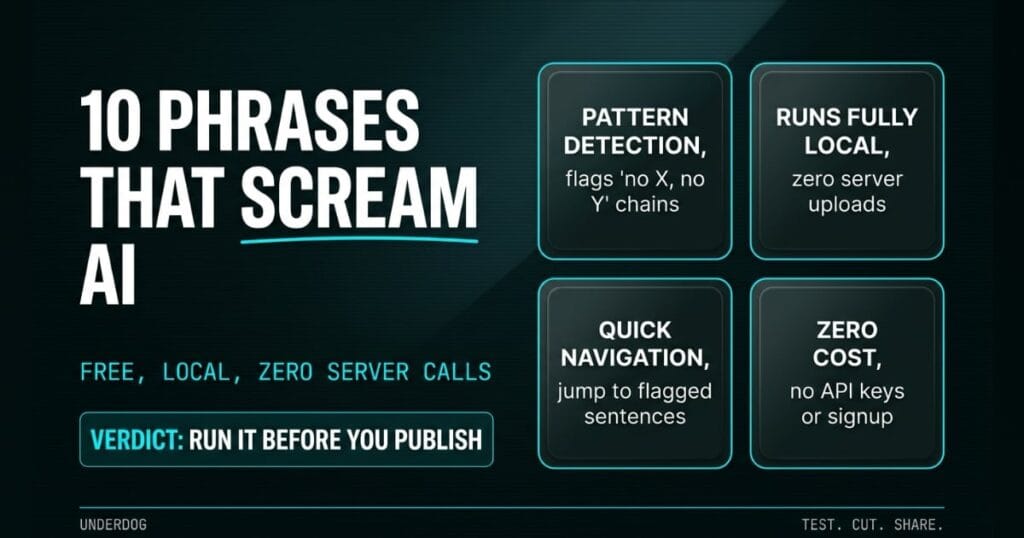
The tool detects “no X, no Y” chains, such as “no fluff, no filler, no jargon.” It also flags expressions like “sit with that” and “you already know,” providing toggleable pattern detection and context-aware sentence highlighting with quick navigation. The interface includes pattern counts and match listings so you can step through every flagged phrase without scrolling blindly. Every feature runs locally, with localStorage handling persistence between sessions so nothing leaves the device. The pattern set is deliberately narrow and tuned to the most repeated phrases in LLM blog output, which is why it works as a fast quality gate rather than a full writing critique.
The tool identifies 10 distinct patterns with deterministic local detection.
How does the LLM Cliche Highlighter compare to the alternatives, and what background do small business owners need?
Unlike subscription SaaS platforms, this tool is free and runs entirely in your browser.
It’s an early vibe-coded application built for immediate utility. It provides instant value by identifying the 10 patterns directly in your browser, with no API keys, no usage data collection, and no recurring fees. The tradeoff is that vibe-coded tools often lack the polish of commercial SaaS, and you trade a polished UI for raw speed and zero cost. For a small business owner reviewing AI-generated marketing copy, that trade is favorable because the work is occasional and the alternative is a manual line-by-line read. The narrow scope is also a feature: a tool that flags 10 patterns is easy to learn, easy to train a team on, and easy to walk away from when something better ships.
You get a zero-cost local tool with no server roundtrips.
The smell of dust and old paper hits you the second you walk into the back room of the used bookstore. You’re pricing a stack of recently acquired volumes, but the descriptions your new assistant typed into the inventory system all sound exactly the same. Every single tagline features a repetitive “no X, no Y” structure, and the phrasing feels completely synthetic. You hand the stack back and tell them to strip out those 10 exact robotic phrases before the online catalog goes live, because customers don’t buy from a robot. Willison’s tool does this in seconds instead of a manual read. You paste the descriptions in, see the 10 patterns highlighted, and ship a cleaner catalog the same afternoon.
How does the LLM Cliche Highlighter affect day-to-day operations for small businesses?
It flags robotic cliches in AI-generated text.
Small business owners can paste text into the analyzer to identify patterns before publishing. This immediate feedback loop removes the need for manual line-by-line reviews of AI outputs, which you can track alongside other developments in the signals archive. The tool also helps teams build a shared vocabulary for what bad AI copy looks like in your specific industry. When a freelancer hands in a blog post, you can run it through, hand back a flagged version, and train them on the exact patterns you reject. The same loop works for in-house teams using AI agents to draft email sequences, landing page copy, or product descriptions, and the deterministic local detection means you can run it on sensitive copy without routing it through a third-party API.
Founders can instantly strip robotic filler from their marketing copy and train their team in the process.
What’s the final verdict on the LLM Cliche Highlighter?
It’s a fast, zero-cost utility for small business owners who refuse to publish obvious AI copy.
Although it’s an early vibe-coded app, it delivers immediate operational value for marketing edits. It identifies exactly 10 common patterns and runs locally without any SaaS bloat. The tool does not promise to fix every writing problem, but it eliminates the most obvious tells that AI copy carries into your published work. For a business owner who delegates content to freelancers or AI agents, it functions as a quality gate that costs nothing and runs in seconds. Willison’s track record on AI tooling makes this a credible first pass rather than a throwaway side project, and the open pattern set means a team can fork it if they want industry-specific additions.
Run your marketing copy through this tool before you publish anything.
Source: simonwillison.net
