Small businesses can drastically reduce AI operational costs by leveraging open-source models that offer comparable performance to premium APIs without the ongoing per-usage fees.
What’s the open-source AI capability gap and what changed?
Open-source AI models have essentially matched the performance of paid closed models, fundamentally altering the economics of artificial intelligence.
The capability gap between open and closed models on Chatbot Arena collapsed to 0.5% by August 2024 and sits at 3.3% as of March 2026. Open weights have reached parity on coding and instruction-following, with the remaining gap concentrated in reasoning and long-context retrieval. Mozilla CTO Raffi Krikorian notes that open models are where the actual work happens, routing the majority of production tokens. The reopening of the gap from 0.5% to 3.3% reflects how quickly closed vendors can ship a frontier push, but the structural parity on the workloads most businesses actually run remains intact.
Open weights are no longer a compromise, they’re the default production layer.
What’s the evidence behind the open-source AI inference cost collapse?
The price of GPT-4-equivalent intelligence plummeted 50x over 36 months, breaking the metered billing model.
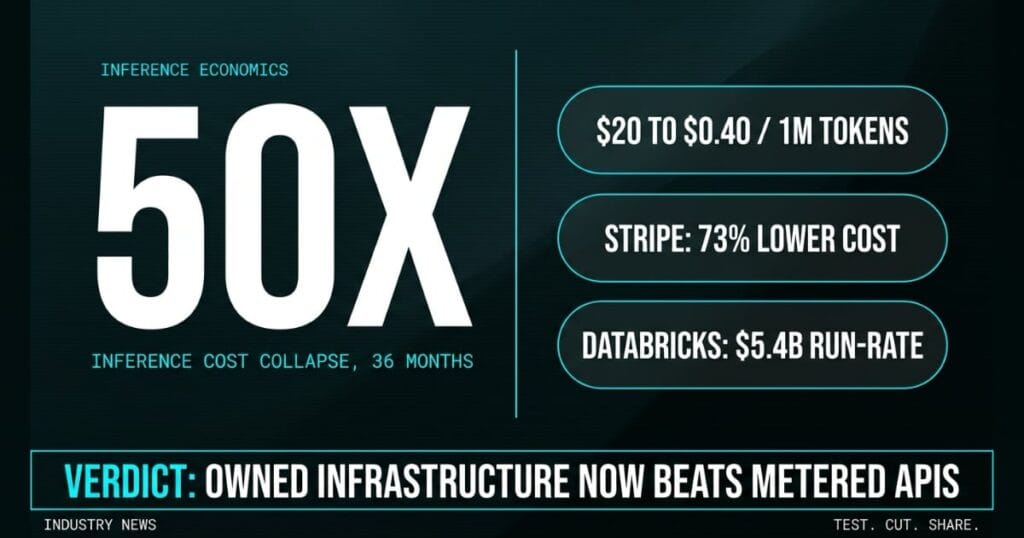
Inference costs fell from $20 to $0.40 per 1M tokens, a decay rate faster than dotcom-era bandwidth or PC-compute curves. Enterprises are reacting aggressively to this price asymmetry. Stripe cut inference costs 73% by serving open models on vLLM, handling 50M daily API calls on one-third the GPU fleet. Conversely, Uber exhausted its entire 2026 AI coding budget in 4 months, and Microsoft is exploring a secured DeepSeek V4 deployment to escape per-token billing. The Stripe proof point is the most cited: same 50M daily API call volume, one-third the GPU fleet, 73% lower inference cost.
The metered API model breaks at scale, forcing a shift to owned infrastructure.
How does open-source self-hosting compare to closed APIs, and what background do small business owners need?
Self-hosted open weights offer an exit from vendor lock-in and unpredictable per-token metered billing.
Closed models currently hold 80% of usage on OpenRouter but capture 96% of revenue, costing roughly 6x more per call for comparable capability. The Linux Foundation estimates this price asymmetry represents $24.8B in unrealized annual savings. The operational reality is harder, with only 51% of open-model teams reaching production compared to 63% for closed models due to integration and maintenance friction. The integration gap is widening as closed vendors ship managed SDKs while open teams still stitch together vLLM, TGI, and custom observability stacks.
Open weights convert a variable vendor expense into a fixed operational asset.
You drop a manifest clipboard onto the auto parts warehouse counter, staring at an invoice from your logistics provider that just billed you $20 for every pallet moved this month. The supplier raised the per-pallet rate again, bleeding your margins dry on high-volume restocking runs. You realize you can buy your own forklift and hire a dedicated driver for a fixed monthly salary, eliminating the variable surcharge entirely. The open-source AI market is undergoing this exact transition. The cost of GPT-4-class inference collapsed 50x in 36 months, dropping from $20 to $0.40 per 1M tokens. Tech giants like Stripe already cut inference costs 73% by self-hosting open models. The operational trap is that you now own the maintenance, integration, and deployment overhead. Only 51% of open-model teams reach production because the tooling is fragmented. You save the per-token drain, but you inherit the infrastructure headaches.
How does open-source AI adoption affect day-to-day operations for small businesses?
Small businesses can drastically reduce AI operational costs by adopting open models that avoid ongoing per-usage fees.
While 79% of developers use open models, production deployment stalls for 51% of teams due to operational tooling gaps. The Mozilla survey shows integration into existing systems and ongoing maintenance are the top operational blockers, with integration up 11 percentage points and ongoing maintenance up 10 percentage points year over year. Small businesses must weigh the 50x inference cost collapse against the engineering resources required to deploy and maintain open infrastructure. You can track the broader shift away from metered billing across our open AI infrastructure analysis in the signals archive.
Founders must calculate if the engineering overhead outweighs the metered billing savings.
What’s the final verdict on open-source AI models?
Open weights have closed the performance gap and shattered the pricing power of closed model providers.
The 3.3% capability gap is negligible for most business workloads, and the 50x inference cost collapse makes self-hosting financially dominant. Companies like Databricks and Mistral are scaling to billions in revenue by providing the infrastructure for this shift. Databricks crossed a $5.4B run-rate, and Mistral scaled 20x to roughly $400M ARR, which proves the open-weights layer is producing real revenue, not just developer enthusiasm. The strategic value of open weights is the ability to walk away from any vendor at any time, avoiding the cloud-era trap of expensive exit costs.
Open weights are a strategic hedge against vendor pricing control and sudden access shutdowns.
Source: stateofopensource.ai
