Provides a practical framework for small business owners to evaluate their AI spending and ROI, while offering new model tiers to optimize costs.
What’s GPT-5.6 and what changed?
OpenAI launched GPT-5.6 and introduced a new scorecard to help businesses measure useful intelligence per dollar.
The GPT-5.6 family features 3 tiers: Sol is the flagship, Terra balances performance and cost, and Luna is the fastest and most affordable model. OpenAI designed this tiered structure to let customers optimize the economics of their tasks, using Luna for high-volume workflows and Sol for complex reasoning. The launch reframes the AI buying conversation away from per-token pricing and toward the cost of a successful task, which is the metric a CFO actually cares about when signing the renewal.
GPT-5.6 shifts the focus from adoption metrics to the actual cost of a successful task.
What’s the evidence behind GPT-5.6?
OpenAI claims GPT-5.6 Sol with max reasoning set a new state of the art on the Artificial Analysis Coding Agent Index.
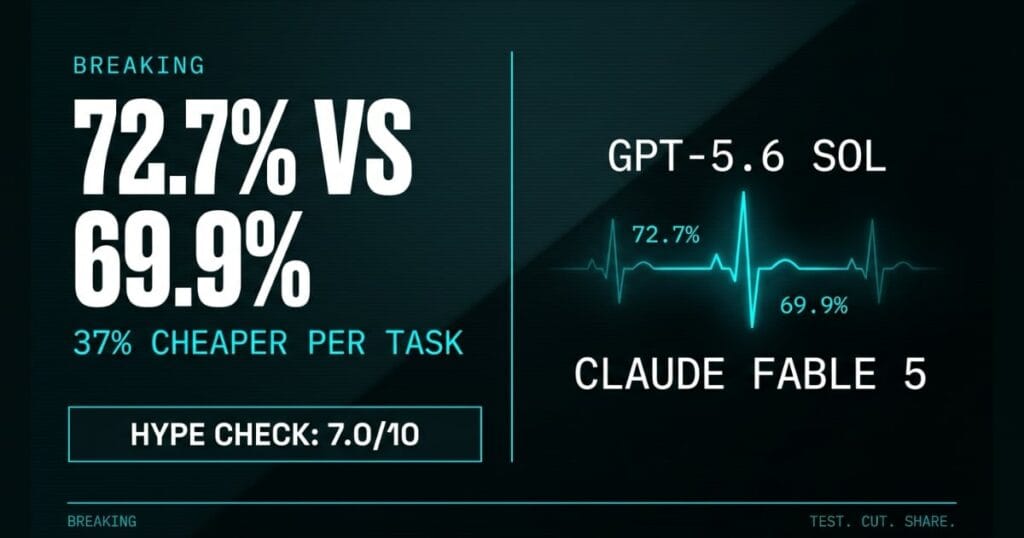
The model reached 72.7% on long-horizon engineering tasks, beating Claude Fable 5 at 69.9%. GPT-5.6 Sol achieved this while using 54% fewer output tokens than another leading model, resulting in a 36.2% lower estimated API cost. The benchmark data backs the scorecard thesis: when a more capable model completes work in a single pass, retries, latency, and human review drop, and the total cost per successful task falls even if the per-token price is higher. OpenAI trained GPT-5.6 to extract more useful work from every token, which is the operational unlock small business owners should track when comparing frontier models.
Sol delivers frontier capability while cutting token usage and overall API costs.
How does GPT-5.6 compare to the alternatives, and what background do small business owners need?
A cheaper model with lower token costs often produces a higher total cost per outcome due to retries and human review.
OpenAI argues that a more capable model like Sol may deliver the best value for routine requests if it produces the right answer in a single pass. The scorecard requires businesses to divide the full cost of completing work by the number of successful tasks, which changes the evaluation criteria from surface-level pricing to operational efficiency. For a finance team preparing for a forecast review, that means tracking the time saved on finding the latest forecast, moving data into Excel, reconciling tabs, and rebuilding slides, not just the tokens consumed. The tiered model family gives customers 3 deliberate pricing points to map against their own task economics instead of forcing a single one-size-fits-all choice.
Frontier models win on total cost when they eliminate the hidden expenses of rework and human correction.
The lead designer stares at a calm screen, waiting for the generative tool to finalize a custom bridal bouquet rendering, unaware the system has silently stalled on a complex reasoning step. The prompt requested a specific blend of sourced stems to reduce wholesale API costs, but the underlying model failed to execute the multi-step reasoning required to balance the inventory. The software reports task completion, but the output is a generic floral arrangement that completely misses the client’s custom specifications. The designer approves the design, sending an unvetted proof to the bride, and the studio absorbs the financial loss when the physical arrangement fails to match the approved concept. This silent failure represents the exact dependability gap OpenAI targets, where a model lacking the capability of GPT-5.6 Sol forces a business to track the cost of corrections, escalations, and rework instead of simply counting successful tasks.
How does GPT-5.6 affect day-to-day operations for small businesses?
Founders must track AI dependability by categorizing results as ready to use, needing correction, or needing escalation.
Before AI moves from drafting to taking action, organizations must define what data the system can access and when a person should review an action. To measure value at scale, teams need to track if completed work grows faster than total cost, a principle that applies directly to managing your AI workflow integrations in the signals archive. The scorecard also asks whether each AI dollar buys more work as usage grows, which forces teams to monitor the trend of cost per successful task over months rather than treating any single bill as the verdict. OpenAI’s ChatGPT Work product builds on the security, privacy, and workspace-management foundation of ChatGPT Enterprise to give AI more context and access to higher-value workflows while maintaining oversight.
Operational AI requires strict boundaries on system access and clear checkpoints for human approval.
What’s the final verdict on GPT-5.6?
GPT-5.6 and the new scorecard force founders to evaluate AI based on useful work and dependable outcomes.
This release earns a hype check of 7.0 out of 10 because OpenAI backs the launch with concrete benchmark gains rather than marketing language. By tracking the full cost of a successful task instead of surface-level token pricing, teams can use the 3 model tiers to optimize their workflows. The data shows GPT-5.6 Sol achieves 72.7% on the Artificial Analysis Coding Agent Index at a 36.2% lower estimated API cost than another leading model. The capability earns first use, but dependability is what makes AI part of how work gets done, and the scorecard gives founders a structured way to measure both.
Survival depends on tracking the cost of a successful outcome, not the cost of a single token.
Source: OpenAI Blog
