Provides strategic foresight for business owners to prepare for the integration of autonomous AI agents into their workflows.
What is the shift to active AI agents and why does it matter now?
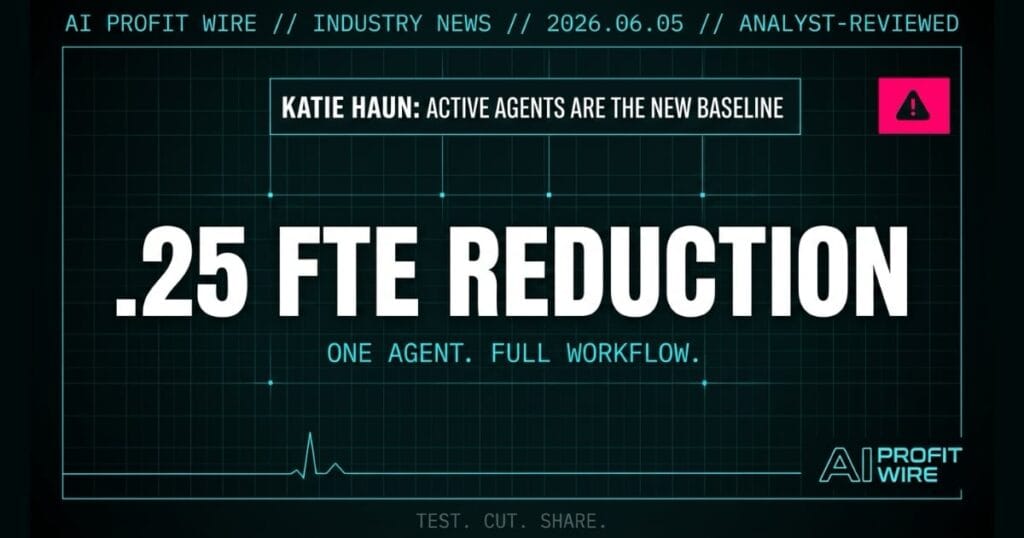
AI is transitioning from passive tools to active agents. Katie Haun, a leading venture capitalist, notes that the focus is now on frontier agents that can execute complex tasks. This moves AI from a response engine to an execution engine. The transition from prompting a tool to managing an agent changes the fundamental ROI of AI integration.
What proof backs this signal?
The signal comes from an expert analysis via Bloomberg Tech. Katie Haun’s position as a frontier AI investor provides the evidence for this structural shift, which carries a Hype Score of 8/10. She identifies the move toward autonomous agency as the primary investment frontier. When the largest pools of AI capital pivot toward autonomy, the market for passive prompt-based tools shrinks.
Should small business owners care about autonomous agents?
Autonomous agents reduce the cost per exception by handling multi-step logic internally. Instead of a human managing 5 separate prompts, 1 agent handles the full workflow. This allows for a .25 FTE reduction in roles centered on coordination. We track workforce automation shifts like this in the AI Profit Wire signals, and the coordination cost reduction pattern shows up consistently across agentic deployments. Moving to active agents transforms AI from a productivity hack into a legitimate workforce expansion.
The version that runs in a vendor demo and the version that runs in your actual business are two different products. I’ve built agentic workflows that passed every internal test I designed, then hit a wall the first time a real customer submitted something the agent had never encountered. Passive tools fail quietly: blank output, you retry. Active agents fail loudly: half-finished work lands in a client’s inbox, a workflow triggers that should never have run, or a task loops until the rate limit kills it and leaves a cleanup job for you to find the next morning. The promise of autonomy is real. The architecture to make it reliable in production takes two to three times longer than any vendor estimate. That gap is where your operational risk lives right now.
Should you act on this signal now?
Start auditing workflows for manual hand-offs today. Identify the 3 most repetitive multi-step processes in your business. Stop looking for better prompts and start looking for agentic frameworks. Map your coordination costs before the next quarter to identify where active agents can replace manual triggers.
Source: Bloomberg Tech
