Enables rapid localization and personalized audio content creation, though infrastructure costs will vary based on AWS usage.
What Is Qwen3-TTS on SageMaker and What Does It Do?
Qwen3-TTS-12Hz-1.7B-Base, an open-source text-to-speech model from Alibaba’s Qwen team, is now deployable from Amazon SageMaker JumpStart to a managed real-time endpoint, per AWS’s September 25 walkthrough. You construct the model object, call deploy, and invoke the endpoint with the SageMaker runtime client.
Voice cloning means the model reproduces a specific speaker’s vocal identity from a few seconds of reference audio plus a transcript, without retraining. It holds that identity across the family’s 10 languages, including Chinese, English, Spanish and German.
The family runs on the Qwen3-TTS-Tokenizer-12Hz and ships in 0.6B and 1.7B sizes, with the Base variant used for cloning and a CustomVoice variant for predefined speakers, per the project’s repository. Qwen3-TTS-12Hz-1.7B-CustomVoice and Qwen3-ASR-1.7B sit in JumpStart alongside the Base variant, so a team can pair the cloner with the recognizer behind the same endpoint pattern.
Self-hosted voice cloning is now a deploy step instead of a research project.
Does Qwen3-TTS Voice Cloning Actually Work in Real Time?
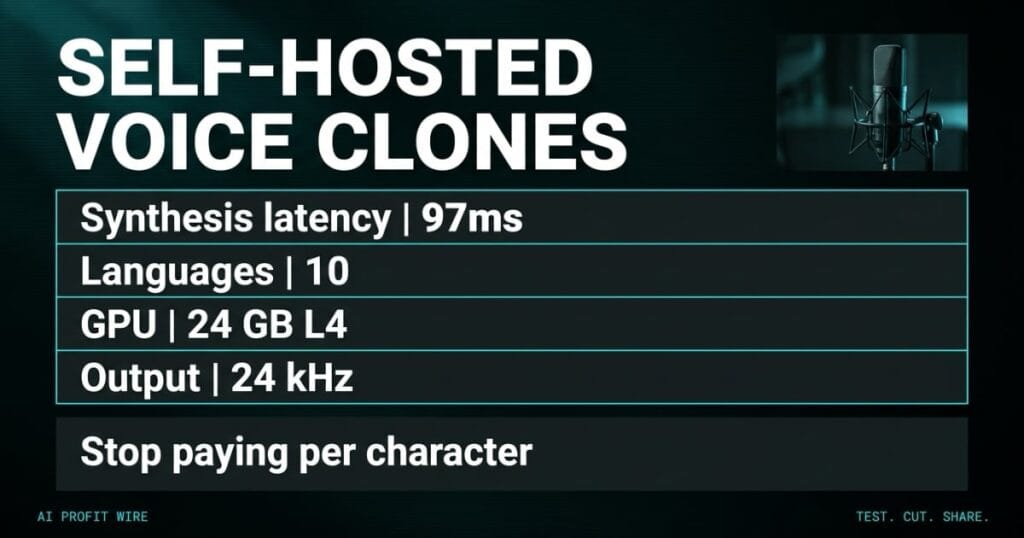
The architecture says yes. A Dual-Track hybrid streaming design outputs the first audio packet after a single character of input, with end-to-end synthesis latency as low as 97ms in the repo’s own numbers.
On AWS, the model runs as 2 stages, talker and code2wav, on 1 GPU. The talker weights load at 3.66 GiB, the code2wav stage at 0.45 GiB, and both stages fit a 24 GB card at 0.45 memory utilization each, with a combined KV cache of 56,928 tokens.
The endpoint emits 24 kHz audio, and the model card confirms the same streaming behavior behind the managed deployment. Two invoke details come from the walkthrough itself: the request routes to the speech handler through a custom attribute, and the reference clip rides in as a base64-encoded 24 kHz mono WAV.
97ms synthesis latency on 1 rented GPU clears the bar for interactive voice work.
Is Qwen3-TTS Good Enough to Replace Paid Voice APIs?
The honest answer splits on volume. AWS frames the cost as aligned with compute usage instead of per-character API pricing, and the audio never leaves your account.
The trade is operational. You size the instance, watch the CloudWatch metrics, and delete the endpoint when idle.
The walkthrough’s own cleanup step exists because the meter runs while the endpoint stands. Alibaba’s open-source announcement carries the same positioning: run it yourself, keep the recordings.
For teams already paying a per-character bill, the break-even question is hours of endpoint uptime against monthly characters, and the 24 GB L4 card keeps the floor low.
Steady narration volume favors self-hosting on cost and control, occasional one-liners still favor an API.
Who Is Self-Hosted Voice Cloning Actually For?
The fit is a team producing steady audio volume, course libraries, product walkthroughs or localized marketing, with someone technical enough to own an endpoint. Media teams, educators and application developers are AWS’s named use cases.
Data control is the second filter. Reference recordings and generated audio stay inside the AWS account, which matters when the voice belongs to a customer or a brand.
Teams weighing this against the per-character services can benchmark the leading API in our ElevenLabs intelligence report before committing either way.
If the voice is an asset and the volume is steady, the account boundary is worth the setup.
The Spanish track of a small training library used to mean a studio booking and a second invoice for every revision. A self-hosted clone rewrites that line item: a few seconds of the founder’s reference recording plus its transcript, and the 1.7B model narrates each new script in her voice, with synthesis latency as low as 97ms.
The control question answers itself at the contract level. The customer recordings that anchor the library never leave the AWS account that already holds them, and there is no per-character meter to forecast against a launch date.
The review step is the one that stays human. Somebody still listens to every cut before it ships, because a cloned voice that mispronounces a product name is worse than a silence.
Is Qwen3-TTS on SageMaker Production Ready?
The deployment path is production-shaped. JumpStart supplies the serving container, SageMaker handles provisioning, health monitoring and automatic scaling, and autoscaling adjusts the instance count on demand.
The sizing is settled: 1 ml.g6.4xlarge instance, an NVIDIA L4 with 24 GB, runs both stages with headroom, and TTS requests run short enough that 1 instance absorbs multiple concurrent requests. CloudWatch splits the metrics two ways, instance-level hardware like GPU and memory utilization, and invocation-level counts, latency and errors.
The one discipline the walkthrough insists on is cleanup, deleting the endpoint and model when idle, because the meter runs on standing infrastructure.
Production-ready for a team that watches its meters, expensive for a team that forgets them.
Source: AWS Machine Learning Blog
