Small businesses relying on AI-generated video for Snapchat marketing may see a sharp drop in organic reach and monetization on the platform.
What is Snapchat Spotlight and what changed?
Snapchat Spotlight is the platform’s short-form video discovery feed, and it no longer rewards fully AI-generated videos.
The company updated its recommendation systems to prioritize human-made content and block automated clips from earning monetization.
Creators can still use AI tools to enhance or edit their videos without losing eligibility, but fully AI-generated videos no longer receive Spotlight recommendations or payouts.
Snapchat first signaled this change in April when it announced users would see less AI-generated content on the platform.
Snapchat wants Spotlight to remain a place where people can discover authentic creativity from real people, because there is enduring value in rewarding original perspectives and personal storytelling.
Snapchat Spotlight now requires human creation for monetization and reach.
What is the evidence behind Snapchat Spotlight AI bans?
The evidence comes directly from Snapchat’s blog post announcing the update on July 31, 2026, which states that only videos created by real people are eligible for Spotlight recommendations.
LinkedIn recently launched a feature allowing users to click a button labeled “seems like AI slop” to report posts that seem AI-generated.
YouTube intensified its crackdown on low-quality AI content by clarifying monetization policies so “inauthentic content” cannot be monetized, including generic, repetitive, or template-based content and AI personas discussing sensitive topics such as health and finance.
Substack also introduced a tool to help users identify AI-written newsletters, showing the crackdown extends beyond video into text.
Meta faced significant backlash over an Instagram feature that allowed users to modify photos from public accounts using AI, leading Meta to remove the feature entirely.
The evidence shows platforms are actively restricting fully automated AI content across every format.
How does Snapchat Spotlight AI bans compare to the alternatives, and what background do small business owners need?
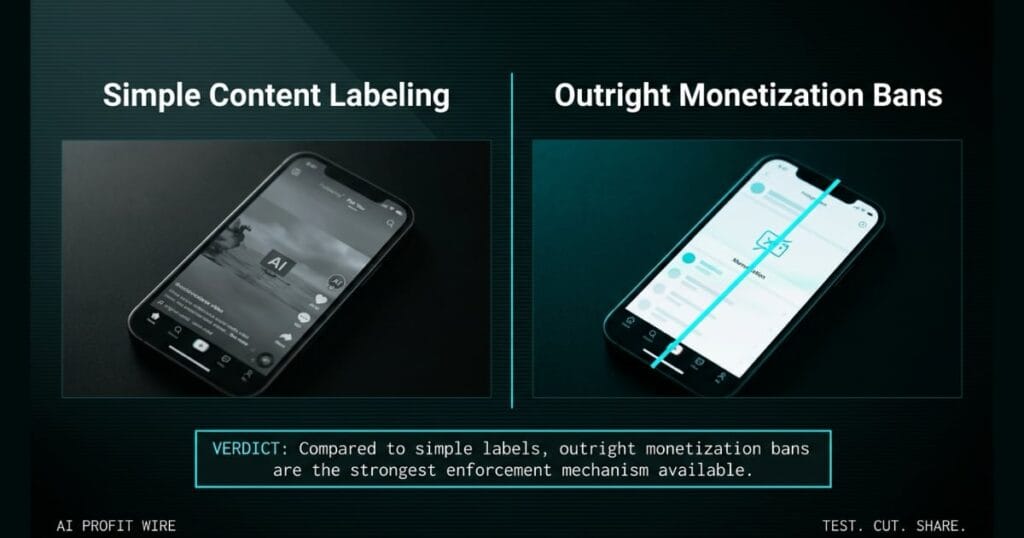
Snapchat is taking a harder line than simple content labeling by removing monetization eligibility for fully AI-generated videos entirely.
While LinkedIn introduces reporting buttons for AI slop, Snapchat is cutting off the financial incentive, which is a stronger enforcement mechanism.
YouTube’s approach targets monetization eligibility for inauthentic content, while Snapchat targets recommendation eligibility for fully AI-generated videos, which means the enforcement models differ but the direction is the same.
Substack’s AI newsletter detection tool focuses on transparency rather than penalties, which is a softer approach than Snapchat’s outright ban.
Compared to simple labels, outright monetization bans are the strongest enforcement mechanism available.
How does Snapchat Spotlight AI bans affect day-to-day operations for small businesses?
Small businesses relying on AI-generated video for Snapchat marketing will see a sharp drop in organic reach and monetization on the platform, and automated content pipelines are now a liability instead of an asset.
You can still use AI tools to edit your videos, which means human-led filming remains a requirement if you want to capture Spotlight traffic.
Snapchat also implemented new content control measures to protect underage users, with those aged 13 to 15 only able to share Spotlight posts with people they follow back, which affects targeting for youth-oriented brands.
Founders adapting to this shift can track related platform updates affecting small businesses to see where automated workflows still function effectively.
Day-to-day operations require shifting budget from AI generation back to human content creation.
The content calendar shows AI-generated video drafts queued for Snapchat Spotlight, and the publishing tool just flagged every single one as ineligible for monetization. The team spent the last quarter scaling the pipeline, and the algorithm change wiped the ROI overnight.
Snapchat first signaled this crackdown in April, and the July update now blocks fully AI-generated videos from earning recommendations or payouts. Creators can still use AI to edit human footage, but end-to-end AI generation is dead on this channel.
The fix is not a workaround, it is a pivot. Founders who treated AI video as a free distribution channel need to put human-led creation back into the loop, because the broader crackdown is hitting Meta, YouTube, LinkedIn, and Substack at the same time.
What is the final verdict on Snapchat Spotlight AI bans?
Fully automated AI video pipelines are dead on Snapchat Spotlight, and founders must pivot to human-led creation immediately or lose their organic reach and monetization.
The platform explicitly stated that only videos created by real people are eligible for recommendations, and using AI to edit human footage is the only viable path forward for small business owners on this channel.
This isn’t a temporary glitch, as the broader industry crackdown on AI slop continues to tighten across Meta, YouTube, LinkedIn, and Substack.
Founders who built their content strategy on cheap AI generation need to reallocate budget to human production, because the platforms have made the math impossible to ignore.
Human-made content is now the mandatory baseline for video monetization.
Source: TechCrunch AI
