This technology could eventually allow small businesses to automate inbound and outbound phone calls with AI that customers cannot distinguish from human staff, drastically reducing customer support costs.
What is Smallest.ai and what changed?
Smallest.ai is a startup developing voice AI agents designed to sound indistinguishable from human staff, and it just secured $13 million in a Series A round.
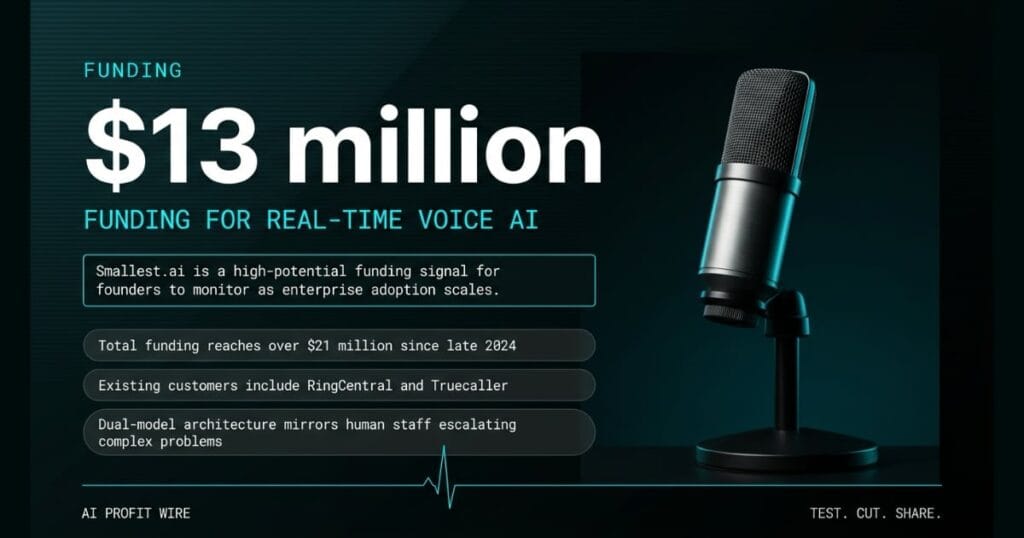
The funding was led by Seligman Ventures, with participation from Sierra Ventures and 3one4 Capital, bringing total backing to over $21 million since its founding in late 2024.
The core change is a shift away from large foundational models for real-time voice tasks, using a small voice model that processes listening and speaking simultaneously.
Founder Sudarshan Kamath told TechCrunch the company’s sole focus is making speaking to an AI agent indistinguishable from talking to a human.
The startup believes the next leap in voice agents will not come from making large language models faster, but from using smaller, specialized models built for human conversation.
Smallest.ai is building real-time voice infrastructure for enterprise customer support.
What is the evidence behind Smallest.ai?
Founder Sudarshan Kamath states the goal is to break the Turing test by sounding genuinely human, which is the company’s sole focus.
Standard LLMs wait for an entire prompt before thinking, which kills conversational flow and creates unnatural pauses in voice calls.
Kamath explained that even a short pause feels unnatural in a voice conversation, which is why the startup built a real-time intelligence layer instead of relying on faster LLMs.
Smallest.ai avoids this by acting as a real-time intelligence layer, handing unknown queries to an offline LLM and placing the caller on a brief hold to research the issue.
The startup’s model focuses on voice-specific nuances like diverse accents, dozens of languages, and noisy environments, which broad-audio tools do not prioritize.
Kamath believes that all AI agents will soon rely on two models: a small voice model for real-time interaction, and an offline LLM that is called upon as needed to solve complex problems.
The evidence relies on architectural design and early enterprise adoption.
How does Smallest.ai compare to the alternatives, and what background do small business owners need?
Smallest.ai competes with voice AI leader ElevenLabs, as well as Cartesia and regional players like Sarvam that focus on local languages.
The startup differentiates by focusing strictly on real-time conversational voice agents for enterprise customers, while competitors apply voice AI to audio dubbing and podcasting.
While some competitors apply voice AI to use cases like audio dubbing and podcasting, Smallest.ai focuses strictly on real-time conversational voice agents for its enterprise customers.
Kamath argued that for customer support startups like Sierra and Decagon, becoming extremely good at doing voice is a distraction from their core business, which is why specialized voice models make sense.
When asked why a well-funded AI customer support company wouldn’t build its own voice model, Kamath said that becoming extremely good at doing voice is a distraction from their core business.
Smallest.ai targets enterprise call centers, while alternatives serve broader audio generation markets.
How does Smallest.ai affect day-to-day operations for small businesses?
This technology aims to automate inbound and outbound phone calls with AI that customers can’t distinguish from human staff.
The dual-model approach means an AI handles routine interactions instantly, while complex queries route to an offline model that briefly places the caller on hold, which is how human agents already operate.
Founders evaluating voice AI alternatives like ElevenLabs should benchmark latency and accent coverage before committing to a platform.
The tech is still early, but the $21 million total funding shows investors are betting on latency as the primary bottleneck in voice automation.
Any customer support company, including newer ones like Sierra and Decagon, is a potential customer for the startup’s specialized voice model.
Small business owners could eventually use this tech to automate front-line phone staff.
The hold music loops again on line 3, and the caller has already threatened to hang up twice. Your receptionist is juggling other lines, and the dispatch board shows unresolved tickets piling up since lunch.
Smallest.ai just raised $13 million in Series A funding to kill that exact latency gap, bringing total backing to over $21 million. The startup’s small voice model listens and speaks simultaneously, so the caller gets an answer instead of another loop of hold music.
The tech hands complex queries to an offline LLM and puts the caller on a brief hold, which mirrors how your best receptionist already escalates to a supervisor. Founders running call-heavy operations should track RingCentral and Truecaller for real-world deployment data before committing.
What is the final verdict on Smallest.ai?
Smallest.ai is well-funded and targeting the correct latency bottleneck in voice automation with its $21 million total backing.
The dual-model architecture of an instant voice layer backed by an offline LLM is a structurally sound approach that mirrors how human staff escalate complex problems to supervisors.
Existing customers like RingCentral and Truecaller confirm the tech is past the prototype stage, though external benchmarks are not yet public.
Kamath’s stated goal of breaking the Turing test is ambitious, but the funding and early customer traction suggest the architecture is sound.
The startup’s focus on voice-specific nuances like diverse accents, dozens of languages, and noisy environments gives it a defensible position against broader-audio competitors.
Smallest.ai is a high-potential funding signal for founders to monitor as enterprise adoption scales.
Source: TechCrunch AI
