Helps small and medium businesses monitor and reduce unchecked employee AI subscription and token costs by routing tasks to cheaper, effective models.
What is the Rippling AI Spend Console and what changed?
Rippling AI Spend Console is an internal cost-control tool turned commercial product that tracks employee AI usage and maps it to actual productivity.
The product was born after Rippling discovered it was on track to burn 40% of its R&D headcount budget on AI tokens, spending millions of dollars in just a few months. Spending was growing at 80% month-over-month at the peak.
It functions as an AI gateway that routes prompts to the most cost-effective model, rather than letting employees default to the most expensive frontier options. The dashboards score attributes like prompts per day combined with work output and spend.
Rippling AI Spend Console forces businesses to treat AI tokens as a measurable operational expense.
What is the evidence behind the Rippling AI Spend Console?
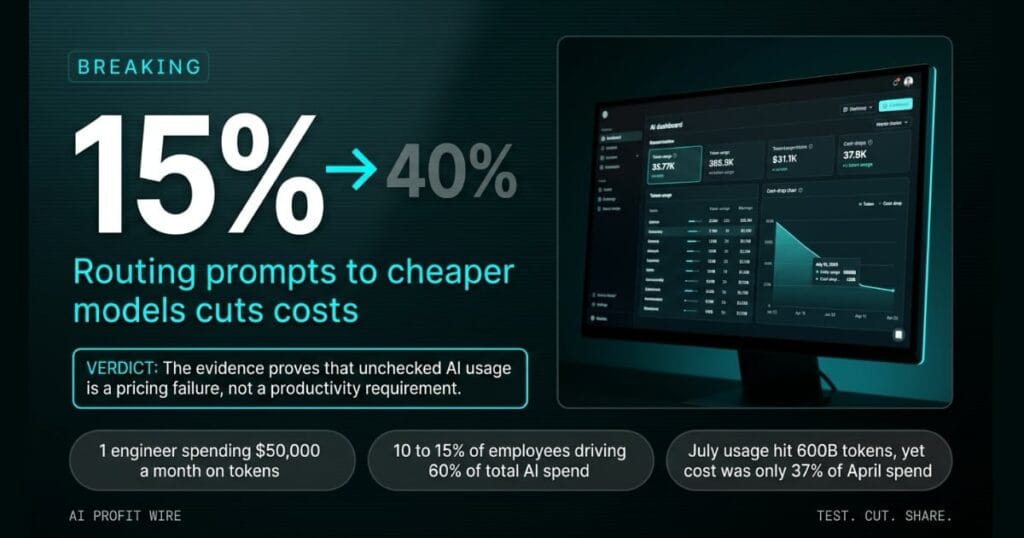
Rippling found that roughly 10 to 15% of its employees were driving 60% of total AI spend, including 1 engineer spending $50,000 a month on tokens.
The company dropped its token spend from 40% of its R&D headcount budget to about 15% after implementing the gateway and routing prompts to cheaper models. In July, internal usage hit 600 billion tokens again, yet the cost was only 37% of the cost of April’s token spend.
Rippling did not curtail AI usage to achieve this drop. The company simply rerouted prompts to more cost-effective models, including cheaper open-weight options.
The evidence proves that unchecked AI usage is a pricing failure, not a productivity requirement.
How does the Rippling AI Spend Console compare to the alternatives, and what background do small business owners need?
Inference providers like OpenAI and Anthropic have no incentive to help you control spend, as their goal is a runaway expense. They do not provide great usage insight, and they do not collaborate with one another.
Enterprises now realize they need multiple models from various AI labs, including cheaper open-weight options, rather than defaulting to 1 expensive frontier model. Rippling’s own benchmarks found SpaceX’s Grok was the all-around leader, but Z.ai’s GLM 5.2 was 85% cheaper with nearly identical performance.
Without a gateway to route tasks to the right price point, your team will default to the most expensive models for basic grammar updates, bleeding cash on tasks that required zero reasoning.
Choosing the right AI gateway is more critical than choosing the right AI model.
How does the Rippling AI Spend Console affect day-to-day operations for small businesses?
Small business owners can no longer hand employees blank checks for AI token spend and expect a positive ROI. The tool produces dashboards that expose exactly who generates value and who generates slop.
Rippling identified highly effective users and made them AI captains to assist the rest of the company, which small businesses can replicate internally. The dashboard scores prompts per day combined with work output like lines of code or pull requests.
Rippling is still extending this model beyond engineering, including customer onboarding teams automating mailing data and reconciliation tasks. Founders tracking how other cost-control signals are landing across the Wire can follow the broader pattern.
Day-to-day operations now require auditing AI usage with the same rigor as payroll and inventory.
A small accounting firm owner opens the monthly AI invoice. Token spend for the bookkeeping assistant tool jumped 80% month-over-month, with one junior accountant responsible for most of the burn. The invoice hits $50,000 for the month, and the partner has no idea what work came out of it.
The junior defaulted to the most expensive frontier model for every receipt categorization and vendor reconciliation. That is premium reasoning prices for grammar-level work, the exact pattern Rippling found when it discovered 10 to 15% of its employees were driving 60% of total AI spend.
Rippling’s AI Spend Console maps token spend to actual output and routes prompts to cheaper models, dropping its own burn from 40% to 15% of headcount budget. The same playbook works for any founder writing checks for Cursor, OpenAI, or Anthropic without measuring what comes back.
What is the final verdict on the Rippling AI Spend Console?
Rippling AI Spend Console exposes the reality that unmonitored employee AI usage will bankrupt your margins. If you can’t link token consumption to actual productivity, you must restrict AI access until you build the proper routing infrastructure.
The product is included for Rippling HR subscribers with additional usage-based costs, or available as a standalone product for existing systems. Rippling’s own launch ad features the CFO sitting on a stool while employees dump wads of cash into a paper shredder, which is the clearest visual for what unchecked token spend looks like inside a small business.
The broader implication is that employee AI access may no longer be like Slack or email, where everyone gets unlimited access by default. The companies that can’t measure productivity will lose access entirely.
If you don’t track AI ROI, you’re paying your employees to generate expensive waste.
Source: TechCrunch AI
