Saves potential debugging and deployment downtime costs by enforcing code review on AI-generated updates.
What Is the Sphinx Git Hook and How Does It Work?
Sphinx is a free, open-source Git hook for agent-assisted development that asks you a question about your AI-written code before it lets the push through.
On a protected branch, Git pauses while a separate reviewer model reads the committed diff through read-only Git tools and asks what the change does when things go wrong, according to the project’s own site.
Answer wrong and it explains the miss, then hands you a new scenario to try; answer right and the same push continues, whether you or your coding agent ran git push.
The repository’s tagline compresses the pitch into one line: you can outsource your thinking, but not your understanding.
It works with Codex, Claude Code, Cursor, OpenCode, and Pi, or plain Git, and it runs on minimal tokens from your existing coding agent, OpenRouter, or any OpenAI-compatible endpoint.
The hook pauses only the branches you protect, so nothing changes for throwaway branches or local experiments.
Sphinx turns the push itself into a comprehension checkpoint, with no new dashboard and no new subscription.
Is the Sphinx Git Hook Actually Maintained?
Early, but moving: the sphinx-understand package on npm sits at version 0.1.11 with a build published this week and roughly 2,000 weekly downloads.
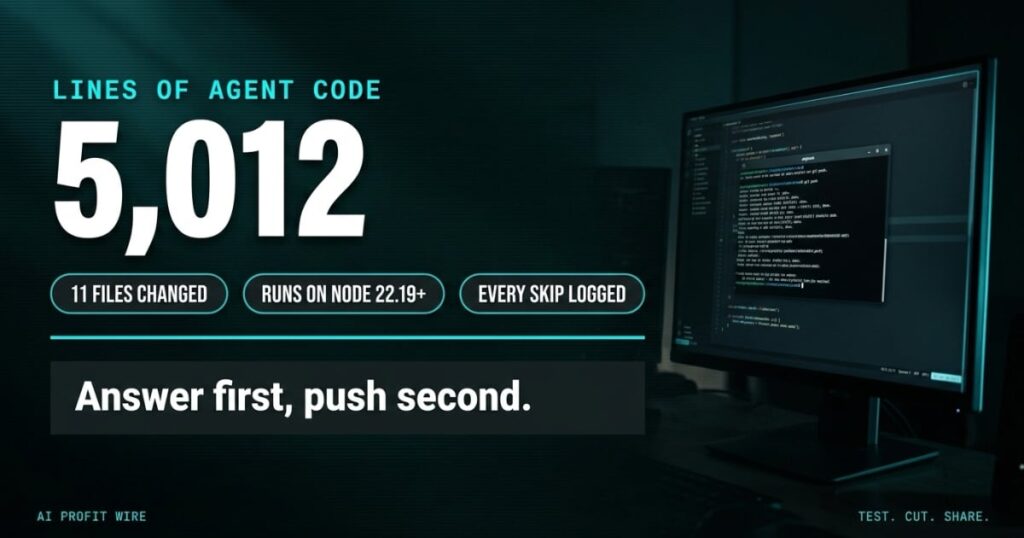
The GitHub repository is MIT licensed and states the requirements plainly: Node.js 22.19 or newer, Git, and macOS, Linux, or WSL, with native Windows not supported yet.
Installation is two commands, npm install -g sphinx-understand followed by sphinx install, which connects the hook to Git and your coding agents.
The project surfaced on Hacker News as a Show HN post, and the npm build and that post landed inside the same window, which is the cadence you want from a maintainer actively fixing.
Maintenance signals are real but young, so treat it as a live experiment with a working install path rather than a mature platform.
How Is a Sphinx Quiz Different From a Code Review?
A human reviewer reads your code and leaves comments on a timeline; Sphinx refuses the push until you, the author, can predict what the code does in a failure case.
The question targets the diff in front of you, not the architecture around it, and the reviewer model that writes the question never saw your coding agent’s chat.
That separation matters for honesty: the quiz measures whether the author understands what shipped, which a review thread never checks.
It is a gate on the author’s understanding, and no review checklist covers that gate today.
The client’s checkout page goes dark at 9:15 on a Tuesday night, and the freelancer who shipped that afternoon’s fix is now reading a webhook handler the coding agent wrote at 4 p.m.
The diff touched 11 files and added 5,012 lines, and the retry path that was supposed to save the event ID before charging the card never ran in that order.
A 30-second question about what happens when the payment gateway times out is the difference between a hotfix at 9:20 and a refund run at midnight, and that question is exactly what the hook exists to ask.
What Breaks When You Run the Sphinx Git Hook in Production?
Environment comes first: native Windows is not supported, so teams on Windows machines need WSL before the hook installs at all.
Speed is the real trade: the push waits while you answer, which is the point, and that wait lands hardest on rapid-fire branch-push workflows you run dozens of times a day.
In a hurry, sphinx yolo lets pushes through, and every skip is logged, so the escape hatch exists but leaves a record your lead can audit.
Privacy holds by design: your answers never reach the coding agent, and .env files and keys are never opened during the review.
The failure modes are schedule friction and platform limits, not data exposure.
Should You Install the Sphinx Git Hook Before Your Next Agent Push?
Install it on the one branch your agents push to most: npm install -g sphinx-understand, then sphinx install, and the gate runs on your next push to a protected branch.
It costs nothing, runs locally, and fits solo developers and small teams who cannot staff a review rotation for every agent commit.
If your repositories carry payment, authentication, or data-deletion logic, the quiz is the cheapest failure-case interview you will run this quarter.
We track guardrails like this as they surface: see the other coding-agent guardrails we’ve logged this month for the rest of the category.
The repository’s own tagline remains the honest sales pitch: outsource the thinking, never the understanding.
For 2 minutes of setup and one question per push, the downside is your time and the upside is not debugging an agent at midnight.
Source: sphinx-six-theta.vercel.app
