Potential future cost or performance improvements for AI-driven business workflows.
What Is the DeepSeek V4.1-Flash-1017 Update?
DeepSeek released V4.1-Flash-1017 late on October 17, 2026, a minor update to its V4.1-Flash model that the company says delivers stronger benchmark performance, faster task completion, and shorter outputs than the previous version.
The update went live the same day across DeepSeek’s web app, mobile app, and developer platform, and Bloomberg’s reporting frames it as a direct challenge to Anthropic, OpenAI, and domestic rivals like Moonshot Kimi and Z.ai.
The official changelog states the API calling method and pricing remain unchanged, so existing integrations reach the new model through the same deepseek-flash call they already make.
The release is a capability bump on an existing bill, which is why the benchmark table matters more than the announcement.
Is DeepSeek V4.1-Flash-1017 Actually Faster?
Faster, in this release, means the model completes tasks in less time and produces shorter outputs, and the published numbers back the direction of the claim.
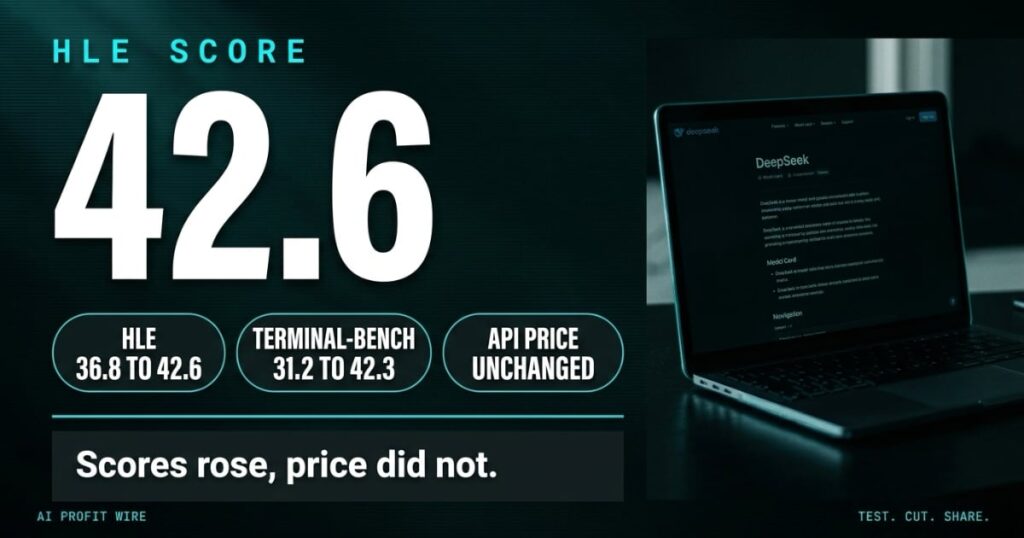
On the Hugging Face model card, HLE without tools rose from 36.8 to 42.6, Terminal-Bench 4.0 climbed from 31.2 to 42.3, and DeepSWE v1.1 improved from 74.2 to 77.0 against V4.1-Flash.
The same table shows ProgramBench up from 20.3 to 29.1 and Apex Bench v1.1 up from 64.6 to 72.1, a consistent move across reasoning, coding, and agentic suites.
The harnesses behind those numbers are real pipelines: Terminal-Bench 4.0 ran on the Claude Code framework and DeepSWE on Mini-SWE-V2, so the gains were measured on agent workflows rather than static quizzes.
One caution flag belongs in the same paragraph: Bloomberg reported a 5-hour DeepSeek outage earlier that week, which some experts attributed to insufficient computing resources.
The benchmarks support the faster-and-stronger claim, with Terminal-Bench 4.0’s 11-point jump the standout for agent workloads.
Is DeepSeek Flash Good Enough to Replace Your Current Provider?
Good enough depends on the workload, and the honest answer from the comparison table is that this model competes in the mid-frontier band rather than at the top.
On HLE without tools its 42.6 sits ahead of GLM-5.3’s 42.0 and behind Opus 5’s 56.3, so it trades punches with peers while the most expensive tier still leads.
On Terminal-Bench 4.0 its 42.3 leads GLM-5.3 at 37.9 and GPT-5.6 Sol at 39.9, which is the suite where agentic coding actually gets measured.
Price is the second half of the comparison, and the changelog is explicit that API pricing stayed unchanged on a line Bloomberg describes as aggressively priced.
Context for that pricing: September’s V4.1-Flash launch was discounted so steeply that shares of MiniMax, Z.ai, and Alibaba fell on the Hong Kong exchange, according to Bloomberg’s report.
For high-volume, cost-sensitive workflows it is a credible primary, and for premium-tier workloads it is now the benchmark to beat.
The support inbox at a three-person ecommerce shop opens at 6:40 a.m. with refund questions stacked from the weekend, and the AI assistant drafts every reply before the owner pours a coffee.
Each draft bills tokens at the same rate the owner configured a year ago, and nobody re-checks that rate because the workflow runs.
The DeepSeek table changes that conversation: HLE moved from 36.8 to 42.6 and Terminal-Bench 4.0 from 31.2 to 42.3 while the API price held, so a fixed line in the stack now has a comparable alternative that costs one test run to evaluate.
Who Is DeepSeek V4.1-Flash-1017 Actually For?
Developers running high-volume automation get the clearest benefit, because shorter outputs and faster task completion reduce per-task token spend on every run.
Teams building agents benefit next, since the headline jumps landed on agent suites rather than chat benchmarks.
The model card’s recommended configuration runs a 1M token context window with temperature 1.0 and max_tokens at 256K or higher, which suits long-document and multi-step workflows more than single-shot lookups.
The architecture underneath explains the economics: V4.1-Flash carries a 552B backbone with 8B parameters active at prefill and 16B at decode, and its KV cache footprint sits at 890 bytes per token.
Agent-heavy and document-heavy teams gain the most, while light users will not see a difference worth a migration.
Should You Use DeepSeek Flash Instead of Paying for Premium APIs?
Run the comparison on your own traffic before you commit either way: point one non-critical workflow at deepseek-flash this week and log output quality, latency, and token counts against your current provider.
The API method and pricing are unchanged, so the test costs engineering hours rather than new contracts, and the weights carry an MIT license if you later want to host them yourself.
Before you rerun the math, check the per-million rates on our AI API pricing tracker so the comparison uses current numbers instead of the rate you remember.
Bloomberg’s reporting adds one operational caution: slowdowns and service disruptions have increased in recent months as demand for the aggressively priced models grows, so keep a fallback provider configured.
Test it this week on one workflow, keep your fallback configured, and let the token counts decide.
Source: Bloomberg Tech
