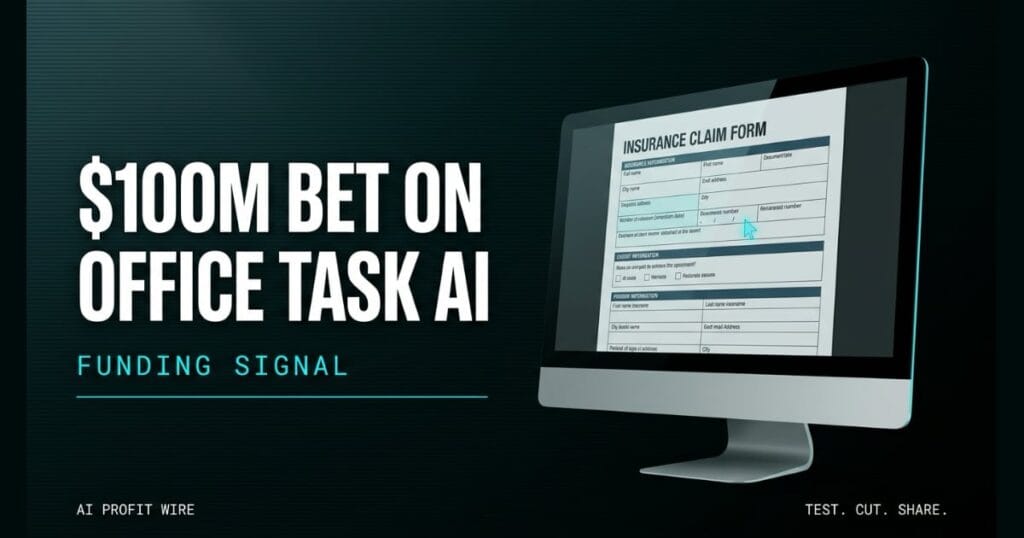
If successful, this technology could significantly reduce administrative costs by automating routine document and system workflows for small businesses.
What’s Prentis AI and what changed?
Prentis is a new AI research lab focused on building computer-use models that automate routine office workflows, and it’s currently in talks to raise $100 million at a $1 billion valuation.
Co-founded by Reid Hoffman, Mark Pincus, and Ritankar Das in April, the startup trains AI agents to control computers and navigate documents and systems without human intervention.
The lab has already hired more than 25 employees, including researchers who previously worked at OpenAI, Google DeepMind, Meta, Tencent, and Alibaba.
Prentis represents a major capital push toward AI agents that execute administrative tasks instead of just generating text.
What’s the evidence behind Prentis AI?
Prentis has already signed contracts worth up to $50 million with several customers, including a healthcare management service organization, a manufacturer, and goods and clothing manufacturers.
Investor materials obtained by TechCrunch predict an estimated $75 million annualized run rate by the third quarter of this year, based on a contracted fee equal to 20% of savings realized.
The company claims its Hive-32B model outperforms OpenAI’s GPT-5.4 and Anthropic’s Claude Opus 4.6 on two specific benchmarks, WindowsAgentArena and ScreenSpot-v2.
The financial traction is substantial, but the benchmark results and projected run rate remain unverified by independent sources.
How does Prentis AI compare to the alternatives, and what background do small business owners need?
Prentis argues its competitive edge comes from running a much smaller and cheaper model, claiming roughly 10 times lower cost per task than frontier APIs.
It’s entering a crowded market where Anthropic, OpenAI, and Mira Murati’s Thinking Machines Lab are also developing AI agents for computer use.
Anthropic has also acquired talent in this category directly by buying the Seattle computer-use startup Vercept, folding in its founders, and shutting down its product.
Prentis is betting that its smaller, cheaper model will be more economical to deploy across everyday workflows than the larger frontier alternatives.
How does Prentis AI affect day-to-day operations for small businesses?
For small business owners, this technology targets administrative costs by automating routine document and system workflows, such as handling insurance claims and automating customs duty refund exceptions.
If the cost structure holds, deploying AI agents for document-heavy workflows becomes highly accessible, reducing the need for dedicated administrative staff.
You can track how automation platforms impact operational efficiency by reviewing comprehensive AI workflow automation signals for small businesses.
Automating routine computer tasks could significantly reduce administrative overhead and free up capital for core business operations.
A stack of roofing material invoices sits on the dispatcher’s desk, waiting for someone to manually cross-reference delivery tickets against the warehouse log. A junior admin confirms the load matches the order, but skips checking the dimensional weight, leaving a hidden billing defect that quietly bleeds your margin on the next job.
Prentis claims its model runs at 10 times lower cost per task than frontier APIs, which matters when you’re processing hundreds of routine customs duty refunds or insurance claims every month. You don’t need a massive language model to parse a standard form, you need a specialized tool that executes the exact workflow without skipping the verification steps that bleed your margins.
If this technology works as pitched, you’re effectively replacing the manual data entry and cross-referencing labor that eats your operational capacity. The value isn’t in the $1 billion valuation, it’s in cutting the cost of routine administrative execution to a fraction of its current burden.
What’s the final verdict on Prentis AI?
Prentis is securing massive contracts by promising to automate office workflows at a fraction of the cost of frontier models, though its benchmark claims remain unverified.
The technology targets a clear operational pain point for small business owners by automating document-heavy tasks like insurance claims and customs refunds.
If the 10 times lower cost per task holds true in production, administrative automation will become a standard operational tool rather than a luxury enterprise expense.
Founders should monitor computer-use AI agents closely, as verifiable cost reductions in administrative workflows will deliver a direct competitive advantage.
Source: TechCrunch AI
