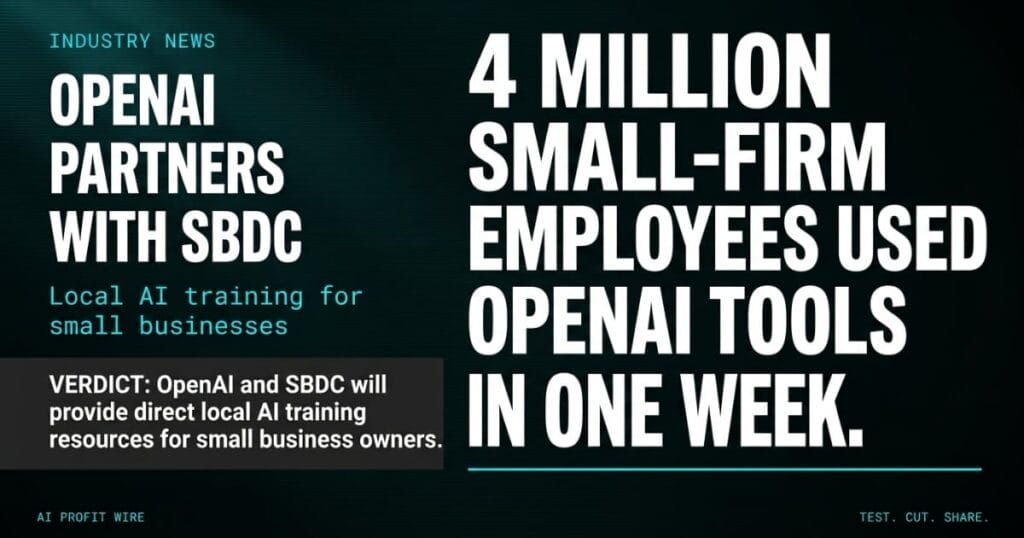
Provides direct local training resources and guidance for small business owners looking to integrate AI into operations, finance, and marketing.
OpenAI is pairing with America’s SBDC to train 150 small business advisors on practical AI use, with a target of reaching at least 1,000 businesses through in-person workshops. The announcement arrived alongside OpenAI’s first adoption report on small firms, which counts 4 million weekly users at companies under 500 people.
What Is The OpenAI And SBDC Partnership?
The partnership runs through OpenAI Academy’s Community Trainer Program and America’s SBDC, a national network of small business development centers serving 1 million entrepreneurs a year. OpenAI plans to train around 150 SBDC advisors and credential them to coach owners on applying AI to real business tasks.
Those advisors will lead Academy Workshops across participating SBDC networks, modeled on OpenAI Academy’s 3-hour hands-on format, and every session ends with a plan the owner can put into practice. OpenAI and SBDC will also publish practical guides on putting AI to work, covering topics such as marketing, operations, manufacturing, exporting, and government contracting.
The program is local training aimed at owners who know they need AI and have no internal expert to ask.
Is Small Business AI Adoption Actually Accelerating?
OpenAI’s report, Small Businesses, Bigger Capabilities, measures adoption with usage data rather than surveys. In the week of September 9-15, around 4 million employees at companies with fewer than 500 people used OpenAI tools, and almost 1 in 5 of those users worked at a business with fewer than 10 employees.
The sharper shift sits in the agent numbers. In August 2026, agentic output tokens from products like ChatGPT Work and Codex made up two-thirds of all small business output tokens, up from one-third in April 2026. The report also finds that finance and accounting, supply chain, legal and compliance, and marketing each account for at least 3 times the share of small-business agent interactions they hold for larger businesses.
Adoption is accelerating, and the growth concentrates in the functions where small teams have no dedicated specialist.
How Is This Different From The Usual Free AI Advice?
Most AI guidance for small businesses arrives as generic content: blog posts, webinars, and prompt lists with no one to follow up when the advice meets a real budget. The SBDC model puts a credentialed advisor between the material and the owner, and the advisor’s job includes follow-up after the workshop to check what is working.
OpenAI has run comparable programs before, including sessions with DoorDash, SCORE, and local business organizations in 5 US cities last November, and it extended small business support with ChatGPT Work resources introduced in July 2026. The SBDC partnership scales that approach through advisors who already hold relationships in their local business communities.
The difference is follow-up: a local advisor who sees the workshop through, versus a tab that closes when the webinar ends.
The renewal folder at a 6-person insurance brokerage sits with whoever has 20 minutes and no better alibi. Licenses, carrier appointments, commission statements, the work that accumulates because the firm has no compliance specialist and never planned to hire one.
OpenAI’s report says that folder is where agents already live. Two out of 3 small-business output tokens now come from agentic work, and compliance is one of the functions running 3 times the large-company share of agent use.
Some piece of software is doing that work now regardless. The decision left inside the firm is whether anyone at the firm chooses which one.
What Does The OpenAI Report Mean For A Team With No Specialist?
The report’s structure matters more than its headline count. Functions like finance, supply chain, legal, and marketing are absorbing agent usage at 3 times the rate seen at larger companies, which is the signature of teams using AI to replace missing headcount rather than to augment existing roles.
For a founder or director at a technology, consulting, or financial services company, the reading is direct: your team’s unstaffed functions are the ones already moving to agents, a pattern that matches the adoption shifts we keep logging from small teams. Owners in the report describe the same behavior, from menu-price comparisons at a 3-restaurant group in New Mexico to district research that turned into a booked training engagement within 10 days.
Assume the specialist gap is filling itself, and decide whether you want a hand in what fills it.
What Should You Do About AI Training This Quarter?
Start with the workshop calendar rather than a tool purchase. America’s SBDC maintains local networks across the country, and OpenAI Academy carries the training material the advisors are being credentialed on, so the entry point for most owners is a call to the nearest SBDC office.
Internal work matters more than the enrollment. Pull the 3 functions where your company has no dedicated head, ask your team what already runs through AI in those functions, and write down what you find. That inventory is the agenda for whatever workshop or advising session you attend, and it is the document that turns training into a decision.
Book the local session, bring the inventory, and leave with a plan attached to named tasks and named owners.
Source: OpenAI Blog
Last Updated: October 1, 2026
