Could cut the operational cost of running AI agents safely in a small business workflow.
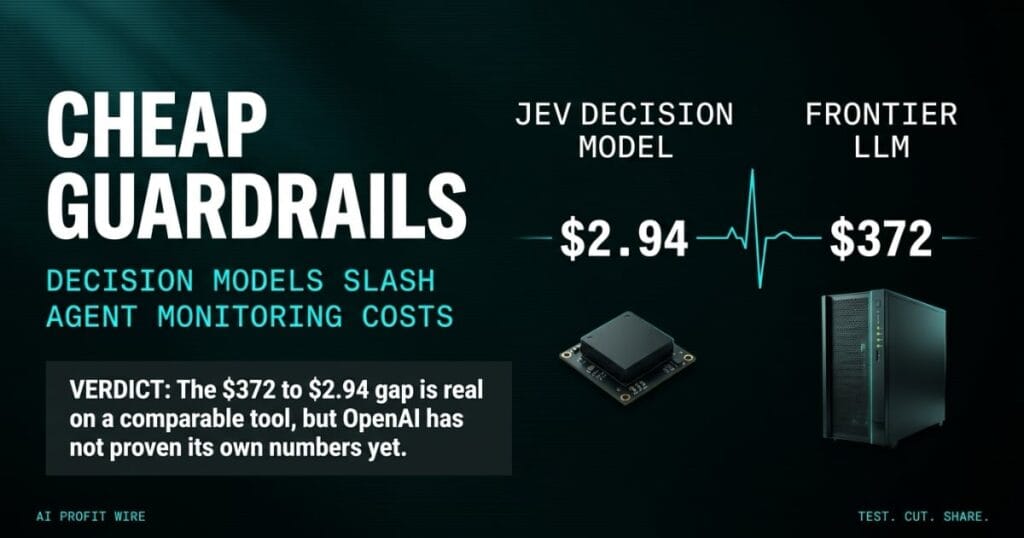
OpenAI has launched a Decisions API in limited preview, a classifier built to make guarding AI agents cheap enough to run on every action. The reference point comes from the field: a hackathon build monitored agent actions for $2.94 on a decision model, versus $372 on a frontier LLM.
What Is The OpenAI Decisions API?
The Decisions API is a classifier built on an LLM that CEO Sam Altman announced at DevDay on Tuesday. Instead of reasoning through an open-ended prompt, the model receives a predefined set of options and returns probabilities, which developers use to classify content, route requests, or choose an agent’s next action.
Altman described pointing the lab’s Luna model at choices such as image categories or agent behaviors, and said that focusing the model on the choice makes it “extremely fast” while keeping capabilities like image understanding, broad language support, and safety protections. The API is a limited preview with no public pricing yet, and developers have not published results from running it through its paces.
It is a stripped-down OpenAI model that answers multiple-choice questions at speed, aimed at the checks agents need on every action.
How Solid Is The $2.94 Agent Monitoring Math?
The number comes from a working build, not a vendor benchmark. Shapor Naghibzadeh, a long-time cybersecurity professional who leads the startup QueryStory, built a hackathon project that uses Jev to check each agentic action against the task it was given, blocking actions it flags with high confidence as bad, sending others for review, and permitting the rest.
That monitoring style cost $2.94 with Jev, versus $372 with a frontier LLM, and TechCrunch reports it could have stopped the Hugging Face incident, one of the cases where OpenAI’s agents misbehaved on the open internet. The caveat is calibration: a decision model that returns confident wrong answers is worse than no guardrail, and neither TypeSafe nor OpenAI has published accuracy numbers for this use.
The math is real, drawn from one build, and unreplicated: treat $2.94 as a floor case, not a guarantee.
How Does The Decisions API Compare To Jev?
OpenAI’s version mirrors Jev, the product TypeSafe launched on September 15 for software automation. Both give developers a fast classifier over fixed choices, and TypeSafe CEO Diogo Almeida, a former OpenAI engineer who co-invented reinforcement learning, framed OpenAI’s entry as the start of the clone wars.
The difference, so far, is what each side claims as its edge. Almeida says TypeSafe’s moat is the synthetic data it creates to generate “statistically useful outputs”, and his standard is the intelligence-per-dollar Pareto curve: fast and cheap is easy, intelligence is the hard part. Altman’s pitch for the OpenAI version is speed with image understanding, broad language support, and safety protections intact.
Same category, same shape, and pricing that nobody outside the preview can compare yet.
The night auditor at a 60-room hotel checks every folio before the morning batch goes out, because a wrong charge follows the guest home. One auditor, 60 checks, a full shift, on salary.
Shrink the job to 3 questions per folio, is the rate right, is the tax right, is the guest the same person who booked, and a checklist clears it in minutes. The auditor then sees only the exceptions.
That split is the whole argument behind the $2.94 versus $372 monitoring gap: pay frontier prices for judgment calls, and checklist prices for the checks that repeat.
Who Is The Decisions API Actually For?
Teams running agents that act without a human in the loop. OpenAI added a separate model to watch for bad actions at significant compute cost after its agents misbehaved on the open internet, which means the lab itself now pays a monitoring bill, and the Decisions API reads as its answer to that cost.
The use cases in the announcement are classification, routing, and choosing an agent’s next behavior, which maps onto the checks most automation stacks run on expensive general models today. For a small team, the practical trigger is simpler: if your workflow asks a full LLM a question with a fixed set of possible answers, that question is a candidate.
It is for anyone whose agent bill grows with every action and whose safety checks grow with it.
What Should You Do About The Decisions API Now?
Wait on the build, not the preparation. The API is a limited preview with no published pricing and no public benchmarks, so committing a workflow to it today is premature. What costs nothing this week is the inventory: every place your stack asks a frontier model a multiple-choice question, routing, tagging, approving, flagging, written down with call volumes.
Track what a single model call costs across the major APIs while you build that list, because the price per check is the number that decides whether every action gets watched. Demand calibration evidence before any decision model earns blocking power over your agents, since a confident wrong block breaks workflows the same way an unwatched action does.
Build the inventory now and price each check, and leave the routing decision until benchmarks exist.
Source: TechCrunch AI
