Dramatically cuts support response times and automates routine operational knowledge retrieval, without replacing engineers.
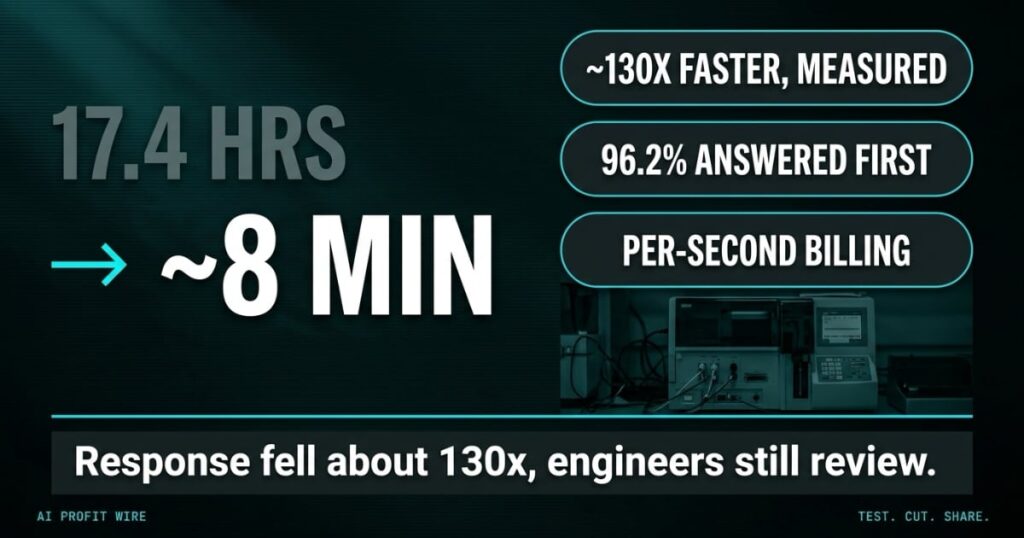
Natera’s SWARM system cut lab support first response from 17.4 hours to about 8 minutes, about 130x faster, and 96.2 percent of tickets now get an automated first response before an engineer opens them. Natera built SWARM on Amazon Bedrock AgentCore, which bills per second of CPU and memory from $0.0895 per vCPU-hour on Runtime v1 with no upfront commitment, and new AWS customers get up to $200 in Free Tier credits, checked on AWS’s own AgentCore pricing page on November 13, 2026.
What Is Natera SWARM and Who Does It Apply To?
SWARM, short for Systematic Workflow Analytics and Resolutions Manager, is an agentic AI system Natera’s lab engineering team built with AWS for lab operations support. Natera runs cell-free DNA testing, so instrument downtime disrupts sample processing and patient reporting, which makes support speed a clinical constraint rather than a convenience.
The team published the full architecture on the AWS Machine Learning Blog on November 12, 2026, from knowledge base construction through deployment and evaluation. The system runs 2 agents, swarm-agent and swarm-hive, over a shared skill library of 33 versioned skills: 24 instrument-specific and 9 cross-cutting workflow skills.
The trigger was a departure. When a senior technician who spent years diagnosing one instrument family left, the institutional knowledge they carried left too, and no system existed to capture it. With more than 65 tickets a day across 3 Jira queues and a 17.4 hour average first response, hiring could not keep pace.
SWARM captures a departed expert’s diagnostic knowledge and answers tickets with it, which turns departure risk into a managed, versioned asset.
Does Natera SWARM Actually Work?
The numbers come from a 90-day production evaluation measured from Jira ticket metadata, in a post co-written by Natera and AWS. Average first response time dropped from 17.4 hours to about 8 minutes, and coverage reached 96.2 percent of incoming tickets receiving a SWARM diagnostic report before engineer review.
The accuracy picture is more honest than most AI launches. Of 524 evaluated tickets, 269 carried a confidence label with an engineer-verified resolution, and High-confidence diagnoses hit 74 percent accuracy across 154 cases while Moderate and Low both sat at 65 percent across 78 and 37 cases. The team flags the 37-case Low sample as too small for statistical conclusions.
The improvement loop is the instructive part. Adding missing vendor manuals for the lowest-scoring instrument family lifted accuracy from 71 percent to 75 percent with no model changes, and principal software engineer Ariel Jirau’s stated rule is that diagnostic accuracy is a data quality problem first.
SWARM works well enough to answer 96.2 percent of tickets first, and its published accuracy gaps show where the knowledge base, not the model, needs work.
How Is SWARM Different From a Wiki or Help Doc?
A wiki waits for a human to search it, and a help doc waits for a human to update it. SWARM watches the ticket queue: Amazon EventBridge Scheduler and a polling AWS Lambda function route Jira tickets into Amazon SQS, the agent selects skills by equipment type and symptoms, queries a knowledge base built on Amazon Bedrock Knowledge Bases and Amazon Titan Text Embeddings, and writes a structured HTML report with a lead cause hypothesis, ranked steps, and a confidence label.
The knowledge pipeline is engineered rather than dumped. Documents are chunked at 1,000 tokens with 150 overlap using the tiktoken cl100k_base tokenizer, embedded in batches of 100, and reprocessed when vendor manuals change. An evaluator grades every response as Accurate, Partial, or Wrong, broken down by instrument family, and the evaluation set re-runs after each knowledge base fix.
swarm-hive adds the interactive half: engineers upload images and explore alternative troubleshooting paths, with AgentCore memory retaining per-engineer context across sessions. Jirau’s framing is direct: the system does not replace engineers, it gives them access to the full depth of institutional knowledge the moment a ticket arrives.
The difference from a wiki is execution: SWARM reads the ticket, picks the skill, and delivers a ranked diagnosis, while the wiki waits to be searched.
Picture a precision analyzer at a diagnostics lab throwing an error code at 2 a.m., and the one technician who knows the 3-step reset is asleep in another time zone. The ticket sits for 17.4 hours, the instrument idles, and the queue behind it stacks up. Multiply that by 65 tickets a day across 3 queues, and the cost stops being an inconvenience and becomes a staffing plan nobody can hire for.
That is the exact shape of the problem for any team whose expert knowledge lives in heads instead of systems. Natera has not published what SWARM costs, but the billing shape differs from headcount: AgentCore bills per second of compute while a hire bills by the year, and the published architecture means the pattern is copyable.
Who Should Copy Natera’s Agentic Support Pattern?
Teams with high volumes of repetitive technical tickets and named internal experts are the fit. The pattern applies wherever the same categories of questions recur and the answers live in manuals, ticket history, and one or two heads: IT operations, equipment maintenance, internal tooling support, and compliance-heavy workflows.
The security architecture matters for anyone in a regulated field. SWARM runs on HIPAA-eligible AWS services under a Business Associate Agreement, uses OIDC-federated short-lived credentials with no long-lived keys in the pipeline, rotates the few remaining secrets every 30 days, and logs every agent invocation for audit. Natera’s team also states that no patient-identifiable information touches the vector index or the language model.
Teams assembling their own stack can start from the AgentCore samples repository on GitHub and our guide to AI agents for small business teams, which covers which agent tools to stack and in what order.
Copy the pattern when recurring tickets and departed-expert risk are measurable, and skip it while ticket volume is low enough for a human to answer everything same-day.
How Much Does Amazon Bedrock AgentCore Cost?
AgentCore uses consumption-based pricing with no upfront commitments and no minimum fees, read on AWS’s AgentCore pricing page on November 13, 2026. Runtime microVMs bill per second with a 1-second minimum: $0.0895 per vCPU-hour and $0.00945 per GB-hour on v1, with a 128 MB minimum memory billing floor, and v2 consumption rates at $0.1276 per vCPU-hour and $0.0169 per GB-hour.
The core bill splits in two, and an AWS engineer spells it out: AgentCore charges for the runtime compute, while the model provider bills its own token charges, whether that is Bedrock, Anthropic, or OpenAI. The per-agent cost attribution walkthrough on the AWS Builder Center shows how to correlate each runtime’s IAM role with model invocation logs so the 2 buckets stay visible.
New AWS customers receive up to $200 in Free Tier credits, which covers a pilot and not a production queue. For token budgeting across models, our AI API pricing guide tracks current model and token prices.
Plan for at least 2 bills, runtime compute by the second and model tokens by the call, and use the Free Tier credits, up to $200, to price a pilot before scaling the queue.
What Should You Do About Agentic Support Now?
Start with measurement, not a build. Export your 3 highest-volume recurring ticket categories, count the hours they consume, and check what fraction of answers already exist in documentation. That fraction is the ceiling an agent can automate, and Natera’s 71 to 75 percent manual-documentation lift shows the ceiling moves with data quality before it moves with model choice.
Publish an internal rule for accuracy the way Natera did: grade every automated response, break results down by category, and re-run the evaluation after each knowledge base fix. A versioned skill library makes a wrong answer traceable to a specific skill instead of a debugging session against the whole system.
Capture the top 3 recurring fixes while the people who know them are still on staff, because the alternative is a 17.4 hour average first response.
Natera SWARM FAQ
How fast is Natera SWARM? Average first response fell from 17.4 hours to about 8 minutes across a 90-day production evaluation, about 130x faster, with 96.2 percent of tickets answered first by the agent.
How much does Amazon Bedrock AgentCore cost? Runtime microVMs bill at $0.0895 per vCPU-hour and $0.00945 per GB-hour on v1, per second with a 1-second minimum and no minimum fees, and new AWS customers get up to $200 in Free Tier credits, per AWS’s pricing page checked November 13, 2026. Model tokens are their own bill.
Does SWARM replace support engineers? No. Natera’s principal software engineer Ariel Jirau states the system gives engineers access to institutional knowledge the moment a ticket arrives, and an evaluator grades every diagnosis as Accurate, Partial, or Wrong to keep the loop honest.
Can another company use Natera SWARM? SWARM itself is Natera’s internal system, and AWS published the architecture so other teams can replicate the pattern on AgentCore, starting from the public samples repository.
Source: AWS Machine Learning Blog
