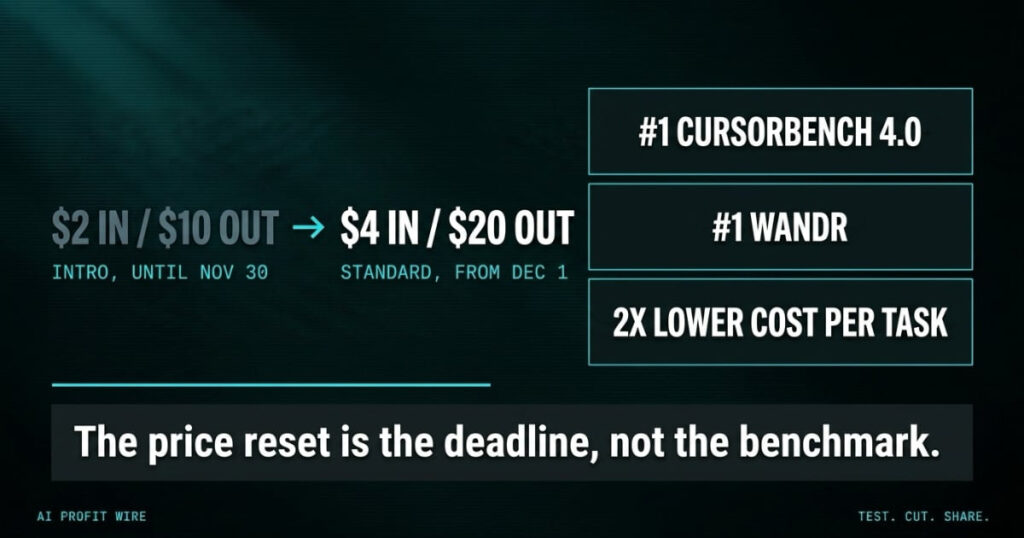
Frontier model capability lands at an introductory $2/$10 per million tokens until November 30, 2026, resetting what complex AI workloads cost businesses that already run them.
What is Gemini 4 Carbon and what changed today?
The hype mostly holds: Carbon ranks #1 on CursorBench 4.0, Perplexity’s WANDR, and Zapier’s AutomationBench per Google’s launch post, and the price undercuts the field. Acting on it costs $2 per million input tokens and $10 per million output tokens at the introductory rate, checked on Google DeepMind’s announcement on November 10, 2026, rising to $4 and $20 per million after November 30, 2026.
Google DeepMind made Gemini 4 Carbon available to developers, enterprises, scientists, and consumers, and the launch post, checked November 10, 2026, calls it the company’s strongest model, with frontier performance in cybersecurity and long-horizon agentic workflows across complex knowledge work, software engineering, and scientific reasoning. Carbon sits above Gemini 4 Argon in the Gemini 4 lineup, released after Argon’s recent launch, and it uses more tokens than Argon to explore thoroughly, reason deeply, and run extended verification loops.
The availability surface is wide: the API in Google AI Studio and Gemini for business for paying developers and enterprises, plus a rollout to Google AI Ultra subscribers in Google Antigravity, the Gemini app, and AI Mode in Search. Scientists can apply for access to both Argon and Carbon through Antigravity’s highest usage tier free for 6 months, and cybersecurity defenders can apply to the Fairwind Program, which has had Carbon for cyber since two weeks before launch.
Carbon is Google’s frontier model for long agentic work, now open to paying API customers and AI Ultra subscribers.
Does Gemini 4 Carbon actually rank first where it counts?
The benchmark claims are specific and named. Google states Carbon ranks #1 on CursorBench 4.0, Perplexity’s WANDR, and Zapier’s AutomationBench, at more than 2X lower cost per task than the next best external model. On the new Multimodal Knowledge Agent benchmark, Carbon ranks #2 while costing more than 6X less per task than the top-performing model.
These are vendor-published numbers, and the honest reading carries two qualifiers. The benchmarks are designed to test real workflows, per Google, but they are still Google’s selection, and the comparisons are cost-per-task, not per-token, which rewards a model that finishes work in fewer passes. The cost claim is the operative one for businesses: the same job at 2X less spend is a budget line you can verify on your own workload.
#1 on three named benchmarks at 2X lower cost per task is the claim, and your own workload is the only test that settles it.
Gemini 4 Carbon vs Argon: which should a small business run?
Google’s own positioning splits the lineup by task shape. Argon remains the ideal choice for the majority of software engineering and knowledge work, while Carbon is built for tasks that test the limits of a model’s intelligence: complex, multi-step coding and debugging, and open-ended scientific research and discovery. The models share the same introductory price, $2 per million input tokens and $10 per million output tokens, so the choice is about token consumption, since Carbon’s deeper verification loops burn more tokens per task by design.
For a cost-controlled stack, that means Argon handles the routine volume and Carbon takes the runs where failure costs more than tokens: a multi-step migration, a security review, an analysis your team would otherwise do by hand. Google’s /swarm preview in Antigravity pushes the same logic further, turning one prompt into a coordinated team of Carbon agents you can track in real time.
Argon for volume, Carbon for the expensive problems, at the same per-token price with a real token-use difference.
The invoice for your AI-assisted rebuild lands on the same day the migration finishes, and the number is 4 times what the prototype cost. Your lead opens the trace: the model ran 11 verification passes on one module, and each pass was correct, and each pass was billed. That invoice is the actual decision Carbon asks you to make, not the benchmark table, because deep-verification models buy correctness with tokens and the tokens are yours.
Running an ecommerce operation taught me the number that matters is cost per outcome, not cost per unit, and Carbon’s pitch is exactly that trade. At $2 per million input tokens, a 2X-lower cost per task claim against the next best external model says the verification loop is priced in, and the December 1 price change to $4 and $20 is the deadline that turns “interesting” into “decide this month.” A team that moves a real workload before the reset gets the same capability at half the standard rate, and the trace logs will show whether the loops earned their keep.
Who is Gemini 4 Carbon actually for?
The paying API customer with a measurable expensive problem fits first: teams running multi-step coding agents, security workflows, or research pipelines where a wrong answer costs review hours. Google AI Ultra subscribers get Carbon in Antigravity, the Gemini app, and AI Mode in Search, which puts the model in reach of power users without an API contract.
The mismatch matters too: routine summarization, classification, and short-form generation are Argon’s territory, and running them on Carbon buys verification depth nobody asked for. The Fairwind Program keeps cyber defender access on a rolling application basis, and the 6-month free Antigravity tier for scientists is the bridge for research teams without budget.
Teams with expensive multi-step problems are Carbon’s customers; routine volume stays on Argon.
How much does Gemini 4 Carbon cost?
The introductory price is $2 per million input tokens and $10 per million output tokens, the same rate as Argon, available through the API in Google AI Studio and Gemini for business. After the introductory period expires on November 30, 2026, the price becomes $4 per 1M input tokens and $20 per 1M output tokens, and Google notes the standard rate applies to the Carbon model intended for public access.
Cost-per-task is the number to model, and Google’s own benchmark framing gives you the shape, with the same discipline behind what AI APIs cost a small business: Carbon ranked #1 on three workflow benchmarks at more than 2X lower cost per task than the next best external model, and #2 on the MKA benchmark at more than 6X lower than the top performer. Run your own task log against those ratios before the reset date, and if the trace is unclear, our guide to finding which workflow drives your AI API bill walks the breakdown.
$2/$10 until November 30, 2026, then $4/$20, and the task-level cost math is what decides your stack.
Should you move a workload to Carbon before November 30?
If you already run Gemini models, the test costs one model ID change: point your most expensive recurring job at Carbon, keep the trace open, and compare cost per completed task against your current model, not against benchmarks. If you are not on Gemini, the December 1 price change is the reason to evaluate this month or wait for the standard rate and judge it there.
Either way, the verification-loop behavior is the thing to measure: more tokens per task is the design, and your workload either monetizes that depth or pays for it without a return.
Pilot your priciest job on Carbon before November 30 and let the task-level cost decide, not the leaderboard.
Is Gemini 4 Carbon available to consumers?
Yes, for Google AI Ultra subscribers: the launch post lists Google Antigravity, the Gemini app, and AI Mode in Search as the consumer surfaces rolling out. Developers and enterprises reach Carbon through the API in Google AI Studio and Gemini for business.
What benchmarks does Gemini 4 Carbon lead?
Google states Carbon ranks #1 on CursorBench 4.0, Perplexity’s WANDR, and Zapier’s AutomationBench, at more than 2X lower cost per task than the next best external model, and #2 on the Multimodal Knowledge Agent benchmark at more than 6X lower average cost per task than the top-performing model. All are vendor-published figures.
How long does the $2 introductory price last?
Until November 30, 2026, after which Google applies $4 per 1M input tokens and $20 per 1M output tokens to the public-access Carbon model. The introductory rate matches Argon’s price, and it is live for paying developers and enterprises as of the November 10, 2026 availability announcement.
Can you run Gemini 4 Carbon inside Google Antigravity?
Yes. Google is previewing /swarm in Antigravity, which turns a single prompt into a coordinated team of Carbon agents you can track in real time, and AI Ultra subscribers get Carbon in Antigravity, the Gemini app, and AI Mode in Search.
Scientists can apply for Antigravity’s highest usage tier free for 6 months, which covers both Argon and Carbon, and developers can assign Carbon to roles that demand the deepest reasoning.
Antigravity is where the multi-agent /swarm preview lives, and it is included with AI Ultra access.
What is the Fairwind Program?
It is Google’s access program for cybersecurity defenders, which received Carbon for cyber two weeks before general availability. Defenders apply on a rolling basis, and the launch post frames the program as the path for cyber-specific use of the model.
Source: Google DeepMind, Gemini 4 Carbon is now available | Also: Google blog, Gemini 4 Carbon is now available | Independent context: Sanity’s Gemini 4 Carbon model glossary | Last Updated: November 10, 2026 | Signal Type: breaking
