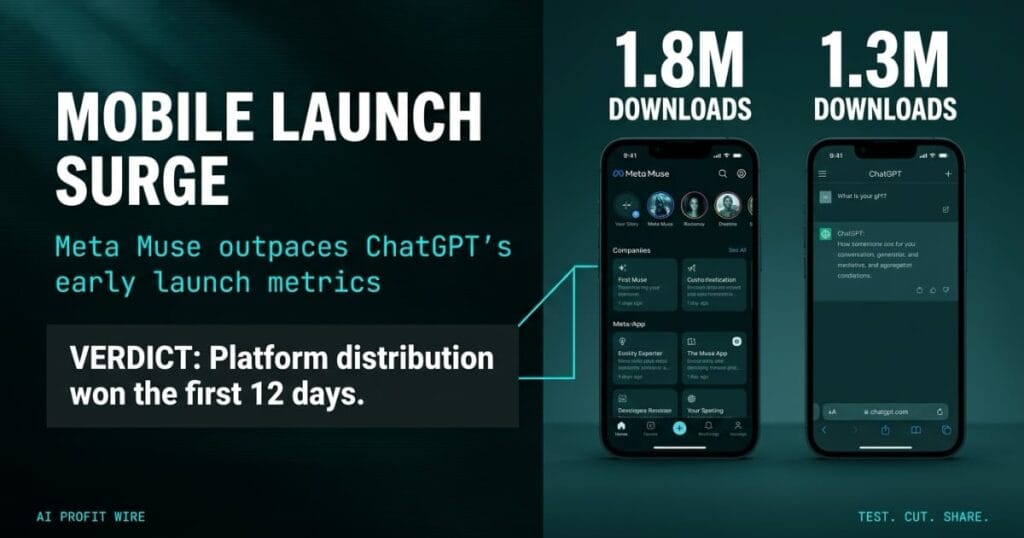
Highlights shifting consumer engagement channels and growing adoption of Meta's AI ecosystem for potential business marketing and automation touchpoints.
What is Meta’s Muse app?
Muse is Meta’s personal AI agent, launched September 8, 2026 on the Apple App Store and Google Play in the US and Canada. The app answers questions and completes tasks for its users, from web browsing and purchases to image and document generation.
The Google Play listing describes an agent for daily-life admin, from email and budgets to bookings. The launch was a distribution play from day one, with Muse connected to Instagram and Facebook and working inside WhatsApp.
Within 12 days it outpaced ChatGPT’s own launch-window numbers on mobile, based on the first clean comparison that market intelligence firm Apptopia could run between the two apps.
Muse is ChatGPT-scale attention delivered through logins Meta already owns.
Is Muse growing faster than ChatGPT did?
On the numbers TechCrunch published from Apptopia’s estimates, yes. Comparing iOS downloads in the US and Canada across each app’s first 12 days, Muse recorded 1.8 million downloads to ChatGPT’s 1.3 million.
The comparison window matters: both figures cover the first 12 days after each app’s mobile debut, so the gap reflects launch velocity rather than cumulative scale.
Daily engagement follows the same pattern. Muse carries 642,000 US daily active users against 231,000 for ChatGPT at the same point after launch, and on iOS alone Muse’s 359,000 daily users still clear ChatGPT’s figures from that window.
Muse has since climbed to No. 1 overall on the US App Store, up from No. 2 right after launch, as Business Insider reported. Global installs reached 2.8 million in the first 12 days.
Appfigures, a second estimate provider, had Muse crossing 1 million downloads at the No. 2 position before the climb to the top slot. Two independent trackers pointing the same direction is stronger evidence than either alone.
Apptopia’s figures are third-party estimates, and Meta has not published its own numbers for the launch.
The gap is wide enough to survive the estimate error, and the launch-window race goes to Muse.
How is Muse’s launch different from ChatGPT’s?
ChatGPT launched worldwide on iOS alone, while Muse launched on both Apple’s App Store and Google Play but only in the US and Canada. Apptopia aligned the comparison by looking at iOS downloads in the overlapping market for both apps.
The deeper difference is the acquisition channel. Over 95% of Muse’s users are also Facebook users and 63% are Instagram users, so the app launched into an audience that already existed and did not need to be bought.
Meta ran the same playbook with Threads, which rode cross-promotion inside Instagram and Facebook to 500+ million users. Muse connects to both platforms and works inside WhatsApp, which adds a distribution surface ChatGPT never had at launch.
Muse skipped the cold start, and the download numbers are the receipt.
Who should pay attention to Muse?
Founders and senior engineers building software watch consumer AI launches for one reason: they price the value of an existing audience. Muse is the current best case for what platform distribution returns when an agent ships inside logins hundreds of millions of people already hold.
For growth and marketing leads, the launch reframes channel planning for the rest of 2026. Agent-led products are arriving at consumer scale, and each one will reach for the same cross-promotion rails Muse used.
For teams that ride someone else’s platform, Muse sets the bar for what that reach returns in 2026. For teams that build on owned channels, it is the benchmark your acquisition costs get measured against.
Anyone who pays for user acquisition has a stake in what Muse demonstrated this month.
A print shop owner spends $3,000 a month on flyers, door hangers, and a paid slot in the local coupon mailer. The shop 2 doors down joined the neighborhood merchant association 8 years ago, and its work arrives through a group chat of 300 business owners who already trust the block.
When the second shop launches a service, the announcement costs 1 message. When the first shop launches one, the announcement costs the print run, and that is the whole gap between Muse’s 642,000 daily active users and ChatGPT’s 231,000 at the same stage.
Meta’s 95% overlap with existing Facebook accounts is that merchant association at planetary scale. Audit which side of the rented-versus-owned line your pipeline sits on before the next launch.
What should founders take from the Muse launch?
Platform distribution beat cold acquisition in this launch window, and the lesson prices into your roadmap. List where your customers already spend their day, then price the gap between renting reach on those platforms and owning a direct channel, because what it costs to build an owned audience is the number that decides the channel.
Muse’s monetization is still unannounced, and Meta has not shared revenue figures or public adoption numbers of its own. The distribution story is complete, and it favors whoever holds the logins.
Study the channel math before you fund the build.
Source: TechCrunch AI
