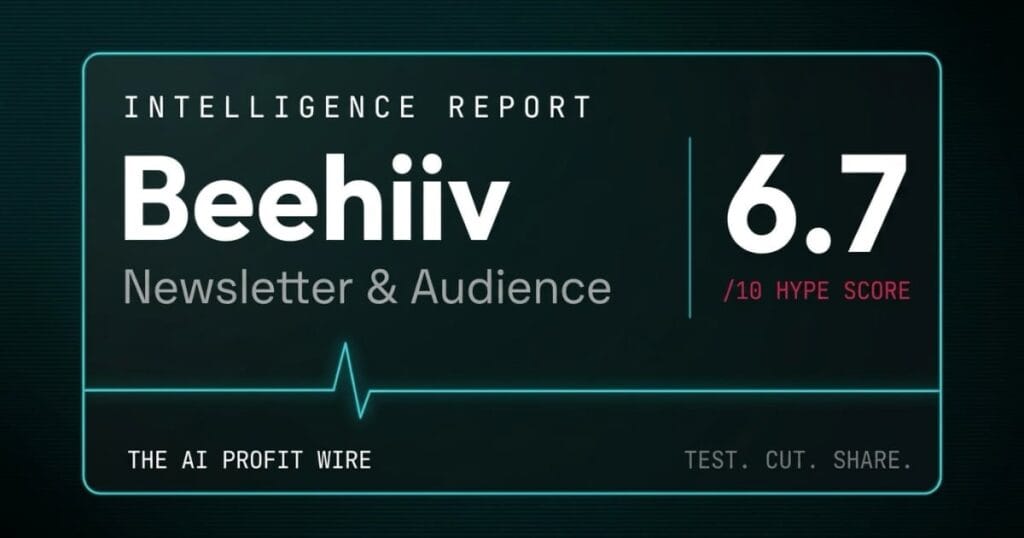
Beehiiv Intelligence Report
Beehiiv
Qualified yes for publishers whose newsletter is the business. Skip it for branching automation, for hobby projects with no plan to charge, or where independently verified deliverability is non-negotiable.
In This Report
Beehiiv scores 6.7/10 on the Hype Check. That is a qualified yes for publishers whose newsletter is the business, and a clear skip for everyone else.
Beehiiv is a newsletter and website platform for creators and small publishers, and small business owners usually weigh it against Substack and Mailchimp. Publishers on the platform sent 28 billion emails and reached more than 255 million unique readers last year (State of Newsletters 2026), and Beehiiv takes 0% of paid subscription revenue while Substack’s own page tells writers they keep 90% minus card fees.
The score carries 3 documented weaknesses. No independent deliverability verification exists, which SaaS Scored flags as the reason it rates deliverability 3 out of 5. Automation is linear drip sequences with no visual builder, no conditional branching, and no tag-based logic (Sasanova comparison). And StatusGator has logged more than 115 outages affecting Beehiiv users since November 28, 2024.
If your newsletter earns money and you want a native ad network and paid subscriptions without a revenue cut, Beehiiv leads the category. If you need branching automation, verified deliverability data, or you are still testing a hobby idea, this is the wrong tool.
How widely is Beehiiv actually being used?
Community Adoption: 7.0/10
The platform’s operational scale is verified and large. The independent review record behind it is thin.
Beehiiv says publishers sent 28 billion emails and reached more than 255 million unique readers in the year covered by its State of Newsletters 2026 report. TechCrunch runs its editorial newsletters on the platform (TechCrunch case study). Tracker GetLatka puts Beehiiv at $30M in revenue as of June 2026, up from $20M in July 2025 and $24K in 2021, against a $225M valuation dated 2024.
The review record is where it thins out. Trustpilot shows 4.0 across 393 reviews with a split distribution: 66% five-star against 23% one-star, on a profile Beehiiv claimed in October 2023 with a paid Trustpilot subscription. EmailVendorSelection reports 4.5/5 on G2 and 4.3/5 on Capterra, and the underlying review counts are small enough that those averages move on a handful of ratings.
The adoption signal here is scale-as-evidence, and a platform moving 28 billion emails in a year is not one that barely functions.
What it cannot substitute for is review depth. Analyst firm Sacra wrote in May 2024 that Beehiiv’s growth put it on a potential trajectory to pass Substack and ConvertKit in revenue in 2026, and that projection is now 2 years old and still unconfirmed.
What does Beehiiv really cost as you grow?
Pricing Model: 7.0/10
The free tier is real, the tier ladder is published in full, and the fine print is where the cost lands.
Launch is free for up to 2,500 active subscribers with unlimited email sends, 3 publications, custom domains, segments, API access, and 2FA, with no credit card required (Beehiiv pricing). Paid plans start at $49 per month on Scale, and every tier price sits on that same page behind a subscriber selector, so nothing about the ladder is hidden. Beehiiv also states the Stripe cut in its own pricing FAQ: you keep what you earn “minus Stripe’s standard processing fee of 2.9% + $0.30 per transaction.”
The costs are in the terms and in the jumps. All fees are non-refundable, cancellation earns no prorated refund, and Beehiiv reserves the right to change fees with not less than 30 days notice (Terms of Use, Section 5). Against that clause, members of r/beehiiv reported the Scale base price moving from $39 to $49 per month with no communication, a community report rather than a company statement. And the ladder itself has real steps: Scale runs $89 per month at the 5,000 tier and $109 at 10,000.
Beehiiv publishes more of its pricing than most of this category does, and buries the expensive part in refund policy rather than in the price table.
The Billing Warnings section below quotes every term from the vendor’s own pages. Read it before you enter payment details.
Pricing checks out against what Beehiiv delivers. Current plans and any free tier are on their site.
Has Beehiiv’s deliverability been independently verified?
Benchmark Data: 4.5/10
No. For an email platform, deliverability is the number that matters most, and no independent test of Beehiiv’s exists.
SaaS Scored rates Beehiiv 7 out of 10 overall and its deliverability 3 out of 5, stating plainly that there is “no independently verified deliverability data.” Beehiiv’s own comparison page cites a rival’s number rather than its own, noting that Kit reports a 99.8% delivery rate. EmailVendorSelection confirms Beehiiv supports SPF, DKIM, and DMARC authentication plus IP warm-up, and also that it ships no built-in email validation, so list hygiene is your job and your second subscription.
Infrastructure signals point the other way. The platform moved 28 billion emails in a year, and a system delivering at that volume is not obviously broken. That is inference from scale, not a measurement.
Scale suggests the pipes work, and suggestion is not a benchmark, which is the entire reason this signal sits where it does.
The absence of data is the data. If your list is your revenue, run your own inbox test on the free plan before you commit a budget.
What do independent reviewers say about Beehiiv?
Expert Sentiment: 7.0/10
Reviewers with hands-on time agree on the shape of it: strong on growth and money, mid on support, weak on automation.
Tooltester rates Beehiiv 3.2 in a review last updated August 28, 2026, calling it polished and best suited to content-first creators while noting that businesses needing abandoned-cart emails or send-time optimization will find it too limited. DevOpsCube published a one-year experience report after growing to around 20,000 subscribers on the platform and praised the editor and growth tools. Head West Guide interviewed a dozen newsletter publishers across more than 100 hours before giving Beehiiv the edge for most newsletter-first cases.
Support is the consistent complaint. EmailVendorSelection, reviewing on August 9, 2026, found email ticketing is the only human channel and only on paid plans. Tooltester adds that responses come during business hours only with no live chat, behind a 24/7 AI chatbot. Sasanova ranks Beehiiv’s linear drips below a visual builder with conditional branching.
Nobody who has used Beehiiv seriously calls it a bad product, and nobody calls its support good, and that split has held across every 2026 review in this research.
Consistency at that level is itself the signal. The ratings moved down through 2026 while the verdict stayed the same.
Is Beehiiv production-ready or still maturing?
Release Maturity: 8.0/10
Beehiiv is production-grade and ships faster than anything else in its category.
The Winter Release recap of November 14, 2025 lists 7 launches in a single event: Digital Products, the AI Website Builder, native podcast pages, website analytics, Link in Bio, Dynamic Content, and an automation-builder rebuild. Both native podcasts and Dynamic Content ship gated, to Max and Enterprise respectively. Shipping continued through 2026 with On-Demand Ads in March and a Beehiiv MCP server later that month.
The developer surface is genuinely mature. Documentation runs on Fern with a downloadable OpenAPI specification, OAuth2, rate-limit and pagination guides, more than 20 webhook events, and an llms.txt index built for AI agents. Reliability is the softer spot: StatusGator has collected data on more than 115 outages affecting Beehiiv users since it began monitoring on November 28, 2024, with the last acknowledged outage on August 21, 2026.
A platform shipping this fast on a public API earns the maturity score, and 115 logged outages in under 2 years is why it is not higher.
Free Launch users also carry a specific exposure: premium support is a paid-plan feature, so a free account locked out of its own publication has the knowledge base and nothing else.
What is Beehiiv’s overall Hype Check verdict?
Beehiiv earns a qualified yes at 6.7/10, and the qualification is the whole point.
The platform leads its category on the things a revenue newsletter needs: unlimited sends at every tier, a native ad network, paid subscriptions with no platform cut, and a release pace no competitor matches. It trails on the things an email marketer needs: branching automation, list validation, and any independent measurement of whether the mail arrives.
Nothing in this report changed the shape of that trade-off. What changed in this update is the evidence underneath it, after 9 claims on the previous version failed re-verification against the primary sources.
Buy Beehiiv for what it monetizes, never for what it automates.
What does Beehiiv actually cost at every tier?
Beehiiv prices 4 plans by active subscriber count: Launch, Scale, Max, and Enterprise. Send volume is free, so a daily sender with 3,000 subscribers pays exactly what a monthly sender with 3,000 pays. All figures below were read from the official pricing page on September 20, 2026.
The Launch plan ($0) covers up to 2,500 active subscribers across 3 publications with unlimited sends, custom domains, segments, magic links, the recommendation network, API access excluding the Send API, 2FA, the AI Website Builder, the AI Assistant, and basic website analytics. What it leaves out matters as much: no automations, no A/B testing, no surveys or polls, no referral program, no ad network, no paid subscriptions, no digital products, no Send API, and no human support.
New accounts get a trial of Scale or Max with no credit card, capped at Launch sending limits and 2,500 subscribers (plan tier support article). Annual billing cuts the effective rate by roughly 12% on every tier, and there are no send overages on any plan.
Scale plan (monthly / annual effective per month):
- Up to 1,000 subscribers: $49/mo / $43/mo
- Up to 2,500: $69/mo / $61/mo
- Up to 5,000: $89/mo / $78/mo
- Up to 10,000: $109/mo / $96/mo
- Up to 25,000: $169/mo / $149/mo
- Up to 50,000: $249/mo / $219/mo
- Up to 75,000: $289/mo / $254/mo
- Up to 100,000: $329/mo / $290/mo
Max plan (monthly / annual effective per month):
- Up to 1,000 subscribers: $109/mo / $96/mo
- Up to 2,500: $149/mo / $131/mo
- Up to 5,000: $169/mo / $149/mo
- Up to 10,000: $219/mo / $193/mo
- Up to 25,000: $289/mo / $254/mo
- Up to 50,000: $379/mo / $334/mo
- Up to 75,000: $419/mo / $369/mo
- Up to 100,000: $459/mo / $404/mo
Scale and Max both cap at 100,000 active subscribers across every publication in a workspace, after which Enterprise pricing is custom and quote-only. The honest read on this ladder is that Beehiiv is cheap to start, fair in the middle, and steep once a list crosses 25,000. Start on the free Launch plan and let the subscriber count decide when you pay.
Beehiiv vs Substack vs Mailchimp: which costs less at 5,000 subscribers?
Substack costs $0 per month and takes 10% of paid revenue, Mailchimp Essentials costs $83, and Beehiiv Scale costs $89.
| Tool | Best At | Monthly Cost (5,000 subscribers) | Where It Breaks | Best Fit For |
|---|---|---|---|---|
| Substack | Free publishing with paid subscriptions built in | $0/mo (no plan tiers) | Takes 10% of paid subscription revenue plus card fees | Writers testing paid subscriptions with no fixed cost |
| Mailchimp | Multi-step automation and lifecycle email | $83/mo (Essentials) | Essentials caps automation at 4 flow steps, 50,000 sends | Stores needing automation more than newsletter monetization |
| Beehiiv | Newsletter growth, ad network and paid subscriptions | $89/mo (Scale, 5,000 tier) | Scale jumps to $109 at 5,001 subscribers | Publishers whose newsletter is the revenue source |
Every price was read on September 20, 2026 from Beehiiv’s pricing page, Substack’s Going Paid page, and Mailchimp’s marketing pricing page at monthly billing. Mailchimp’s own footnote states that “overages apply if contact or email send limit is exceeded,” and its Essentials tier ships 50,000 monthly sends, 3 seats, and 3 audiences. The Billing Warnings section covers what each Beehiiv ceiling costs you when you hit it.
At matched capacity these 3 cost within $89 of each other, so the decision is never price, it is whether you are selling subscriptions, selling products, or selling nothing yet.
Substack’s marketing page says writers keep 90% of revenue minus credit card fees, while its publisher agreement states the revenue share percentage is set during registration, so confirm your own rate before you count on 10%.
What billing warnings should you know before subscribing to Beehiiv?
1. All fees are non-refundable. Beehiiv’s Terms of Use, Section 5 states it in 5 words: “All fees are non-refundable.” Cancel mid-term and the same section confirms you get no “prorated refund of any portion of the subscription fee paid for the then-current subscription period.”
2. Subscriptions auto-renew at the same price. Section 5 states your subscription “will automatically renew for an additional equivalent period at the same price,” so an annual plan re-bills in full unless you cancel first (Terms of Use).
3. Prices can change on 30 days notice. Beehiiv may “change the subscription terms or subscription fees at any time on a going forward basis by providing not less than thirty (30) days advance notice” (Terms of Use, Section 5). Members of r/beehiiv reported the Scale base price rising from $39 to $49 per month with no communication, which is a community account and not a company statement, and it is worth watching your invoices against that clause.
4. Your bill follows your active subscriber count. Beehiiv’s help center states that “your monthly cost can vary based on the number of active subscribers you have,” and that Scale and Max cap at 100,000 subscribers across all publications in a workspace (plan tier support article). Moving from the 5,000 tier to the 10,000 tier on Scale costs $20 more per month.
5. The free-to-paid step is a real step. Launch stops at 2,500 active subscribers. Past that you are on a paid plan, where Scale is $69 per month at the 2,500 tier and $89 at the 5,000 tier (Beehiiv pricing). Budget for it before the list gets there, not after.
6. The 0% platform commission excludes Stripe fees. Beehiiv’s own pricing FAQ says you keep what you earn “minus Stripe’s standard processing fee of 2.9% + $0.30 per transaction” (Beehiiv pricing). On a $10 monthly subscription your net is $9.41, not $10.
7. A downgrade does not refund the difference. Section 5 states you “will continue to have access to your then-current higher tier until the end of your then-current subscription term,” so a downgrade takes effect at renewal, not at the moment you click it (Terms of Use).
8. A failed payment can cut access immediately. Beehiiv may “immediately suspend access to the Services (in whole or in part) and/or cancel the affected account” (Terms of Use, Section 5). Prepaid credit cards are not accepted at all, per the plan tier support article, so keep a live card on file.
9. Your data is not guaranteed after termination. Beehiiv “is not required to receive, compile, or maintain communications or data of any nature for you (such as a record of unsubscribe requests) during a Service Suspension or after a termination of any nature” (Terms of Use). Export your list on a schedule.
10. Pausing is monthly-only and short. You can pause a monthly plan for up to 30 days, during which the account reverts to Launch features and its 2,500 subscriber sending limit. Annual plans cannot pause at all (plan tier support article).
Is Beehiiv’s 0% commission actually free?
I ran restaurants for 16 years, and this is the oldest trick in payments, told honestly for once.
Every card terminal salesman who walks into a restaurant leads with the monthly fee, because the monthly fee is the number an owner remembers. The money is never in the monthly fee. It is in interchange, in the per-transaction cents, in the rate that moves when the card is a rewards card. You sign for the headline and you pay the footnote for 3 years.
Beehiiv’s 0% is real, and Beehiiv says the footnote out loud on the same page as the headline, charging 2.9% plus $0.30 to Stripe on every transaction. That is a platform telling you where the money goes before you ask, which is more than most of this category does.
The number to run is not the plan price, it is the plan price plus 2.9% of everything you sell, and at $2,000 per month in subscriptions that is $89 plus about $58 in card fees.
Who should use Beehiiv?
There are 4 small business profiles where a 6.7/10 turns into real money.
Solo publishers running paid subscriptions above 1,000 subscribers. Beehiiv takes 0% where Substack’s page tells writers they keep 90%. On $2,000 per month in paid subscriptions, that gap is about $200 per month, which covers the Scale plan at the 5,000 tier twice over.
Local service businesses whose newsletter is a primary customer channel. The referral program, recommendations, and Boosts marketplace arrive on Scale at $49 per month, which replaces the separate growth tools most small lists bolt on. For the website those subscribers land on, see the Elementor Intelligence Report.
Ecommerce owners running a content newsletter beside the store. Segments, a custom domain, and unlimited sends are available at $0 on Launch, so the content arm costs nothing until the list crosses 2,500 and monetization becomes the reason to upgrade. For the funnel side of that stack, see the Systeme.io Intelligence Report.
Creators monetizing through sponsorships. The native ad network, On-Demand Ads, and the Boosts marketplace do in a single dashboard what otherwise takes a sponsor-outreach tool plus a cross-promotion tool plus 2 invoices. For the content engine feeding it, see the NeuronWriter Intelligence Report.
Who should skip Beehiiv?
There are 4 situations where the monetization stack does not save it.
Anyone running branching automation. Beehiiv runs linear drips with no visual builder, no conditional branching, and no tag-based logic (Sasanova). Mailchimp is the better fit here, though check the tier: Essentials caps flows at 4 steps and Standard opens up to 200 flows at $100 per month at 5,000 contacts.
Anyone validating a hobby idea with no plan to charge. Launch is generous to 2,500 subscribers and then it ends. Substack is the better fit, because its 10% applies to revenue you do not have yet, and $0 against 10% of nothing is still $0 (Substack Going Paid).
Anyone who needs verified deliverability before signing. No independent test of Beehiiv exists, and SaaS Scored docks it to 3 out of 5 for exactly that. In a regulated industry, or anywhere a bounced email costs money directly, that gap is the whole decision.
Anyone Stripe will not underwrite. Beehiiv processes all payments through Stripe, “which excludes certain types of businesses and those who employ certain practices” (Terms of Use, Section 5). If Stripe declines your category, paid subscriptions on Beehiiv are off the table, and Mailchimp’s plain email plans are the fallback because they never touch your revenue.
Should you use Beehiiv? Final verdict.
Yes if the newsletter is the business. No if the newsletter serves the business.
A 6.7/10 buys you the best monetization stack in the category, unlimited sends at every tier, a public API with documentation most vendors would charge for, and a release pace nobody here matches. It costs you branching automation, list validation, human support on the free plan, and any independent proof that your mail lands.
If you have crossed 1,000 paid subscribers, the 0% cut alone settles the argument. If your list is a channel rather than a product, Mailchimp does more per dollar, and if you are still testing whether anyone wants the thing, Substack costs nothing until it works.
Try Beehiiv on the free Launch plan. Send to a small seed list for 30 days and check the inbox placement yourself, because nobody else has measured it.
If you’re also publishing content that needs to rank in search, see our best newsletter tools roundup, which prices Beehiiv alongside NeuronWriter for the full stack. For the methodology behind every Hype Check score, see the Pipeline page. For weekly pipeline intelligence, subscribe to The AI Profit Wire.
This report is updated quarterly. Pricing verified September 20, 2026. The score moved from 6.9 to 6.7 in this update: Pricing Model rose because Beehiiv discloses the Stripe cut on its own pricing page and its terms require advance notice of fee changes, while Community Adoption, Expert Sentiment, and Release Maturity each fell after re-verification against the primary sources.
Test. Cut. Share.
Qualified yes for publishers whose newsletter is the business. Skip it for branching automation, for hobby projects with no plan to charge, or where independently verified deliverability is non-negotiable.
Try Beehiiv →Qualified yes. Read the billing warnings above before you pay.
