Helps technical teams build more reliable, long-running AI workflows that can execute multi-step business and software tasks on their own.
How Do You Pick the Right GPT-6 Model for Each Task?
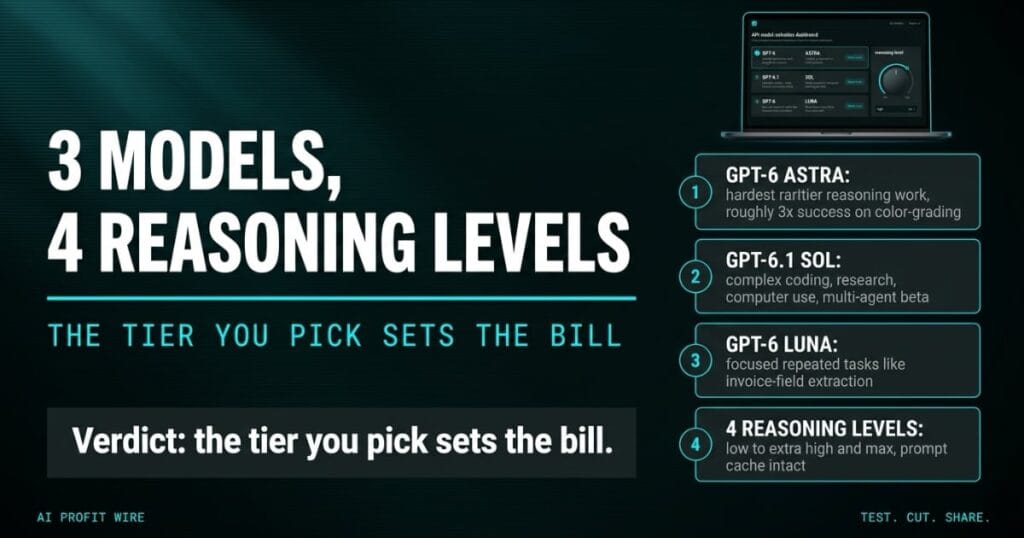
OpenAI published a practical guide to the GPT-6 family on October 2, 2026, and the core move is matching capability, cost, and latency to the task instead of defaulting to the smartest model. The family splits into 3 tiers: GPT-6 Astra for the hardest reasoning work, GPT-6.1 Sol for complex coding, research, and computer use, and GPT-6 Luna for focused, repeated tasks like extracting invoice fields or classifying requests.
The API adds 4 reasoning levels from low for routine extraction to extra high and max for deep debugging, and you can change reasoning effort mid-conversation without breaking your prompt cache. Speed is its own dial: Fast mode buys faster, more consistent response times at a higher per-token cost, and Ultrafast is available for GPT-6 Astra.
The reasoning documentation grounds the settings, and the guide frames the whole family as an intelligence-to-price tradeoff. GPT-6 works as a cost-management system as much as a model upgrade, and the tier you pick sets the bill.
Pick the model and the level per task, because the defaults decide your spend before the first token runs.
Does Matching Reasoning Level to Task Actually Cut GPT-6 Costs?
The strongest evidence comes from early production users rather than benchmarks. Invideo reports roughly 3x the success rate on color-grading and correction tasks with GPT-6 Astra, and a few of its editors created about 50 effects in 1 day.
Cognition runs GPT-6 Astra inside Devin to test software and return evidence, producing a simulator recording and a report that separates checks which passed from areas left untested. Hex turns sales-channel questions into written findings and interactive dashboards, and asks the model to examine whether the numbers make sense.
OpenAI’s own guidance keeps the cost logic honest: test before deploying, run representative tasks, and measure task success, latency, and cost per successful task. Cached input tokens cost up to 95% less than uncached input tokens depending on the model, so stable instructions placed before changing task details cut the per-run price.
The savings are real when the level matches the work, and invented when it does not.
Is There a Cheaper Way to Run Routine GPT-6 Work?
The old habit sends every task to the smartest available model. The guide argues that habit is the cost problem, and the fix is routing: Luna handles extraction, classification, and structured summaries at the low end of the dial, while Astra stays reserved for work that earns its rate.
Prompt caching does the rest for recurring work. Stable instructions and reference material go before changing task details, tool definitions stay consistent, and the caching dashboard shows where reuse breaks down, with the pricing page carrying the per-model rates behind the math.
For long-running work, compaction reduces context size while preserving the state needed to continue, which keeps a multi-day job from paying full-context prices on every turn.
Cheap tiers plus caching cover the routine majority, and the flagship earns its keep on the hard minority.
Month-end at the restaurant ran on 1 spreadsheet, and the forecast broke whenever a single cost line moved. The stable-looking lines were the ones that sank us, because nobody re-priced them until the month was over.
AI bills behave the same way. The reasoning level you default to in week 1 is the line item you argue about in month 3, and by then the spend is already history.
Price the task first, then pick the level that does the job. That order is the whole discipline, and the guide just formalized it.
Who Should Run GPT-6 at Max Reasoning, and Who Should Skip It?
Max effort belongs to deep debugging and analysis where the answer is expensive to get wrong. The guide is blunt about the rest: test where supported when high falls short, and keep the higher level only if the improvement justifies the added time and cost.
In Codex, start at the default reasoning level for the model, lower it for simpler tasks, and raise it only when the output proves the need. Multi-agent workflows are in beta, where GPT-6.1 Sol delegates independent subtasks and combines the findings into 1 response.
Long-running jobs need boundaries set in advance: define which actions proceed without approval, steer mid-run through the Responses WebSocket API when requirements change, and let asynchronous tools keep work moving while slower steps finish. Teams that skip the boundary-setting part pay for it in review time.
Max reasoning is a tool you point at hard problems, and a habit everywhere else.
What Should You Measure Before You Migrate to GPT-6?
Audit your existing AI tasks against the 4 reasoning levels before you migrate anything. Tag each task by complexity, run it at the lowest level that holds quality, and record cost per successful task as the deciding metric.
Set the decision boundaries the guide asks for: which choices the model can make, when it should ask for input, and what a useful response includes, plus what counts as done. If you are comparing vendors on price, our tracker on what each model charges per million tokens keeps the rates in 1 table so the comparison takes minutes.
The computer use capability across Astra, Sol, and Luna changes the task list too, since the models can now investigate a bug, fix the code, and open your product in a browser to check the fix. Plan for it where the workflow lives outside the API.
Pick the tier per task, measure cost per successful run, and let max level earn its keep.
Source: OpenAI Blog
