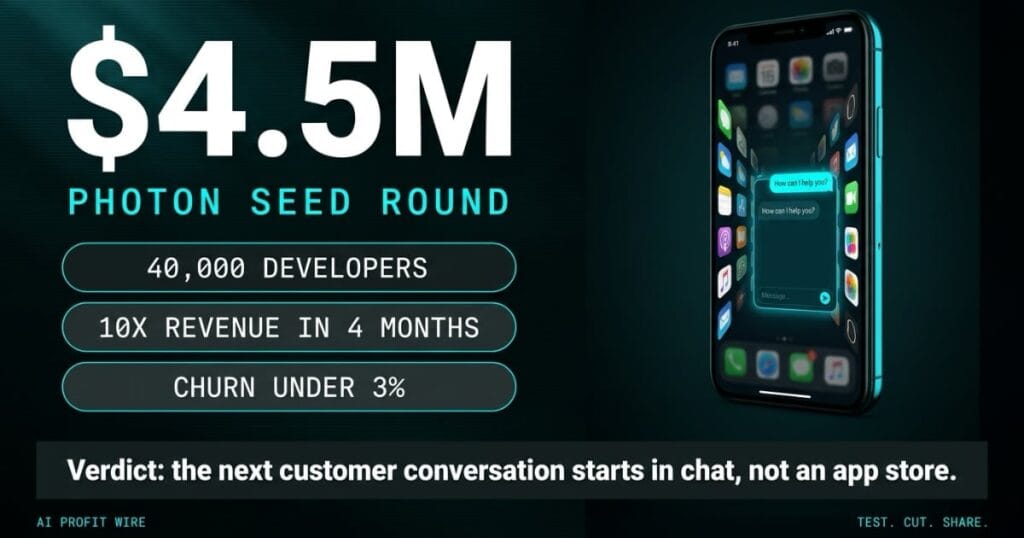
Signals a broader market shift away from traditional apps toward conversational AI interfaces that customers already use daily.
Photon has raised $4.5 million in seed funding to scale its platform for building AI agents that run inside iMessage, WhatsApp, Telegram, SMS, RCS, email and voice. The round was co-led by Gradient and A*, with participation from Vercel, HongShan, Z Fellows and Llama Ventures, per TechCrunch.
Co-founder and CEO Daniel Tian marked the raise with a funeral for mobile apps, held in a San Francisco church on September 17, featuring panels from Vercel, Stripe and OpenAI plus an actual coffin for app icons. The stunt matched his stated thesis: users no longer want to install apps, and agents should meet them inside the messaging apps they already use.
$4.5M from Gradient, A* and Vercel says professional money agrees the conversation layer beats the download.
Who Invested In Photon And How Much Did It Raise?
Photon raised a $4.5 million seed round co-led by Gradient and A*. Vercel, HongShan, Z Fellows, Llama Ventures and Karman participated alongside angel investors.
The founders built the company young: Tian dropped out of UPenn’s M&T program and CTO Ryan Zhu left high school, later becoming a visiting student at MIT’s Media Lab, after their open source iMessage bot pulled in thousands of developers on GitHub. This April they added the managed, subscription-hosted platform on top of that open source base.
$4.5M is the price of the bet, and a 10x revenue run in 4 months is the evidence the company offers for it.
What Are Photon’s Actual User And Revenue Numbers?
The company reports more than 40,000 developer sign-ups, revenue up 10x in 4 months, and messaging volume up 5x in the last month alone. Churn runs under 3%, and no absolute revenue figure was disclosed, so treat every growth number as the company’s own report.
The open source version still accounts for 98% of Photon’s use, and Tian estimates the technology reaches millions of end users across hosted and open source deployments. The hosted platform adds 99.95% uptime, SOC 2 Type II and HIPAA compliance, and usage beyond 10 users requires 1 of the 3 paid tiers.
Yahoo Finance’s syndicated coverage of the round matches the TechCrunch reporting on every figure above.
40,000 developers, 5x volume in a month and under 3% churn are the numbers that make this more than a mascot funeral.
Is Photon Good Enough To Replace Your Mobile App?
The core is open source and carries 98% of the platform’s usage, so a technical founder can run the whole stack without paying Photon anything. The framework is published on GitHub, where the multi-channel agent kit and its channel adapters live alongside the docs.
What the open source route lacks is the operational layer: the hosted version carries 99.95% uptime, SOC 2 Type II and HIPAA compliance, which is what opens healthcare and finance deployments that a self-run hobby setup cannot touch. Customers named in the announcement include Corgi Insurance, Boardy, Ditto, Rho, Fliptexts and Slashy across fintech and consumer AI.
You still design the agent, its guardrails and its escalation path yourself. Photon supplies the unified API, the extensible channel framework, the CLI and the observability suite.
The pull shows up beyond Photon’s own customer list: Nous Research’s Hermes agent runs on Photon as its default iMessage layer, and integrations span LangChain, Mastra, Convex, Render and Railway.
For reach per dollar, an agent inside iMessage or WhatsApp beats a new app install, and Photon is the shortest route to testing that on real customers.
A customer stands in your lobby with a phone full of apps, and yours is not one of them. That install you beg for is a toll booth between you and the conversation you wanted.
Photon raised $4.5M on the opposite bet: the channel is already installed. 40,000 developers now build agents that arrive inside iMessage and WhatsApp, and messaging volume on the platform grew 5x in one month.
The locksmith who answers texts books the job before the one who demands a download finishes his onboarding flow.
What Does The Photon Raise Mean For WhatsApp Business Users?
If you already run customer conversations on WhatsApp, the raise validates the channel and invites competition onto it. 40,000 developers are building agents for the same inboxes your customers use, so response-time expectations move up.
Consumers are being trained for this whether you join or not: Meta’s Muse, the consumer AI app that soared to No. 1 on the app stores, teaches the same audience to expect answers in chat. Tian believes the shift from apps to agents is “directionally” inevitable, and his stated next act is agent-to-agent traffic where your assistant pulls in a flight-booking or hotel agent mid-conversation.
Keep the channel and expect the intelligence: your reply speed now gets judged against agents instead of the other small businesses on your street.
Is Photon Production Ready?
For messaging-first customer workflows, the evidence says yes within limits: the hosted platform runs 99.95% uptime with SOC 2 Type II and HIPAA compliance, and paying clients in fintech and consumer AI already sit on it. The scope limits are real: Photon covers channels and agent operations, so the agent design, the guardrails and the escalation policy stay your job.
If you want AI answering customers on your website today without a build, Tidio’s AI chat for support and lead capture runs the same conversational pattern as a subscription, and it is the fastest way to feel what containment and handoff look like before you commit to a messaging-native stack.
Agent-to-agent traffic is a stated direction with nothing shipped yet, so budget against what exists today.
Ship a narrow agent on 1 channel, measure containment and churn for a month, then decide if the app you planned still earns its build cost.
Source: TechCrunch AI
