Helps small businesses avoid wasted engineering hours by scoring AI agent workflows that deliver immediate operational savings.
How Do You Choose Your First Databricks Genie Agent?
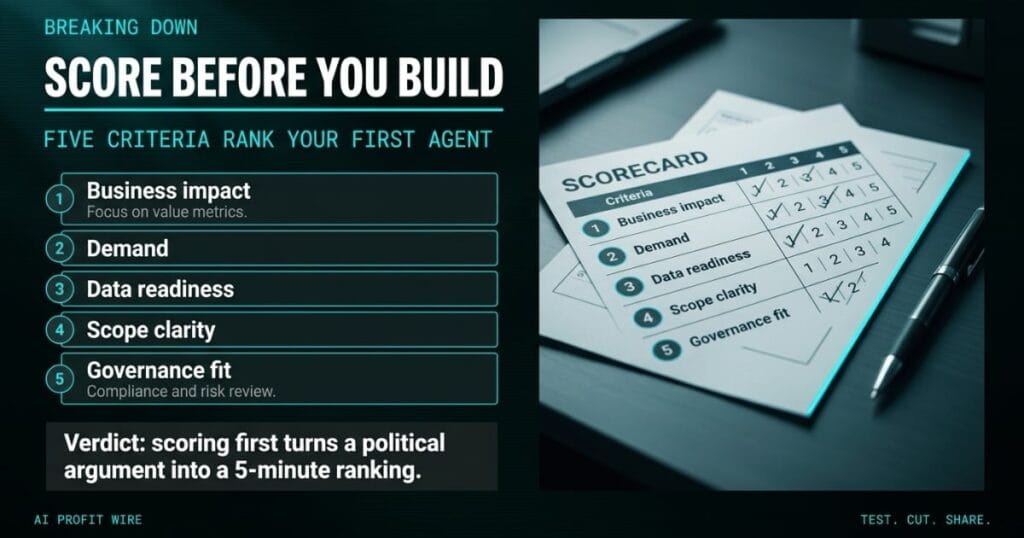
Databricks published a field-tested rubric that scores candidate workflows on 5 criteria: business impact, demand, data readiness, scope clarity, and governance fit. With Genie sitting on the governed data in your lakehouse, the rubric decides which question gets an agent first.
You score each criterion from 1 to 5 and total the result. A score of 20 to 25 means build now, 14 to 19 means the workflow needs shaping first, and under 14 means the workflow is not a fit yet.
One factor sits outside the math: a named executive champion. Databricks states that if no business owner or executive sponsor backs the workflow, you hold off regardless of how high it scores.
The framework comes from dozens of Genie Agent rollouts across financial services, energy, and retail, and Databricks reports more than 1 million Genie Agents created in 2026 alone.
The first agent you build sets the standard every later agent gets judged against, so the selection step matters more than the build step.
Does the Databricks Genie Agent Rubric Actually Work?
The field examples cut both ways, which is what gives the rubric its credibility. A pension fund built a risk and portfolio Q&A agent that scored near the top on every axis, and usage climbed before the agent even reached production.
A national retailer needed the same supply and inventory forecasts day after day with governed data behind them, and the team had a working agent live in weeks. The Azure Databricks documentation grounds why: answers stay reliable when the tables, metrics, and governance behind them are certified.
Production deployments back the pattern. Banco Bradesco runs real-time open finance insights on Genie Agents, Unilever accelerates finance insights, and Coty turned days-long data requests into seconds.
High scores adopt fast, and the pattern holds across industries that share nothing else.
What Breaks When You Skip the Databricks Genie Agent Rubric?
Databricks names 2 failure shapes the rubric screens out. The everything-agent tries to cover an entire department, scope sprawl drags down accuracy, and the first wrong answer in a demo erodes trust. The vanity demo is built for 1 executive meeting and gives nobody a reason to return.
The wealth manager case shows the same failure from the data side. The team built a self-serve analytics agent that should have won on impact, but the underlying tables carried metadata gaps, answers came out inconsistent, and user trust eroded, exactly where a high-impact, low-readiness score would have predicted.
The rubric’s stated job is to reshape weak candidates early rather than only rank them. Databricks frames a score of 12 as a signal about what to fix first, most often a metadata investment, not a permanent rejection, and its companion guide on designing effective agents walks the same discipline from the build side.
Scoring before building turns a political argument about priorities into a 5-minute ranking exercise.
My pipeline reads more than 100 sources a day, and every signal it surfaces waits in a review queue before it ships. The queue exists because volume without a filter produces noise, and noise kills trust in the whole system.
Agent selection runs on the same discipline. The workflow 30 people ask every Monday beats the demo built for 1 meeting, and the table behind it decides whether the answers hold.
Score the candidates before anyone writes an instruction. The 5-minute ranking is the cheapest argument a data team will ever win.
Who Should Build a Databricks Genie Agent First, and Who Should Wait?
The profile that fits is any team with governed data and a recurring question people already ask. High-frequency questions, a certified gold-layer table with rich column descriptions, and a tight domain like HR analytics or marketing performance are the strongest starting shape.
Teams without governed data or a named owner should wait. Databricks lists ungoverned data, ambiguous metric definitions where 2 teams mean 2 things by revenue, and missing owners among the traps that stall pilots.
If reporting is the pain point but a lakehouse is out of reach for now, our Databox intelligence report covers what pulling 130-plus tools into one dashboard looks like for a smaller team.
If your team answers the same question every week from clean data, this framework was written for you.
Should You Build Your Databricks Genie Agent Now or Shape It First?
Run your candidate list through the rubric, total the scores, and let the bands decide. Build at 20 to 25, shape at 14 to 19, and walk away under 14.
Build your top 2 agents, have leaders champion adoption from day 1, and let real demand guide the third choice. A global engineering firm watched a middling agent take off because the CIO used it himself, and that signal carried further than a perfect score with no advocate.
Treat a 12 as a to-do list: fix the metadata, re-score, and try again next quarter. The rubric costs minutes, while the wrong first agent costs the program.
Score, build the winner, and put a champion behind it from day 1.
Source: Databricks Blog
