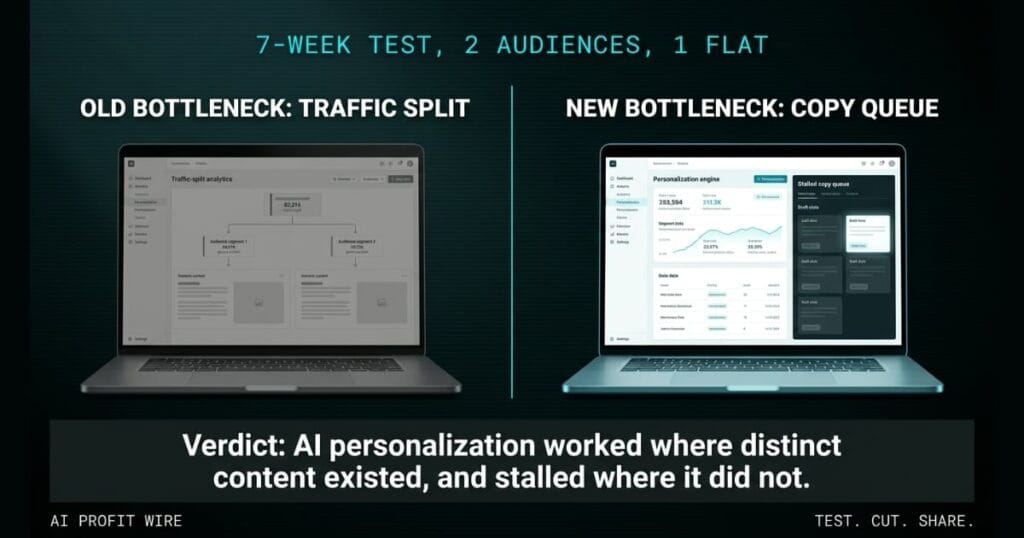
Demonstrates that generating personalized content variations can improve conversion rates, provided you have enough distinct marketing copy ready to deploy.
Amazon Payments applied AI personalization to a product acquisition funnel using a multi-objective contextual bandit on Amazon SageMaker AI, and the AWS Machine Learning Blog documents the full build. In a 7-week online A/B test, one customer population showed a high single-digit relative lift in final-funnel conversion while a second saw no improvement over the existing experience.
The team pinned that gap on the content supply, and the same write-up states the problem turned out to be the content. For a founder, that split is the whole story.
Personalization produced a high single-digit lift where content existed, and stalled where it did not.
What Did Amazon Payments Find About AI Funnel Personalization?
The system treats each content variation as an arm, tries arms against live traffic, and shifts impressions toward what performs while holding a fraction back to keep testing the rest. Selection runs on LinUCB, the linear UCB method introduced by Li et al. in 2010, chosen for a deterministic and auditable decision on every impression.
The multi-objective design optimizes the whole funnel rather than one stage: the model carries weights across start, submit and approve outcomes, so a policy cannot win upstream while degrading the conversion that pays. Pre-deployment validation showed single-stage policies consistently produced at least one negative directional lift on a downstream metric.
The lift was real, the mechanism is auditable, and the constraint turned out to sit outside the model.
How Solid Is The Amazon Payments Personalization Test?
The evidence comes in layers, which is what makes the write-up credible. Offline replay validated the policy against random assignment before launch, and the 7-week online A/B test against the static baseline delivered the verdict, including the finding that content pool quality was the binding constraint on one population.
The operational design is published too: warm-start from a period of randomized assignment, delayed approval feedback handled through an attribution window, a weekly batch cadence on SageMaker Processing with model state versioned in S3, and serving through a low-latency key-value store. If no recommendation exists for a visitor, the page falls back to the default experience, which bounds the downside.
The scope limit matters: the lift applies to one audience inside one Amazon Payments funnel, which makes it a case study rather than a benchmark for your forecast. The team’s code repository lets you run the same bandit on synthetic data to see the mechanics yourself.
Treat the high single-digit lift as proof the mechanism works; your funnel writes its own number.
How Is A Contextual Bandit Different From An A/B Test?
A classic A/B test splits traffic evenly, waits for the test to conclude, then declares a winner. A bandit serves the current best arm while it keeps exploring the rest, so it keeps improving as new variations arrive instead of waiting for a test window to close.
The contextual part is the personalization: instead of one best arm for the whole audience, the model conditions on a feature vector of behavioral signals per visit, so a pattern learned in one context transfers to similar visits. The source notes this is why bandits scale with generative AI, which multiplies the number of variations worth testing.
A bandit is a standing allocation system, and it pays when the funnel stages it optimizes match the ones your business measures.
The print shop runs 200 flyers a week for a shop that wrote 4 messages. The press does not care which one runs, but the customer reading it does, and the shelf decides what personalization can mean.
Amazon Payments hit the same wall in a 7-week test: one audience converted on a high single-digit lift, the second starved on identical copy. The model allocates what the shelf stocks, and your copy queue is the shelf.
What Does The Amazon Payments Finding Change For A Small Business Right Now?
It changes the order of operations. Before evaluating personalization tooling, count the distinct approved messages each funnel step could serve tomorrow, because the model is idle without them.
The supply side is where generative AI already helped this project: the team’s previous post on personalization with Amazon Bedrock covers producing content at scale inside brand guardrails, and the arm pool was composed from reviewed building blocks: industry-themed images crossed with benefit-focused taglines.
Vet the parts and the combinations inherit the approval: each building block gets reviewed once, while the combinatorial space keeps growing. That is how a small team ships a large variation pool without a review bottleneck.
Personalization ceiling equals approved variations, and generation makes raising that ceiling a review problem instead of a production problem.
What Should You Do About AI Funnel Personalization Now?
Audit your funnel content inventory this week and write down the number of distinct messages each step can serve. If any step has fewer than 5, that step is where personalization spend goes to stall.
Then use generative AI to draft variations and run them through your normal approval pass before anything reaches a customer. AWS’s SageMaker Processing documentation covers the batch pattern the team used, and a weekly cadence absorbed approval feedback that lags by days without a real-time stack.
If the funnel itself needs work before personalization, fix that first: the ClickFunnels platform breakdown covers what a working funnel costs a small team today, and a bandit on top of a leaking funnel only reallocates the leak.
Stock the copy queue first, then rent the machine that sorts it.
Source: AWS Machine Learning Blog
