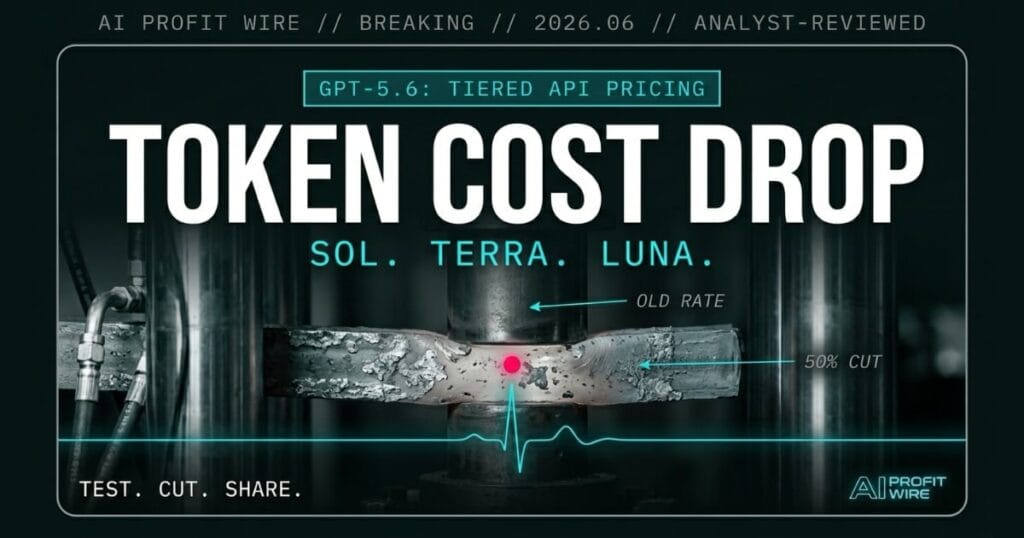
The new Luna and Terra models offer significantly cheaper AI capabilities, directly reducing operational costs for businesses integrating AI into their workflows.
What’s the GPT-5.6 series and what changed?
OpenAI launched three new models: Sol, Terra, and Luna, with tiered pricing and improved cache predictability.
Sol costs $5 input and $30 output per 1M tokens, Terra costs $2.50 input and $15 output, and Luna costs $1 input and $6 output. Cache writes now bill at 1.25x the uncached input rate, while reads keep a 90% discount.
This is a direct cost reduction for businesses running API-dependent AI workflows.
What’s the evidence behind the GPT-5.6 pricing and performance claims?
The announcement came from OpenAI via Simon Willison’s curation, with specific per-token rates confirmed in the release.
Terra is stated to have competitive performance to GPT-5.5 while being 2x cheaper, and Luna is positioned as the lowest-cost option with strong capability. The 30-minute minimum cache life and explicit cache breakpoints are new technical additions.
The numbers are clear and verifiable, though external benchmark verification is pending.
How does the GPT-5.6 series affect day-to-day operations for small businesses?
Any SMB using OpenAI APIs can now reduce token costs by switching to Terra or Luna for appropriate workloads.
Terra at $2.50/$15 replaces GPT-5.5 for most tasks. Luna at $1/$6 opens high-volume use cases that were previously uneconomical. The cache changes mean more predictable billing if you structure prompts with breakpoints.
This is a vendor-driven cost cut that requires zero negotiation.
For small business owners tracking operational AI costs, our live archive of pipeline-filtered AI signals and operational trends surfaces pricing shifts like this as they happen, not after your next billing cycle.
The delivery truck rolls up to your warehouse every morning with 200 packages. Your current sorting system handles it, but you’re paying per-package rates that haven’t changed in 18 months. Then the carrier announces overnight: same service, 50% off, plus a budget tier for non-urgent boxes. You don’t retrain anyone. The packages still get sorted. The only thing that changes is what you write on the check. That’s The Margin Obsession in API pricing: Terra and Luna aren’t features you configure, they’re rate cards you swap to.
The 2x cost drop on Terra isn’t a capability upgrade. It’s a line item that shrinks without touching your workflow. The cache rules (1.25x writes, 90% read discount, 30-minute minimum life) are like knowing exactly which packages get charged dimensional weight and which don’t: structure your prompts with breakpoints, and you stop bleeding on unpredictable line items. Luna at $1 input means you can finally run experiments, batch-process old records, or build internal tools you used to kill in the proposal stage because the math didn’t work. Our live archive tracks which AI pricing shifts actually change the operational math for small businesses.
What’s the final verdict on the GPT-5.6 series for small business owners?
Move your GPT-5.5 workloads to Terra immediately, and test Luna for high-volume, lower-stakes tasks.
The 2x savings on Terra and the $1 floor on Luna are concrete operational reductions. The limited preview means planning now for broader release, but the pricing is set.
Delaying this switch is leaving money on a table that OpenAI already cleared.
Source: simonwillison.net
