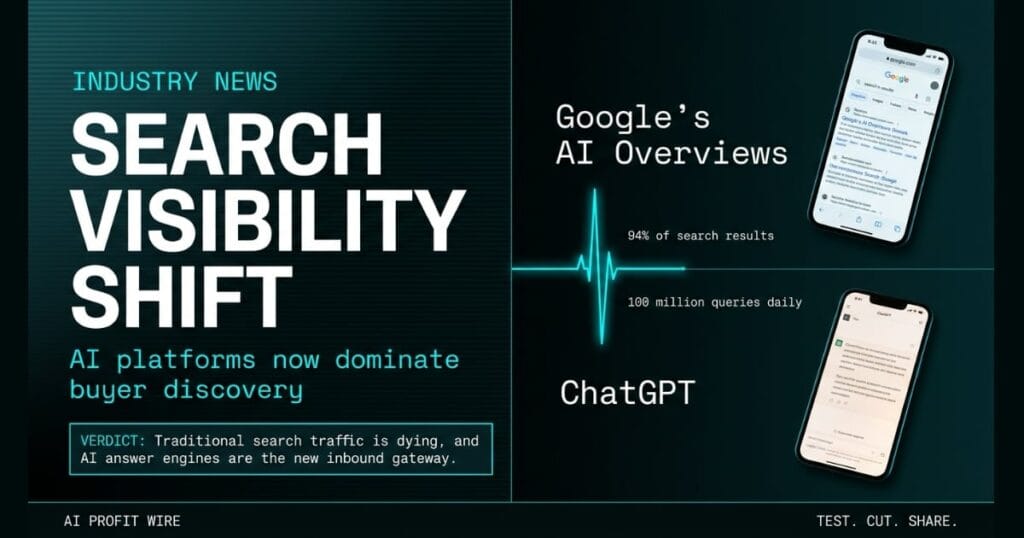
With 94% of B2B buyers using AI in their purchase process, small business owners must shift focus to AI search visibility to protect inbound lead generation.
What is competitive AI visibility and what changed?
B2B buyers are increasingly skipping Google to ask AI tools like ChatGPT and Gemini for business recommendations. Traditional SEO strategies are losing effectiveness because the discovery process has shifted to AI answer engines.
Forrester’s 2026 Buyers’ Journey Survey of nearly 18,000 global business buyers found that twice as many buyers named generative AI or conversational search as their most meaningful research source than any other category. The proportion of B2B buyers using AI grew from 89% in 2025 to 94% in 2026.
Spotlight and Profound estimate that 80 to 100 million B2B research prompts hit AI platforms every single day, with over 20 million on ChatGPT alone.
AI answer engines are now the primary gateway for B2B discovery, and standard search is declining.
What is the evidence behind competitive AI visibility?
ATAK Interactive, a HubSpot Platinum Partner agency, confirms that B2B buyers are asking ChatGPT for direct recommendations instead of using standard search. The most common question from their prospects is how to show up in more AI searches.
Forrester’s data shows 94% of B2B buyers use AI in their purchase process. Roughly 70 to 80% of buying research happens before a buyer ever contacts a vendor, meaning the shortlist is mostly built before your sales team enters the conversation.
Over 20 million B2B prompts hit ChatGPT daily, and when you add Claude, Copilot, Perplexity, and Gemini, the total balloons to 80 to 100 million B2B research prompts per day.
The evidence proves buyers want direct answers from AI platforms, not blue links to click through.
How does competitive AI visibility compare to the alternatives, and what background do small business owners need?
Standard SEO focused on keywords and ranking positions, but AI search visibility requires content that AI engines can easily understand and cite. A Search Market Opportunity combines two things: the volume of people asking about your product across AI and traditional search, and the competition currently being surfaced in the answers.
High volume with weak, declining competition is a land grab. High volume with entrenched competitors is a long game that needs a sharper wedge. Your AI visibility score only means something when you can see the whole board, including how competitors are performing.
Niche companies actually have an advantage here, because their Search Market Opportunity is often less crowded even if the volume is smaller.
AI search visibility replaces standard SEO by forcing brands to optimize for AI citations, not just search rankings.
How does competitive AI visibility affect day-to-day operations for small businesses?
Small business owners must shift their focus to AI search visibility to protect inbound lead generation and prevent revenue drops from declining traditional search traffic. If your content isn’t structured for AI engines to understand and cite, your brand won’t appear when buyers ask for vendor recommendations.
This requires auditing existing content for AI readability and ensuring your website architecture allows AI platforms to easily parse your data. You also need to track how often your brand appears in AI-generated answers across platforms like ChatGPT, Gemini, and Perplexity.
See how NeuronWriter can help structure your content for AI discovery and optimization.
Ignoring AI search visibility directly causes inbound lead generation to drop and revenue to stall.
A prospect asks ChatGPT for the best CRM consultant in your region, and three competitor names appear in the answer. Your company isn’t one of them. You’ve been ranking page one on Google for that term for 3 years, but the buyer never typed it into a search bar.
The traffic didn’t disappear overnight, it migrated to a different question format. Buyers are asking AI platforms for direct recommendations, and if your content structure isn’t machine-readable, the AI skips you regardless of how good your service is.
You don’t need to abandon SEO, you need to add AI visibility as a second track. Audit your top pages for whether ChatGPT and Gemini can cite them, fix the structural gaps, and your inbound pipeline stops bleeding to competitors who already did this 6 months ago.
What is the final verdict on competitive AI visibility?
Small business owners must shift focus to AI search visibility immediately. With 94% of B2B buyers using AI in their purchase process and 80 million daily B2B prompts across AI platforms, standard SEO strategies are losing effectiveness.
Companies must adapt by creating content that AI engines can easily understand and cite, or they’ll suffer revenue drops from declining traditional search traffic. The brands that win will be the ones who treat AI citability as a first-class optimization target.
Your AI visibility score only means something when you benchmark it against competitors. A score of 20 out of 100 looks rough until you discover the category leader sits at 16 and dropping.
Adapt your content for AI discovery now, or lose your inbound leads to competitors who already did.
Source: ATAK Interactive
