Small business owners can use this upgraded tool to create higher quality audio and music for marketing content at potentially lower costs.
What is Google Lyria 3.5 and what changed?
Google Lyria 3.5 is the newest music generation model from DeepMind, and it launched today inside Google Flow Music. It delivers advances across musicality, lyrics, and vocal quality.
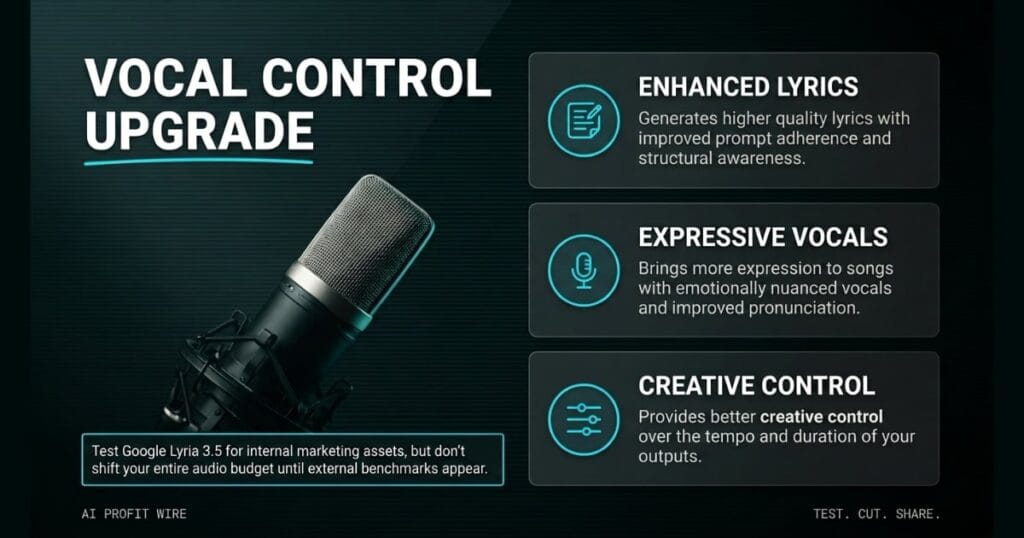
The update allows you to craft richer tracks with more complex melodic structures that sound more natural. It also brings enhanced lyrics with improved prompt adherence and structural awareness.
You can now bring more expression to your songs with emotionally nuanced vocals and improved pronunciation. The model also provides better creative control over the tempo and duration of your outputs.
Google Lyria 3.5 focuses on giving you tighter creative control over AI-generated audio.
What is the evidence behind Google Lyria 3.5?
Google claims the model delivers significant advancements across musicality, lyrics, and vocal quality. The announcement confirms that Lyria 3.5 generates higher quality lyrics with improved prompt adherence, and the vocals feature more realistic and emotionally nuanced expression.
The announcement provides improved pronunciation and easier control over tempo and duration as concrete feature claims. These are the four pillars Google highlights: musicality, lyrics, vocals, and creative control.
Google rolls Lyria 3.5 out today inside Google Flow Music, which is the only environment where the model is currently accessible. There is no standalone API access mentioned in the announcement, and no integration with external DAWs or marketing platforms.
The claims of improved musicality and creative control remain unverified externally. The announcement includes no pricing data and no external benchmarks.
The evidence is currently limited to official launch claims without external benchmark verification.
How does Google Lyria 3.5 compare to the alternatives, and what background do small business owners need?
Google Lyria 3.5 operates inside Google Flow Music and targets users who want to create songs with specific creative controls. The model gives you easier manipulation of tempo and track duration alongside vocal generation.
The announcement provides no pricing details, which makes it difficult to compare against established AI voice synthesis tools that have clear usage costs. You cannot verify the vocal quality without testing it directly against your current audio provider.
Small business owners need to treat this launch as an untested capability rather than a verified upgrade. The lack of external benchmarks means you must run a direct comparison to see if it actually saves time.
You must test Google Lyria 3.5 directly to validate its quality against your existing audio production stack.
How does Google Lyria 3.5 affect day-to-day operations for small businesses?
Small business owners can use Google Lyria 3.5 to create higher quality audio and music for marketing content. The ability to control tempo and duration helps you format audio assets for specific ad placements.
The improved lyrics and vocal quality could let you produce structured tracks with emotionally nuanced vocals in-house. You can generate audio assets without booking external production time.
The lack of pricing data means you need to monitor your access costs closely. You must weigh the time spent prompting the model against the cost of buying stock audio tracks.
Google Lyria 3.5 shifts audio production in-house but requires strict tracking of time saved versus output quality.
The boutique retailer’s IG Reel needs a 15-second audio bed for the weekend sale announcement, and the owner opens Flow Music to test Lyria 3.5 on a Tuesday afternoon. The model ships today with claims of better vocals, easier tempo control, and improved pronunciation, but the announcement includes zero pricing data and zero external benchmarks.
The first prompt generates a track with the right tempo, but the vocal pronunciation sounds flat and the emotional nuance is absent. The owner spends another 20 minutes tweaking the prompt to fix a 15-second audio clip, which derails the afternoon restock. The model’s promise of easier creative control does not match the actual time spent debugging the output.
The 3.5 version number is the only hard data point in the announcement. Founders producing marketing audio need to test the tool against their current stock audio cost and their internal production time, because Google has not published pricing or benchmarks to make that comparison for you.
What is the final verdict on Google Lyria 3.5?
Google Lyria 3.5 offers specific controls for tempo and duration that make it attractive for small business owners producing marketing audio. The vocal and musicality claims lack external verification.
The absence of pricing data means you must test the tool cautiously to avoid unknown usage costs. You should run a direct comparison against your current audio production workflow.
If the model delivers on its prompt adherence claims, it could reduce your external audio production expenses. If it fails, you have lost nothing but a few minutes of testing time.
Test Google Lyria 3.5 for internal marketing assets, but do not shift your entire audio budget until external benchmarks appear.
Source: Google DeepMind
