Small businesses must adapt their SEO strategies to target conversational queries and optimize content for AI citations rather than just traditional blue links.
What is Google AI Overviews and what changed?
Google AI Overviews is the search engine’s artificial intelligence layer that generates direct answers for user queries. Over the past year, this feature has transitioned from an experimental add-on to a dominant fixture in the search journey.
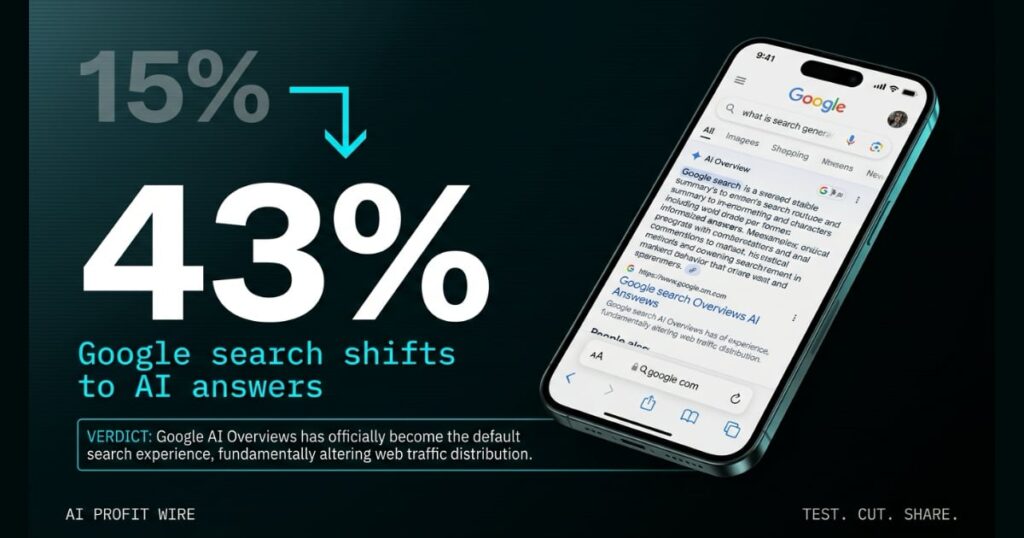
The presence of AI Overviews surged from 15% to 43% of all searches in a single year. This rapid adoption indicates a fundamental shift in how users interact with search engines.
Google is dropping users directly into AI Overviews, where they can continue their research via conversational follow-ups. This integration transforms Google from a simple gateway of blue links into a destination platform that keeps users on-site longer.
Google AI Overviews has officially become the default search experience, fundamentally altering web traffic distribution.
What is the evidence behind Google AI Overviews?
Market intelligence firm Similarweb provided the concrete data illustrating this search behavior shift. The numbers show massive adoption rates for both traditional AI summaries and expanded conversational modes.
During the same period, AI Mode visits rose from 126 million in June 2025 to 279 million by May 2026. The average length of Google searches has also risen, suggesting people are replacing short keyword queries with natural conversational prompts.
AI citations that link back to external websites have grown more than 5 times during the past year. However, just 6.8% of U.S. ChatGPT desktop queries included citations as of May 2026, showing a disparity in how different AI platforms handle source attribution.
The Similarweb data confirms a massive, measurable migration toward AI-generated answers over traditional website click-throughs.
How does Google AI Overviews compare to the alternatives, and what background do small business owners need?
Google AI Overviews is shifting how search engines operate when it comes to driving outbound traffic. The system aims to keep users engaged within its own interface while offering varying degrees of citation visibility.
While Google’s AI citations have grown 5 times, ChatGPT’s citation rate sits at just 6.8% for U.S. desktop queries. This indicates Google currently offers a different opportunity for content discovery through AI summarization.
There’s some hope for publishers relying on AI-driven search engines, as ChatGPT U.S. desktop referrals improved after a May 7 search update. The proportion of visits landing on webpages more than doubled from 25% in March 2026 to nearly 60% by May 30, 2026.
Cloudflare has also introduced tools that allow publishers to block AI bots from their websites unless those AI companies pay for access. This creates a new monetization path for content creators facing lost traffic.
While ChatGPT is improving its outbound link visibility, Google AI Overviews maintains a wider overall reach with 43% search penetration.
How does Google AI Overviews affect day-to-day operations for small businesses?
Small business owners must adapt their SEO strategies to target conversational queries and optimize content for AI citations rather than just traditional blue links. The shift from short keywords to long, natural prompts requires a complete rewrite of content strategies.
If you run an e-commerce brand, relying on outdated keyword optimization means losing visibility as users adopt conversational AI search behaviors. Founders who plug into NeuronWriter’s AI content optimization workflow can structure product pages to answer conversational queries directly and stay cited inside AI Overviews.
Businesses in travel, retail, and sports generate cited responses more frequently than others, giving them a distinct advantage. Founders in these niches must ensure their product pages are structured to answer direct user questions.
Operations must pivot from keyword density to conversational query optimization to maintain organic visibility.
The buzz of a pallet jack echoes through the warehouse as the morning shift starts, but the outbound shipping lane is completely empty. You check the management dashboard and see 43% of your standard customer orders are being intercepted at the central distribution hub, repackaged, and handed directly to the buyers without a delivery truck ever reaching your loading dock.
The customer thinks they’re getting the full product experience, but they’re actually receiving a generic summary tag slapped on the outside of the box. Your warehouse crew is still writing detailed spec sheets and assembling accessories inside, yet that labor never translates into a completed delivery or a repeat buyer.
You have to change the packaging strategy immediately, moving the core value to the outside of the carton so the central hub is forced to cite your brand when it hands the product over. If you keep packing value deep inside the crate, the automated logistics layer will siphon your margins and leave your dock quiet.
What is the final verdict on Google AI Overviews?
Google AI Overviews represents a permanent structural shift in search traffic that small business owners can’t afford to ignore. The data shows a clear migration away from traditional website click-throughs toward AI-generated answers.
With AI Overviews appearing in 43% of searches and AI Mode visits climbing to 279 million, the era of optimizing for short keywords is over. Small business owners must restructure their digital presence to answer conversational queries and secure direct AI citations.
Those who adapt their content for AI summarization will survive the traffic loss, while those who cling to blue link optimization will fade into obscurity. The gatekeeper has become the destination, and your content must feed the machine.
Adapt your SEO for conversational AI queries immediately, or accept the permanent loss of your organic search traffic.
Source: TechCrunch AI
