Automating repetitive administrative tasks with cost-effective AI agents saves small business owners hours of manual data analysis daily, directly improving operational efficiency.
What’s Gemini 3.6 Flash and what changed?
Gemini 3.6 Flash is an advanced reasoning model designed to handle complex tool use, coding, and continuous agentic loops at a lower cost. It features a 1 million token context window and a 64,000 token maximum output.
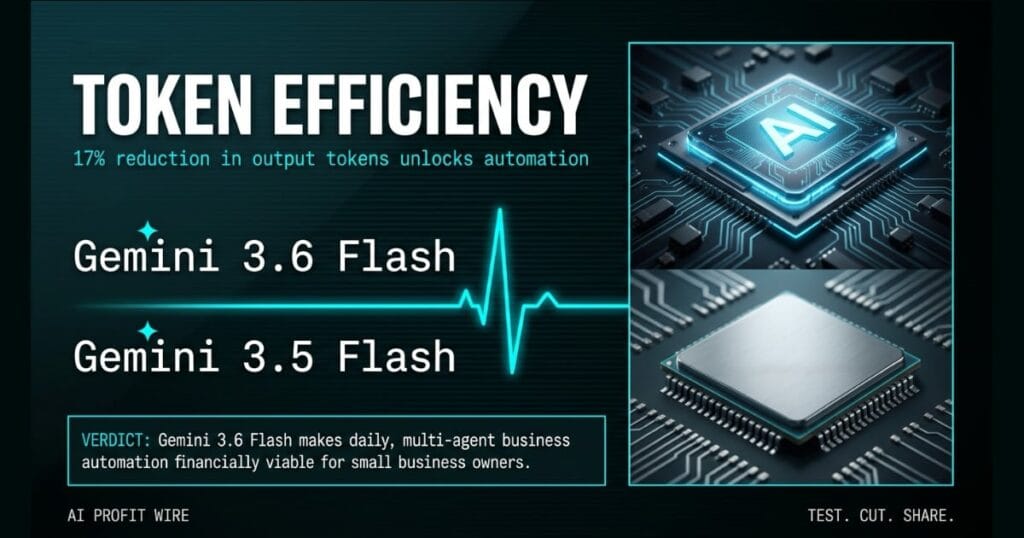
The model achieves roughly a 17% reduction in output tokens compared to Gemini 3.5 Flash. It also operates at a lower cost per output token, significantly lowering the expense of running continuous agentic workflows.
This cost reduction allows small business owners to run continuous reasoning and tool execution without facing prohibitive API costs. It makes daily, multi-agent automation accessible for tight-margin operations.
Gemini 3.6 Flash makes daily, multi-agent business automation financially viable for small business owners.
What’s the evidence behind Gemini 3.6 Flash?
A Michigan dairy farmer named Paul Windemuller built a custom multi-agent system using Gemini 3.6 Flash to manage Dream Winds Dairy. The farm milks 260 Holsteins and generates continuous data streams from sensor collars and local weather stations.
The farmer spent hours every morning downloading files, merging spreadsheets, and calculating performance. He built a local, multi-agent AI system to integrate siloed farm data and calculate daily profitability automatically.
The system uses a local, directory-based file-interface instead of APIs or web scraping. When CSV data exports or photos of paper receipts are saved to a monitored folder, Gemini extracts and merges visual and numeric metrics while keeping data under the farmer’s control.
The evidence shows Gemini 3.6 Flash effectively eliminates hours of manual data merging in a live business environment.
How does Gemini 3.6 Flash compare to the alternatives, and what background do small business owners need?
Previous models made operating multi-agent systems at farm scale too expensive for small businesses. Continuous reasoning, parsing, and tool execution require significant token output, which previously created a cost barrier.
Gemini 3.6 Flash addresses this by offering a 17% reduction in output tokens compared to Gemini 3.5 Flash at a lower cost per token. This specific efficiency metric is what unlocks the ability to run daily automated workflows without API bloat.
By keeping the workflow local and using a directory-based file-interface, the system avoids the complexity and vulnerability of web scraping. This approach allows founders to maintain complete control over sensitive operational data.
Gemini 3.6 Flash beats alternatives by combining local data control with token efficiency for daily operations.
How does Gemini 3.6 Flash affect day-to-day operations for small businesses?
The system replaces manual spreadsheet work with a specialized 4-agent workflow. This workflow includes an Orchestrator, Ingestion Agents, an Analysis Agent, and a Reporting Agent.
Ingestion agents parse raw files like milking robot exports and feed logs into standardized data. The Analysis Agent evaluates biological and weather impacts, while the Reporting Agent generates a clear, natural language summary.
The reporting agent translates raw numbers into a daily Farm CEO Briefing that isolates daily margin drivers. If Static Variable Margin drops by $0.15 per cow, the agent pinpoints specific causes like a $0.08 drop in Dry Matter Intake due to humidity.
You can apply this exact automated reporting structure to your own operations. We track similar AI agent deployments built for small business margins in our ongoing coverage.
Gemini 3.6 Flash transforms raw operational data into actionable, daily business intelligence automatically.
You’re on the phone with a supplier arguing about a sudden 17% price hike on microinverters, which directly threatens your installation margins. You hang up and stare at disconnected software portals tracking your crew schedules, your inventory shipments, and your customer contracts. You know your true installation margin is bleeding out somewhere in those silos, but you don’t have the hours to manually merge the spreadsheets.
Getting a custom integration built to connect those portals would cost more than the job itself. You need an automated system that reads the raw PDFs and CSVs locally, calculates the true margin, and isolates the operational drain from the supplier surcharges.
That 17% drop in output tokens just made running that daily agentic loop cheap enough to leave running overnight. You wake up to a single briefing that tells you exactly why your margin dropped $0.15 per panel, without touching an API or paying a developer.
What’s the final verdict on Gemini 3.6 Flash?
Gemini 3.6 Flash provides a 1 million token context window and a 64,000 token maximum output for complex reasoning. It lowers the cost of running agentic loops by reducing output tokens by 17% compared to Gemini 3.5 Flash.
The Michigan dairy farmer used these capabilities to build a 4-agent system that parses siloed CSV and PDF data locally. This eliminated hours of manual spreadsheet work and generated daily, actionable profitability reports.
Small business owners can now build local, cost-effective multi-agent systems that merge disconnected data without API web scraping. This directly improves operational efficiency by isolating true biological or operational costs from market noise.
Gemini 3.6 Flash is the key that unlocks affordable, local, and automated daily intelligence for small business owners.
Source: Google AI Blog
