Could eventually improve automation for businesses dealing with heavy visual workflows like robotics, media, and design, though currently limited to API waitlists.
Elorian, a Palo Alto startup that raised $55 million before shipping anything, released its first model on Friday. Glimpse is a visual reasoning model that re-reads images and video mid-reasoning instead of converting them to text once and describing them from memory.
The $55 million seed round closed at a $300 million valuation before the product existed, co-led by Striker Venture Partners, Menlo Ventures and Altimeter Capital, with participation from Nvidia and Google chief scientist Jeff Dean. Glimpse is the first thing the company has shipped.
What is Elorian Glimpse?
Glimpse is a research-preview model built around 1 behavior most multimodal systems skip: going back to the source. Mid-reasoning, it crops into a region, pulls specific frames from a video, or runs code to measure and compare what it is looking at, a design Elorian calls the visual scratch space and documents in its launch post.
CEO Andrew Dai, a former Google DeepMind researcher, told TechCrunch the idea came from board games: each has its own visual language and iconography, and frontier models could not say who was winning from a photograph. He compares the gap to Ikea diagrams, which humans follow with no text at all.
Glimpse is built around 1 mechanism: return to the pixels and look again before answering.
How accurate is Elorian Glimpse compared to frontier models?
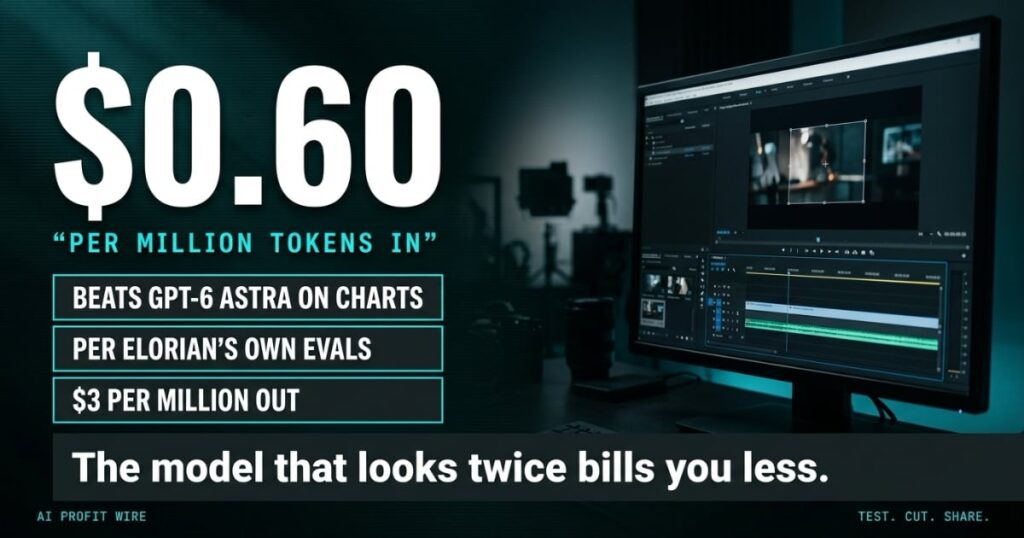
Elorian’s own evaluations put Glimpse ahead of GPT-6 Astra on scientific chart reasoning and short-form video captioning, with competitive results on other visual reasoning tasks. The published results table lists CharXiv-R scientific chart reasoning at 92.90 and UGC-VideoCap short-form captioning at 82.66.
These are the startup’s numbers from a research preview, so weight them accordingly. The training story carries more independent weight: a small team trained Glimpse on a few hundred GPUs, and the model is substantially smaller than the frontier systems it benchmarks against.
The mechanism has precedent: OpenAI’s o-series began thinking with images, cropping and zooming mid-reasoning, back in April 2025. Elorian’s pitch is that it built the entire model around that behavior, cheaply.
The benchmark claims are self-reported, but frontier-adjacent results from a few hundred GPUs is the part worth taking seriously.
Is there a cheaper alternative to Elorian Glimpse?
Glimpse costs $0.60 per million tokens in and $3 per million tokens out. That prices it below mid-level models like Sonnet and Sol and above lightweight options like Haiku and Luna, per the launch coverage.
Price only matters against the task. If your current stack converts video to text and misses what a re-read would catch, you pay for the miss twice: once in tokens and once in human review. Together.ai’s model page lists the full results table and deployment details for teams comparing API options.
Cheaper visual models exist, and none of them re-read the source the way this one does.
The QC pass on a multi-camera shoot used to be a person scrubbing footage frame by frame, and the AI pass that replaced it answers from one look and moves on. The caption swears the product is in frame, and the product is not.
Glimpse re-reads the source mid-reasoning at $0.60 per million tokens in, which prices a second look at roughly the cost of the first one. That is the difference between a model that describes your footage and a model that checks it.
Before the next pipeline renewal, ask every vendor on the list whether their model looks twice, and whether they can prove it. The answer sorts the vendors faster than any benchmark table.
Who is Elorian Glimpse actually for?
The initial targets are organizations sitting on heavy video datasets: robotics firms, scientific labs, and media companies. Longer term, Elorian wants to move from seeing to doing, including models that choose actions and control robots directly.
Availability is the constraint today: API access is live in research preview, and the chat interface is waitlist-only. Dai’s stated goal for next year is a model that leads on every visual reasoning test, which tells you the roadmap is ambition rather than stability.
Pipeline-heavy visual teams should test now, and everyone else can wait for the waitlist to move.
Is Elorian Glimpse worth $0.60 per million tokens?
Worth is a function of error cost. If misread frames turn into reshoots, mislabeled datasets, or wrong robot actions, a model that re-reads the source pays for itself fast, and if your workload is low-stakes description, lightweight models cost less and suffice.
Run your last video-heavy month’s token spend through both price sheets before deciding, starting with the per million token rates we track across models. The research preview makes that comparison cheap to run: the API is live, and the waitlist only gates the chat interface.
Pay the $0.60 where a missed frame costs more than a token, and stay on the lightweight meter where it does not.
Source: TechCrunch
