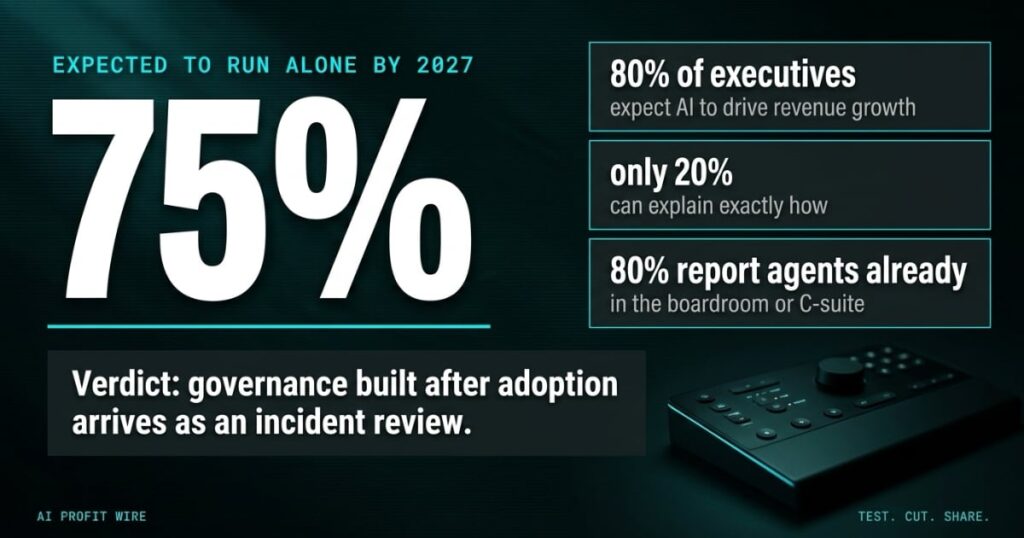
Highlights the necessity of implementing structured AI controls to avoid costly operational failures as autonomous tools scale.
What Did IBM’s Research Find About Agentic AI Governance?
IBM’s research presented at its Think on Tour EMEA 2026 conference found that three-quarters of surveyed executives across EMEA expect an agent to execute a complete business task and make a decision without human intervention by 2027. Meanwhile, 80% said at least 1 agent had already reached the boardroom or C-suite, and AI Business reported the full findings from the event.
In her keynote, Ana Paula Assis, senior vice president and chair for EMEA and APAC at IBM, said 80% of executives expect AI to drive revenue growth, yet only 20% can explain exactly how that will happen. Her argument to the room: operating AI at scale is an operating problem that needs a new AI operating model.
As AI agents move from answering questions to making decisions and acting, the accountability layer has to move with them. The research describes a deployment curve that is already past the pilot stage inside large organizations.
Deployment is running ahead of accountability, and the gap is where the losses land.
How Solid Is IBM’s Agentic AI Research?
The numbers are survey findings from executives across EMEA presented at IBM’s own event, so treat them as directional rather than audited measurements. The qualitative warnings come from practitioners on the same stage: Michael Nimhauser, global head of sovereignty at Atos, said organizations hold excitement about AI’s potential alongside a deep fear of losing control as adoption accelerates.
What the event does document is a deployment reality that is easier to verify than a survey: agents are already in boardrooms, revenue expectations are set, and the explanation layer is missing at 4 out of 5 companies. TechTarget’s coverage of the same event confirms the figures and adds speaker detail from the conference floor.
The sample is self-reported, but the pattern it describes, agents without named owners, shows up in every deployment story told at the event.
How Is Agentic AI Governance Different From Earlier AI Risk Controls?
Chatbot-era controls asked where data is stored and who may see it. Agent-era governance extends to control over infrastructure, models, and the systems coordinating AI agents, which is the concern Nimhauser and other speakers argued needs governance running alongside adoption from day 1.
Craig Aston, CEO of the U.K.-based managed services provider Celerity, described a parallel approach: the company assesses applications for business value and ROI while a separate governance review considers risk, data, and access. The design lets employees propose AI use cases without letting enthusiasm outpace appropriate controls, and Aston warned that getting it wrong could bring a company down.
The old checklist cleared a tool for use, and the new one has to clear a decision-maker that acts on its own.
The auto-reorder screen in the warehouse flashes green at 6 in the morning, and 200 purchase orders have already gone out before anyone walks the floor. Every order under $500 runs on thresholds a manager set 2 summers ago, and the system has never once asked a human to sign. The manager learns that a supplier changed its lead time 3 weeks ago because the shelves for the fast-moving SKU went empty anyway.
IBM’s research puts a harder version of that scene on every 2027 planning calendar: 3 in 4 EMEA executives expect agents to complete whole tasks and make decisions with no human in the loop. The threshold you set once is about to stop being a reorder rule and start being a buying decision.
Ownership is the fix, not suspicion. Every automated decision gets a named person, a spending ceiling, and a weekly review, the same parallel governance Celerity runs alongside adoption, and the cheaper habit by far.
What Does Agentic AI Governance Require From a Small Business?
U.K. insurer Markerstudy gives the working example. The company used an agent called Bob to analyze 6 million lines of code in a core insurance system it built over roughly 30 years, a review that took 4 weeks and produced a heat map to inform a targeted modernization strategy instead of a wholesale replacement.
CTO Dan Fiehn said the company kept people validating output and training the models throughout, and the goal was better decisions rather than the most AI deployed. The requirement in practice: a named human owner, a validation step, and a scope limit for every autonomous workflow.
Managed service providers are already selling this discipline. The parallel-review pattern, business value on 1 track and risk, data, and access on another, is something a small team can copy internally without buying anything.
Measured outcomes with human oversight beat blind automation, and the Markerstudy review is the costed proof.
What Should You Do About AI Agent Governance Now?
List every autonomous workflow your team runs and assign each 1 a named human owner with a review cadence, before the 2027 autonomy expectations in IBM’s data become your operating default. Pause any workflow that cannot name its owner until 1 signs on.
Platform options exist for teams that need infrastructure-level control. IBM has introduced Sovereign Core, an open source platform for running AI environments under organizational control, positioned for businesses managing data, operations, and governance as adoption grows.
Details sit on IBM’s Sovereign Core product page, and we follow the rest of the agent governance warnings we have logged this quarter as they land.
Embed oversight into every automated workflow now, before an agent makes an unmonitored decision you have to explain.
Source: AI Business
