Provides a case study on scaling consumer app revenue through direct creator payouts tied to measurable reach, a model any business buying attention can copy.
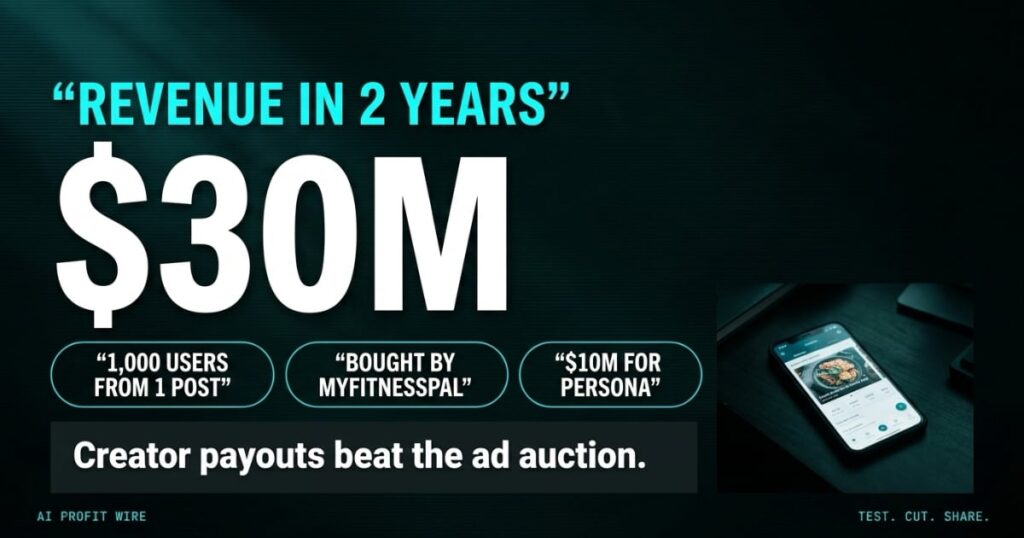
Cal AI, the AI calorie-tracking app built by 2 teenagers, sold to MyFitnessPal in March after generating over $30 million in revenue in 2 years, and the mechanics of that sale read as a playbook for anyone buying attention. Founder Zach Yadegari walked through the creator-payout system at TechCrunch Disrupt on Thursday.
Who Bought Cal AI And How Much Did It Sell For
MyFitnessPal bought Cal AI for an undisclosed amount in a deal announced in March. The price stays private, MyFitnessPal’s CEO notes the team did not have to sell, and coverage of the deal put talks at almost a year, on and off, before the close.
The buyer tracked Cal AI through app-store rank data before making contact: MyFitnessPal CEO Mike Fisher told TechCrunch his team watches about 70 competitors through tools like Sensor Tower, with the acquisition confirmed through that coverage. Yadegari announced the sale in his own post, noting he and co-founder Henry Langmack started the company as 17-year-old high school students.
The incumbent bought the upstart, kept the team, and the founder has already moved on to build again.
What Are Cal AI’s Actual Revenue Numbers
Cal AI generated over $30 million in revenue in 2 years, per the numbers Yadegari shared onstage, and the buyer’s own statements carry the download figure. MyFitnessPal’s own characterization puts the app at more than 15 million downloads alongside that revenue line.
The growth curve had a measurable starting point: an early influencer post drove about 1,000 new users over 2 days, which convinced the team to recruit creators as fast as it could. Yadegari described the result as a linear formula where every post reached a predictable number of viewers who converted.
$30 million in 2 years built on creator payouts is the number that forces an acquisition-mix rethink.
How Is Cal AI’s Creator Playbook Different From Paid Ads
Creator deals at Cal AI were fixed contracts: Yadegari negotiated rates that paid a set amount for a defined scale of reach, and creators kept posting until the target hit. He described his recruits as college students who wanted cash up front.
Paid acquisition runs through auction platforms where costs move daily, while the Cal AI model priced distribution in advance and selected creators whose communities were tight enough to quantify. The team’s filter was reach it could measure, which is why the formula converted at a predictable rate.
Fixed creator contracts turn distribution from a volatile auction line into a plannable budget item.
The creator invoice arrives with 40,000 views and the dashboard shows 12 sales, and now someone has to explain the gap at the Monday numbers meeting. The gap between views and sales is where marketing budgets go quiet. Cal AI’s founders built their payout structure to close that gap before they turned 20.
The anchor number is small on purpose: 1,000 users from a single post over 2 days told them the math was linear, so they scaled the posts instead of the hope. I buy attention for my own companies the same way, price attached to delivered conversions.
A payout tied to a tracked conversion behaves like a supplier invoice, and a payout tied to reach behaves like a lottery ticket. Budgets absorb the first and drown in the second. The auctions do not get that vote.
What Does The MyFitnessPal Deal Mean For Cal AI Users
The app stays independent with the same photo-first calorie estimation, and MyFitnessPal connected it to a nutrition database that spans 20 million foods and 68,500 brands.
The 7-person Cal AI team, including Yadegari as CEO, stayed on through the integration, though he left in June to build Persona, an AI agent startup that raised $10 million led by Vine Ventures with Z Fellows founder Cory Levy and Collective Global participating, per the launch coverage. Persona’s first hardware is a $179 wearable band that activates on a button press rather than listening all day.
Users keep the app, gain the database, and lose the founder to his next company.
What Should You Copy From Cal AI’s Playbook
Copy the contract structure before the channel: payouts tied to a defined and trackable result, creators chosen for community density, and posting commitments that continue until the number lands. Yadegari called it a clear formula, linear and fast, and the formula is what transfers.
The model works at any budget where conversions can be measured.
The practical step is measurement first: our report on tracking which campaign produced each lead covers the attribution layer that turns the creator question from an opinion into a ledger line. Without attribution, each creator looks like a win.
Write the conversion floor into the contract, track it with your own tooling, and drop the creators who miss it twice.
Source: TechCrunch
