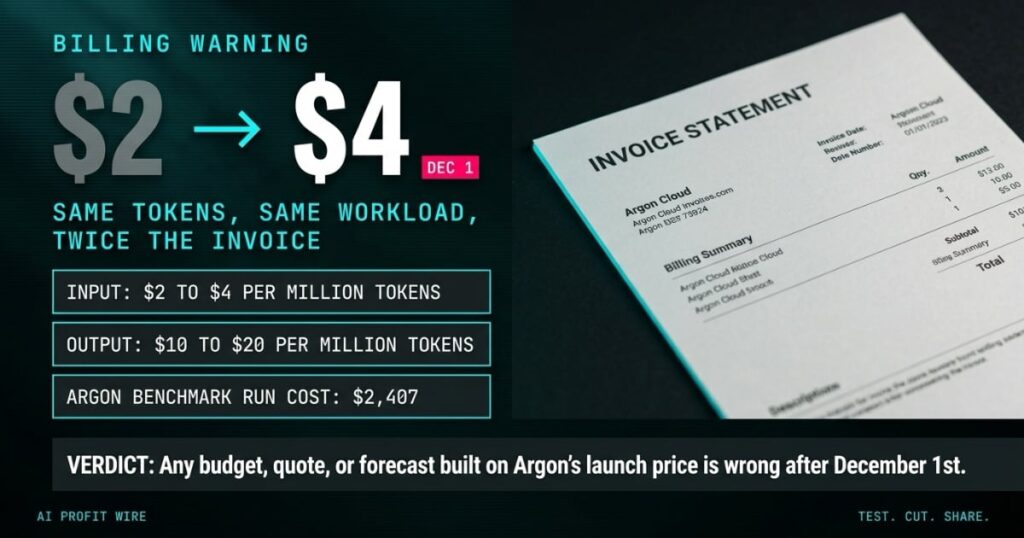
Direct impact on operational software costs as API expenses double next month.
How much does Gemini 4 Argon cost through the Gemini API?
Gemini 4 Argon launched at $2 per million input tokens and $10 per million output tokens through the Gemini API, with cached input tokens at 95% off, and access also included for customers on Google’s $100-per-month subscription plan.
At those launch rates, Argon matches GPT-6 Sol on price, undercuts Claude Opus 5.5 by half, and costs a fifth of Claude Fable 5.1 and GPT-6 Astra.
Cached inputs at 95% off matter as much as the headline rate for agentic loops that re-read the same documents every turn, because the discount compounds on every repeated token the workflow touches.
Gemini 4 Argon is a frontier model at an introductory rate, and the introductory rate has an expiry date.
What triggers the Gemini 4 Argon price increase?
Nothing you did. The trigger is a calendar date: Google has set the launch rate to expire, and the official Gemini pricing documentation lists $4 per million input tokens and $20 per million output tokens once the introductory period ends on November 30, 2026.
Simon Willison flagged the same schedule when he added Argon support to his llm-gemini plugin: on December 1st the price doubles, which moves Argon to the same per-token rate as Claude Opus 5.5. Two independent sources agree on the date and the destination.
The footnote matters for planning: the doubled rate applies to the public-access Argon model, so the number in a procurement spreadsheet belongs as $4 and $20, never the launch pair.
Any workflow deployed this month inherits the doubled rate in January, and no usage change on your side prevents it.
How does Gemini 4 Argon pricing compare with rival models?
Sticker price per token matters less than how many tokens a model burns to finish a task, and Argon performs well on that measure. Artificial Analysis publishes the total cost of running its benchmark on each model, and Argon completed the suite for $2,407.
That $2,407 run puts Argon close to GLM-5.3 and significantly cheaper than the latest models from OpenAI, Anthropic and Meta. Even at double the launch price, Argon matches Opus 5.5 per token and stays a little cheaper than GPT-6 Astra, because its efficiency per task keeps the total bill competitive.
The doubled rate lands Argon in the middle of the frontier price band, and its token efficiency keeps it on the right side of that band.
The invoice for October reads $2 per million input tokens, and the forecast spreadsheet copied it. On December 1 the same workflow bills at $4, and nobody changed a cell.
Argon’s efficiency softens the hit: the model ran the full Artificial Analysis benchmark for $2,407, fewer tokens per task than the rivals it undercuts. Efficiency is the cushion, and it is not an exemption.
A small team shipping an AI feature this quarter inherits whichever rate is live when usage scales. The number in the budget has to be the December one.
Who pays the doubled Gemini 4 Argon price?
Anyone building on the Gemini API paid tier, and the bill lands heaviest on teams whose workflows run long agentic loops, because output tokens bill at $20 per million after the change.
Teams on Google’s $100-per-month subscription plan get access without metered billing, which makes the plan a hedging option for testing before committing API spend. High-volume API users wear the full increase.
The increase also lands on internal tooling, and not only on customer-facing features: an agent that summarizes documents every night wears the same doubled rate as the product your clients touch.
The teams who get burned are the ones who treat the launch price as the real price. Quotes, retainers and internal budgets built on $2 per million input tokens go stale on the same date.
The increase is universal for API users, and the only variable is whether your budget knows about it before the invoice does.
Is Gemini 4 Argon worth using after the price increase?
Yes, with one condition. Build your cost model on the December 1st rates, treat anything cheaper before then as a bonus, and Argon remains one of the best-value frontier models available through an API, because the $2,407 benchmark run shows it spends fewer tokens than its priced rivals to finish the same work.
Before you lock the December rate into a client quote, check what each model charges per million tokens right now, because the gap between Argon and the field is the margin your feature runs on.
The condition is honest accounting: teams that lock December rates into client quotes protect the margin, and teams that quote on launch rates donate the difference back to the invoice in January.
Gemini 4 Argon is worth building on, but only if your budget starts at the December price, not the October one.
Source: simonwillison.net
