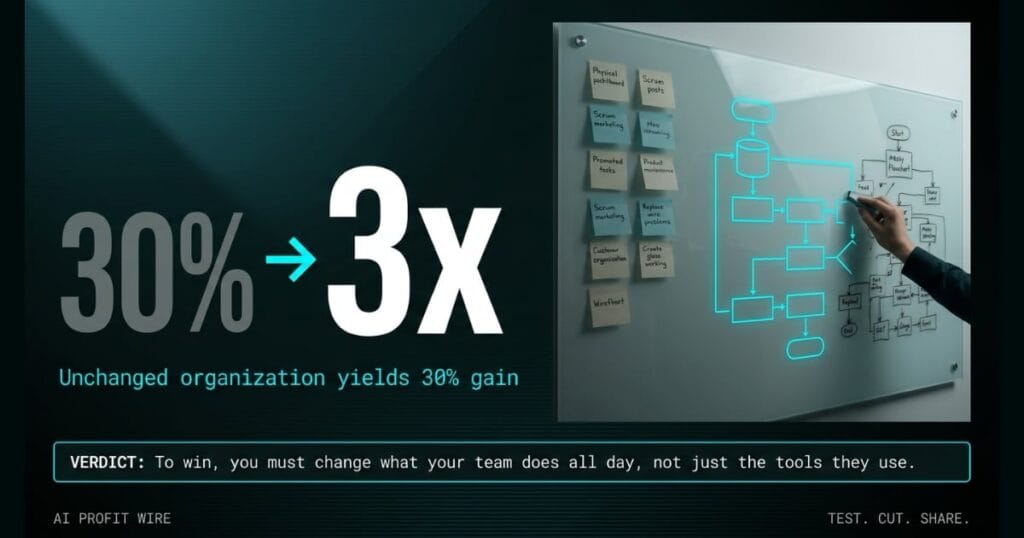
Redesigning your team's daily workflow around AI can drastically reduce project timelines and engineering costs, yielding massive operational efficiency.
What is AI-native workflow redesign and what changed?
AI-native workflow redesign means changing what your team does all day to put off-the-shelf AI tooling first, using humans to orchestrate and communicate. Instead of adding an AI layer to an unchanged organization, you restructure the actual jobs.
A software company originally planned an 18-month timeline with a 30% engineering headcount surge to rewrite a legacy product. By redesigning the engineering team organization around AI, they completed the rebuild in 15 weeks.
The new approach finished a week ahead of schedule and migrated the first 34 customers to the new platform. The team also freed up the 30% headcount surge to work on other developments.
AI-native redesign is a business change, not a technology change.
What is the evidence behind AI-native workflow redesign?
The evidence comes from HireRoad, an HR software business owned by Strattam Capital, that achieved 3x productivity gains by moving beyond the AI-sprinkle approach. The firm provided engineering teams with access to Copilot and Claude Code.
They initially saw productivity gains of 10%, then 20%, and eventually 30%. However, their companies kept getting stuck at those 30% gains until leadership changed the daily workflow.
The breakthrough happened when leaders trained the team on a new hour-by-hour daily schedule built around the power of the AI tools. The system logged bugs, wrote code to fix them, and presented the solution to a human in the loop for final judgment.
Multiplicative productivity gains require redesigning team structures, not just buying software.
How does AI-native workflow redesign compare to the alternatives, and what background do small business owners need?
The alternative is the AI-sprinkle approach, which involves providing AI tool access to an otherwise unchanged organization. This induced strategy delivers evolutionary gains of up to 30% but fails to achieve revolutionary 3x improvements.
An analogy from manufacturing shows that replacing a single steam engine with one large electrical motor delivered very little productivity gain. Productivity skyrocketed only when the factory layout was redesigned with distributed small motors.
Small business owners face the same institutional inertia that delayed the factory redesign for decades. The autonomous strategy of rewriting job definitions is uncomfortable and requires full buy-in from leadership to succeed.
You can’t sprinkle an AI layer onto an unchanged organization and expect revolutionary results.
How does AI-native workflow redesign affect day-to-day operations for small businesses?
Day-to-day operations shift from humans executing core tasks to humans orchestrating AI tools. The engineering team becomes smaller and more senior, with resources freed to work on other initiatives.
Prototypes get into the hands of clients much faster, which shortens the user feedback loop significantly. When users identify bugs, the AI logs them, writes the fix, and waits for a human to approve the publication. You can track more operational shifts like this in our AI workflow signals archive as the playbook for AI-native teams matures.
Operations move from manual execution to rapid delegation and quicker learning loops.
The pressure gauge on the industrial steam cleaner hits the red zone as a 3-car backlog builds in the detailing bay. You bought the same commercial extractor the high-volume shops use, expecting it to slash your interior detailing time. The tech runs the wand over the stained seats, but the physical layout of the bay means he wastes 15 minutes dragging hoses back and forth between vehicles.
You sprinkled a high-powered tool onto an unchanged workflow, capping your productivity gain at a measly 30%. The bottleneck isn’t the cleaning power of the extractor, it’s the outdated layout of the shop floor and the manual steps your tech takes between jobs. To get a 3x gain, you have to rip out the stationary vacuum racks and build mobile detailing carts that live next to the vehicles.
That operational remodel is uncomfortable, and it means changing what your employees do every hour of their shift. If you don’t redesign the bay, competitors with mobile units will turn cars 3x faster and slowly starve your business. Sprinkling tools doesn’t win, redesigning the work does.
What is the final verdict on AI-native workflow redesign?
The final verdict is that small business owners must redesign daily workflows around AI to achieve 3x gains. Sprinkling AI tools on an unchanged organization yields a 30% gain at best, which is a trap that leaves you vulnerable to faster competitors.
To win, you must change what your team does all day, not just the tools they use.
Source: Crunchbase AI News
