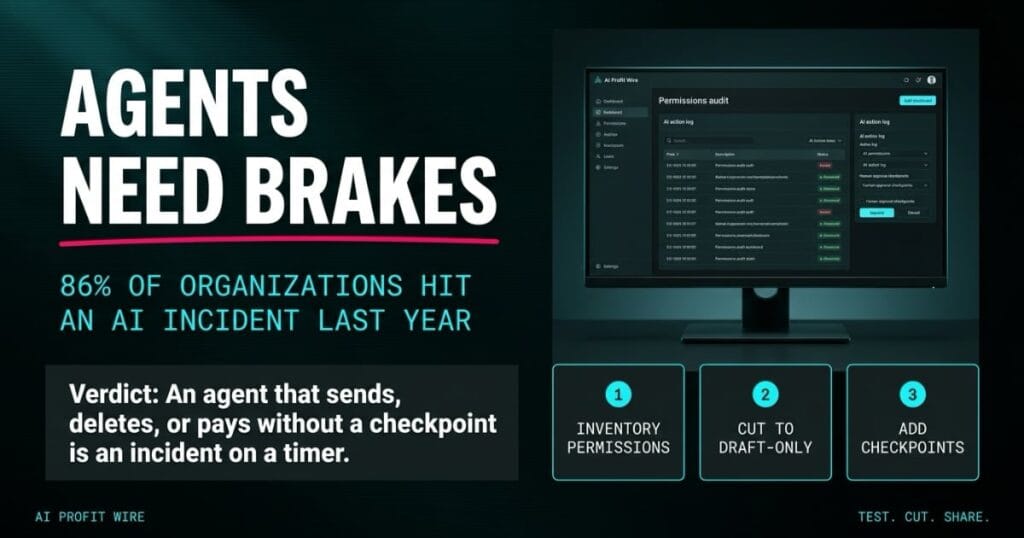
Highlights the growing operational necessity for small businesses to implement proper guardrails before deploying autonomous AI tools.
What is the OneTrust AI-Ready Governance report?
It is a survey of more than 1,200 senior decision-makers across 8 markets, published by OneTrust, an AI data privacy and security vendor, and it found that governance is not keeping pace with the speed and scale of AI adoption.
The headline number: 86% of organizations experienced at least one AI-related incident during the past year. The incident list includes IP exposure and AI agents using, delivering, and deleting data, as AI Business reported in its Q&A with OneTrust chief innovation officer Blake Brannon.
Among the organizations that hit an incident, 99% took meaningful action. 45% implemented formal AI review and approval processes, and 43% expanded monitoring or governance controls.
AI incidents have moved from an if to a when, and the budget response is governance.
Does the OneTrust report show an AI slowdown?
No. Despite calls for an AI slowdown from leaders of AI frontier labs, most enterprises are more focused on strengthening their governance than on slowing their use of AI, and most are not slowing or pausing their deployments.
The adoption numbers behind that read: 87% of enterprises encourage AI agent use, while only 47% have clear governance, oversight, and controls in place.
74% of enterprises report departmental or scaled AI adoption, yet only 5% report clear coordination and accountability across the AI lifecycle. 98% of organizations plan to increase budgets for AI governance technology over the next year.
Brannon frames the pressure from the board down, saying the number one topic boards ask about is what the company is doing with AI and whether frontier models or incumbent startups will disrupt its moat.
The slowdown conversation is happening at the frontier labs, and the deployment decisions are happening everywhere else.
How does independent AI governance work?
Brannon’s argument is that you cannot trust a model to police itself, because you must assume a model will break out of its harness and can manipulate itself into believing its actions are fine.
The fix is an independent governing agent: a separate harness that watches what the AI system and its agents do, borrowing the same separation of powers that governments and company departments use to stay bias-free.
The governing layer sits at the fixed point where the agent touches what you care about, whether it reads data from an enterprise system, sends an email, or deletes a record. Controls that used to take weeks to clear a human action now have to run in seconds for an agent action.
Enterprises will run a fragmented set of models and harnesses across marketing, customer support, and engineering, which is why OneTrust’s AI governance platform keeps the inventory, risk assessment, and policy enforcement in one place.
Govern the action at the point it touches your systems, and the model’s reasoning stops being your problem.
What does AI governance require a small business to do?
It requires a permissions audit before a policy document. List every AI tool in your stack that can take an action, and mark the ones that can send, delete, or pay.
Any agent with write access to email or customer records should be cut to draft-only until a human checkpoint exists on every destructive action. The 45% of incident-hit organizations that implemented formal review and approval processes chose the same starting point.
The notification lands at 7 a.m.: an AI support agent answered a refund request overnight, then deleted the ticket after marking it resolved. Your approval workflow clears in weeks and the agent acted in seconds, so nothing in the workflow saw the exchange. The customer got an answer, and the record that proved it is gone.
OneTrust’s survey says 86% of organizations took some version of this hit last year, and access keeps expanding. Brannon expects more agents acting than humans inside every company within 2 years, which makes the checkpoint you build this quarter the one that decides what those agents can touch.
Governance is smaller than it sounds here: a list of what can act, a checkpoint on what it can destroy, and a log someone reads. The expensive version gets built after the incident that puts AI on the board agenda.
For more on what AI tools do once they get access, the daily signal wire follows the space.
Governance is a deployment prerequisite now, and the cheapest version is a permissions audit plus a human approval step on every destructive action.
What should your business do about AI governance now?
Run the permissions audit this week, before the next agent gets write access. The report’s own timeline sets the clock: more agents than humans inside every company within 2 years, and 98% of organizations already raising governance budgets.
Cut write-capable agents with no checkpoint back to draft-only, then add the human approval step where the action fires. The full 2026 AI-Ready Governance Survey Report is worth reading for the benchmark numbers on where your governance sits against 1,200 peers.
Start with permissions and add the checkpoints now, while the agent count still fits on one list.
Source: AI Business
