Helps small business owners evaluate whether their AI development partners are building resilient agents or fragile demos.
What is the instinctools approach to AI agent development?
It is a production-first methodology that runs discovery, failure analysis, and tool hardening before any code gets written, as laid out in a technical breakdown published on the AutoGPT blog.
The engagement opens with a different question than most shops ask. Where a standard brief says what do you want to build, instinctools starts with what needs to be true for this agent to deliver business value 6 months after deployment, and that reframe shapes every later decision from task boundaries to monitoring.
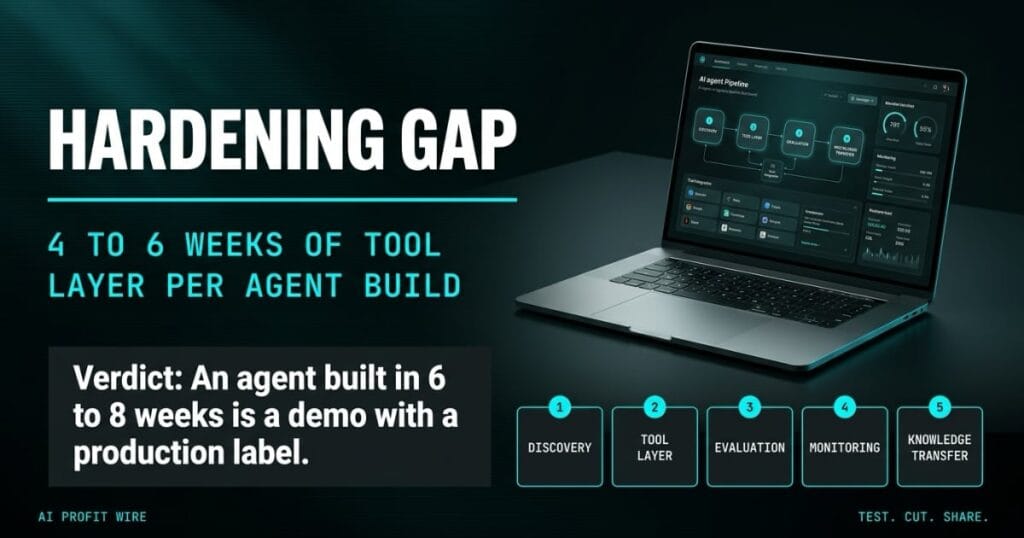
The method runs 5 phases: discovery, tool layer construction, evaluation, monitoring, and knowledge transfer. Each phase produces specific artifacts rather than status updates.
The method treats an AI agent as production infrastructure from day 1, and the phase documents are the receipts.
How long does AI agent development take?
Discovery alone runs 2 to 4 weeks, and the tool layer for a moderately complex agent adds 4 to 6 weeks on top of it.
Discovery produces 4 documents before development begins: a task boundary specification, a failure mode analysis, an evaluation framework design, and an architecture recommendation. The failure mode analysis maps each anticipated failure to its trigger condition, probability, business consequence, and handling approach.
The tool layer carries the schedule weight. An agent with 5 to 8 integrations needs 4 to 6 weeks because each integration ships with input validation, runtime authorization checks, typed error handling, retry logic with backoff, idempotency, and structured logging.
The breakdown is blunt: engagements promising full delivery in 6 to 8 weeks are either building simple agents or building tool integrations that will fail in production.
A 6 to 8 week delivery promise on a complex agent is a warning sign, and the rebuild it invites costs more than the hardening it skipped.
How is the instinctools process different from a standard agent build?
Standard projects answer the hard questions during development, which is why they hit scope changes, architecture rebuilds, and post-launch firefighting.
This process inverts the order. Performance thresholds get set by business requirements before the first line of code, test sets reflect production distribution rather than training distribution, and the edge case library exists before the agent does.
The evaluation suite tests 3 input categories: expected inputs, edge cases, and inputs designed to trigger the failure modes cataloged during discovery. When the agent misses a threshold, the investigation runs a structured path across 4 possible root causes: model, prompt engineering, training data, or tool layer.
The firm’s own AI agent development services page shows what the method produces in practice, including an insurance aggregator that cut partner onboarding from 3 to 6 months to 2 weeks and a law firm that accelerated request processing by 72%.
The difference is whether failures get anticipated in a document or discovered by your customers.
What does production-grade AI agent development mean for your business?
Any founder hiring a partner to build an agent that touches customers, money, or internal systems is buying infrastructure, and the hardening decides whether it survives contact with production.
Idempotency is the clearest example. A tool call that fails and gets retried creates duplicate effects in any system that stores state, which is why the source calls it critical for every tool that modifies state.
The contract lands in your inbox with delivery in 8 weeks printed on page 1. The demo two weeks later impresses the room, and the agent places a test order without a hitch. The 4 to 6 weeks of tool layer hardening behind a 5 to 8 integration build sits nowhere in the schedule.
Month 3 runs fine until a payment API times out mid-order and the retry fires. With idempotency in place the second call recognizes the first and holds. Without it the retry creates duplicate effects, the same order lands twice, and your support queue finds out before your dashboard does.
The 2 to 4 weeks of discovery that read as stalling is the phase that mapped this failure before any code existed. It is the cheapest line item in the entire build.
Monitoring is the part your team inherits. The standard tracks output quality on sampled production inferences, confidence score distributions, tool call analytics, escalation rates, and the business metrics the agent was built to move, with alerts configured before deployment.
Knowledge transfer decides who owns the system after the engagement. The instinctools standard seats your engineers in architecture decisions, evaluation sessions, and monitoring setup, so they can answer why the orchestration approach was chosen and how to add a new integration without calling the firm back. The daily signal wire tracks what AI tools do to small business budgets once they hit production.
The more state your agent can change, the more every skipped hardening step becomes a liability with a dollar figure attached.
What should you do before hiring an AI agent development partner?
Ask 2 questions in the first meeting: what does your discovery phase produce, and what happens when a state-changing tool call fails and retries.
A serious partner describes 4 discovery documents and a 2 to 4 week timeline, then walks you through typed error handling that treats an API timeout as a different case from an authentication failure or a rate limit. A weak partner shows you a demo reel and a 6 to 8 week delivery promise.
Ask how knowledge transfer works before signing. instinctools publishes its own delivery framework, and the standard to hold any firm to is simple: your engineers should be able to explain the architecture and add a new tool integration without calling the vendor back.
The 2 to 4 weeks of discovery is the cheapest phase in the build, and skipping it converts the savings into production failures.
Source: AutoGPT Blog
