Helps small business owners evaluate whether to build on proprietary APIs or open-source models to optimize infrastructure costs.
What Is the Open vs Closed AI Debate for Startups?
Nvidia is sending two of its own to argue the question onstage at TechCrunch Disrupt 2026, running October 13 to 15 in San Francisco. Nader Khalil, Nvidia’s Director of Developer Tech, and Sydney Sykes, the company’s Global Head of VC Partnerships, lead a Builders Stage session called “The Open vs. Closed AI Debate Is Just Getting Started.”
The session targets the decision every founder with an AI product makes in week 1: build on a proprietary frontier API for speed, or on an open model for control. TechCrunch’s session preview frames the stakes as cost, infrastructure, margins, differentiation, speed, and control, because a wrong call touches all 6.
The debate matters now because both camps carry production-grade models, and the price gap between them stopped being trivial. Nvidia is hosting the argument because it sells infrastructure to both sides.
Open versus closed is a margin decision in 2026, and the founders treating it as ideology are paying for the posture.
Are Open AI Models Closing the Gap With Proprietary APIs?
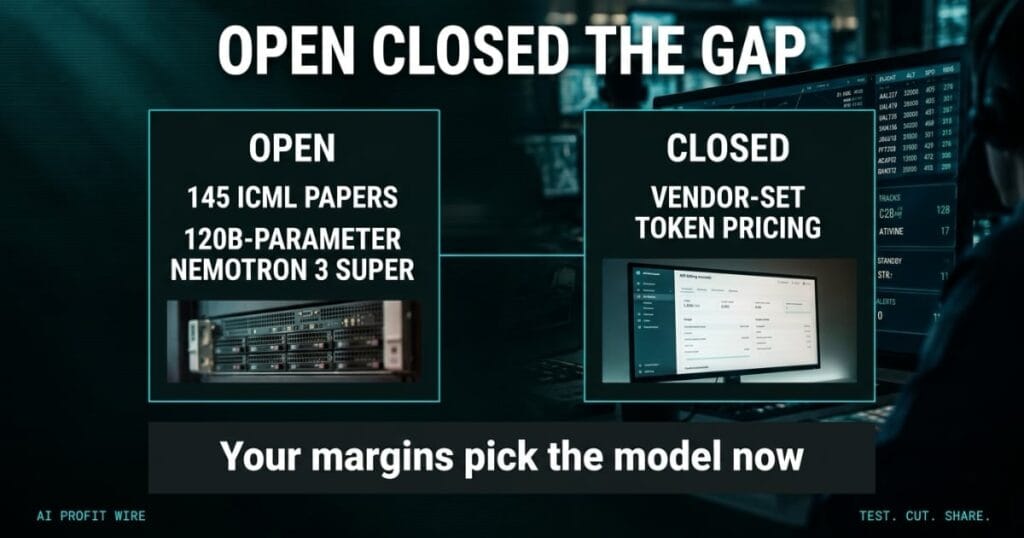
The evidence says yes, and it comes from Nvidia’s own reporting. The company said in July that 145 papers accepted at ICML 2026 cited its Nemotron open models and datasets, alongside research using other Nvidia open model families in robotics, autonomous vehicles, and biomedical work.
The open side also ships efficient flagships. Nemotron 3 Super, launched in March, is an open 120-billion-parameter model built for agentic workloads, and Nvidia claims 5x higher throughput than the prior open generation for those tasks. The model also carries a 1-million-token context window, which matters because Nvidia says multi-agent workflows generate up to 15x more tokens than standard chat.
The technical detail behind that claim sits in the open literature. The Nemotron 3 Super paper describes a mixture-of-experts hybrid Mamba-Transformer that activates 12 billion of its 120 billion parameters per query, which is how an open model stays cheap to serve at agentic scale.
Proprietary frontier labs keep pushing raw capability forward, and the honest read is that the gap narrowed without closing. The commercial question moved from “can open models work” to “which workloads deserve the premium.”
Open models now carry production workloads at a fraction of the serving cost, and the citation count says the research floor agrees.
How Is the 2026 AI Stack Different From the 2023 Playbook?
The 2023 answer was to call a frontier API, ship fast, and apologize to your margins later. In 2026 the loudest voice in the market says both, with Jensen Huang arguing at GTC that the future is “not proprietary versus open, but proprietary and open.”
Companies already run that hybrid. TechCrunch reports teams combining Nemotron 3 Super with proprietary models rather than treating the choice as binary, which matches how the deployment layer matured.
The tooling caught up too. Khalil co-founded Brev.dev, which Nvidia acquired in July 2024, and its stack lets teams deploy AI software across public cloud, private cloud, and on-premises infrastructure without locking into a single compute source.
The 2023 question was which model to bet on, and the 2026 question is which parts of each workload to route where.
Who Pays When You Pick the Wrong AI Model?
Founders pay first, because model architecture sits under pricing power. A product built on one proprietary API inherits that vendor’s price moves, and per-token costs change with no vote from the people paying the bill.
Investors pay next. If competitors can access the same proprietary API, differentiation has to come from proprietary data, workflow, distribution, or customer relationships, and a thin product layer on somebody else’s model reads as a funding risk.
Operators pay monthly. Choosing open without the team to run it converts a margin problem into a headcount problem, which is the trade the Disrupt session exists to walk through, and the trade we watch land on small teams first in the daily signals we publish.
Founders, investors, and operators each pay for this decision in a different currency, and the expensive version is the one made by default.
Your API invoice doubles while your user count stays flat, and the renewal terms arrive as a fact rather than a negotiation. That line item is the closed-model trade: speed you rented, at a price you don’t set.
The open alternative hands you a 120-billion-parameter model for the cost of running it, and charges you in discipline instead, because someone has to own deployment, optimization, and the 2 a.m. pager when inference queues back up.
The 145 ICML citations say the open side stopped being a bet on potential. The real question for a small team is which workloads earn the operational burden, and that answer changes with every pricing cycle.
What Should You Do About the Open vs Closed AI Choice Now?
Run a routing audit before Disrupt hands you the debate on a stage. Tag your AI spend by workload: which calls need frontier quality, which need speed, and which need a probability your code can branch on.
Move the high-volume, low-judgment calls to the cheapest capable option first, and keep the proprietary API where quality differentiates the product. The Nemotron model family documentation makes a reasonable starting bench for the open side of that split.
Watch the October 13 to 15 session if the decision is live for you this quarter, because the builder and venture perspectives land on the same stage with the same numbers.
Decide per workload and revisit the split every quarter, because the economics will move again before your next budget cycle.
Source: TechCrunch AI
