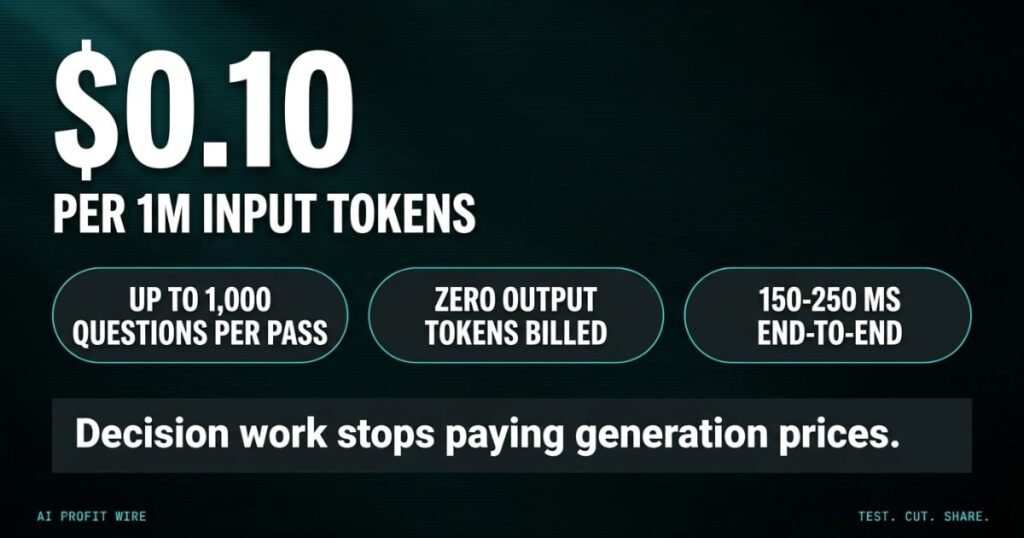
Reduces AI processing costs by eliminating output token billing for classification and routing tasks.
Google opened the Gemini Decisions API on November 11, 2026, and the read is blunt: most teams pay generation prices for work that needs a yes, a no, or a score. The new endpoint scores typed questions in a single pass instead of writing answer text.
Input costs $0.10 per 1M tokens and output tokens cost $0, with a no-cost tier in Google AI Studio for prototyping, per Google’s launch post on November 11, 2026. For a small business that routes support tickets or checks policy rules on every request, that price changes which decisions are worth automating.
What Is The Google Gemini Decisions API?
The Gemini Decisions API is a new endpoint in the Gemini API, built on the new Gemini Decision 1 model, gemini-decision-1, and available through Google AI Studio. Google DeepMind product manager Min Choi and principal scientist Felix Yu announced it on November 11, 2026, in the company’s launch post.
Developers pass one shared input across text, images, audio, video, and PDFs, up to 256K tokens, together with up to 1,000 independent questions. The API scores every question in a single forward pass and returns calibrated probabilities with confidence scores, per the Decisions API documentation.
Three question types cover the bounded choices: yes/no questions return the probability that a condition holds, choice questions pick from 2 to 255 options, and score questions grade input against an ordered rubric. Every answer carries a confidence score your code can branch on.
The Decisions API gives routing, grading, and policy checks a purpose-built path that never generates a word.
Does The Gemini Decisions API Actually Cost Less Than A Chat Model?
Yes, by a wide margin on the price line. Google prices Gemini Decision 1 at $0.10 per 1M input tokens with $0 for output tokens, and the company reports it runs nearly 5x cheaper across its shared benchmark suite than Gemini 3.5 Flash-Lite with the Interactions API.
A no-cost tier in Google AI Studio covers prototyping, and each request bills the shared input once no matter how many questions you evaluate, per Google’s launch post. Rates can change, so check Google’s pricing page before you build. There are no separate audio transcription or OCR costs and no variable thinking-token bills.
On performance, Google reports a median of 50-100 ms of model compute (150-250 ms end-to-end) for inputs up to 16K tokens, staying nearly flat from 1 to 100 questions per request. On benchmarks spanning agent routing, reasoning, ranking, and multimodal understanding, the company states Gemini Decision 1 leads across the suite with the lowest calibration error.
Calibration is the claim to watch. The API returns probabilities with a confidence score from 0 to 1 per answer, so the numbers are built to be thresholded in code, and ambiguous cases can route to a fallback or a human reviewer.
For bounded decisions, the price gap between a scored answer and a generated one is the output token bill itself.
Gemini Decisions API vs Gemini 3.5 Flash-Lite: Which Should You Use For Routing?
Use the Decisions API when the answer space is closed: tool selection, model routing, policy checks, content grading. Use a generation model like Gemini 3.5 Flash-Lite when the answer needs words a human will read.
The cost claim carries its own scope. Google’s nearly 5x comparison covers its shared benchmark suite against Flash-Lite with the Interactions API, so your workload’s mix decides how much of that gap carries over.
The launch post sets the outer limits: one shared input of up to 256K tokens and zero output tokens billed, and the Gemini Decision model page lists the rest. A routing layer fits inside those limits; a drafting assistant does not.
Score the closed decisions, generate the open ones, and the stack gets cheaper at both ends.
The scale at a shipping counter does one job: it reads a weight and points at a truck. It does not write a letter to the customer, and nobody bills you for the ink. Product teams have been paying the ink anyway, because the only scale on the market wrote a full paragraph before it answered.
At $0.10 per 1M input tokens, the Decisions API is the scale that answers without the letter. The confidence score that comes back tells your code which questions deserve a human, which is the part a busy founder can act on the same afternoon.
Wiring one routing call takes an afternoon. The savings start the first day your queue runs without writing a word it never needed.
Who Is The Gemini Decisions API Actually For?
Teams that make the same bounded call at volume: support routing, intake triage, policy checks, content grading, model-tier selection. Google’s own products show the pattern.
Gemini Notebook routes incoming queries to the right model tier and reports up to 40% lower latency on everyday queries. Stitch uses the API to generate playable wireframes in seconds and apply voice or tap edits almost instantly, and CC from Google Labs picks emoji reactions from more than 200 options in a fraction of a second.
Google Search runs the API as a safety layer for MCP tools, detecting adversarial behavior inside its latency envelope. Integrations are rolling out across OpenRouter, LangChain, Vercel, LiteLLM, Pydantic AI, Pipecat, LiveKit, and OpenCode, with support coming soon to Gemini in Google Cloud.
If your product asks the same closed question per request, this endpoint was built for that call.
How Much Does The Gemini Decisions API Cost?
Input costs $0.10 per 1M tokens across text, images, video, audio, and PDFs, and output tokens cost $0, because the model generates none. A no-cost tier in Google AI Studio covers prototyping, per Google’s launch post.
Each request bills the shared input once, and each question adds its own instruction and criteria tokens. Check the model page for caching and batch support before you plan high-volume calls.
A worked sense of scale sits in our running tracker of what small businesses pay per token across the major models. The number to model for your own case is requests per day times input tokens per request.
The billing shape rewards the workload the model is built for: one input, many questions, zero output.
Is The Gemini Decisions API Worth $0.10 Per 1M Tokens?
For bounded decisions at volume, the price is hard to beat with a generation model, since the output token line disappears. Google’s own comparison puts it nearly 5x under Gemini 3.5 Flash-Lite across its shared benchmark suite.
The honest caveats: no generated text at all, and a 256K token input ceiling. Workloads that need reasoning in prose, tool use, or long generated answers still belong on a generation model.
Prototype the swap on the free tier, instrument the latency, and watch the confidence distribution before cutting over. Our guide on tracing which workflow drives an AI API bill covers the measurement half of that move.
Worth it for closed-set calls at volume; keep generation models where the answer needs words.
What Can You Build With The Gemini Decisions API?
The three question types map onto ordinary product work: yes/no checks for policy and moderation, choice selection for routing and triage, rubric scores for grading and prioritization. A team can wire a policy check or a triage route by defining options, without training a custom classifier or waiting on a generative call.
Google’s internal builds show the range: a real-time router in Gemini Notebook, a rapid design canvas in Stitch, emoji selection in CC, and an adversarial-behavior safety layer for MCP tools in Search. Each ships features by defining options instead of training models.
For teams assembling broader automation, the API slots in as the judgment layer of an AI agent stack for a small business, deciding which agent, which tier, or which queue handles each input. The multimodal input means one call can read a photo, a PDF claim, and a text note together.
Anything your product decides with a regex, a fine-tuned classifier, or a chat prompt today is a candidate for one scored call.
Frequently Asked Questions About The Gemini Decisions API
Is the Gemini Decisions API free?
A no-cost tier in Google AI Studio covers prototyping, and the paid price is $0.10 per 1M input tokens, per Google’s launch post on November 11, 2026. Output tokens cost $0 because the model generates none.
Does the Gemini Decisions API generate text?
No. The API returns calibrated probabilities and confidence scores for typed questions, and no output tokens are billed, per Google’s launch post. Your code branches on the numbers instead of parsing sentences.
How many questions can one request score?
Up to 1,000 independent questions against one shared input of up to 256K tokens. Google reports latency stays nearly flat from 1 to 100 questions per request, for inputs up to 16K tokens.
Can the Gemini Decisions API read images and audio?
Yes. One request can combine text, images, audio, video, and PDFs, and you can tune resolution on image and video inputs to control visual detail and token cost.
Source: Google (blog.google). Last Updated: November 11, 2026. Signal Type: breaking.
