Provides small businesses with access to a low-cost, high-performance open-source AI model for office automation and workflow integration at approximately $0.90 per million input tokens.
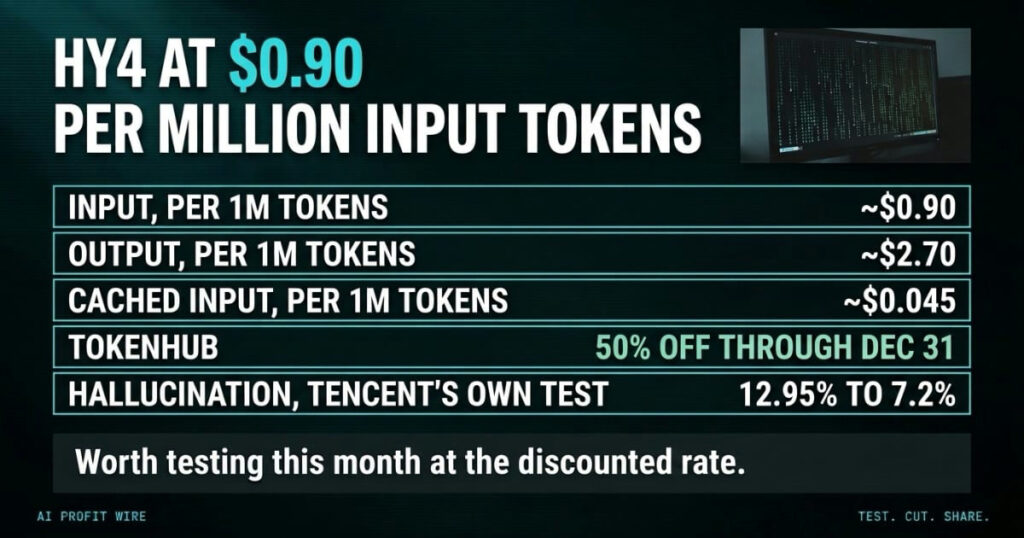
Tencent launched Hy4 on November 4, 2026, its latest open-source large language model, and held API pricing at approximately US$0.90 per million input tokens, US$2.70 per million output tokens, and US$0.045 per million cached input tokens, per the company’s own announcement checked on November 6, 2026. The model adds visual understanding and computer-use skills for the first time, cuts its internal hallucination rate from 12.95% to 7.2%, and for a team paying a premium per token, that price is the whole story.
What Is Tencent Hy4 and What Does It Do?
Hy4 is Tencent’s newest-generation open-source large language model, announced November 4, 2026, on the company’s official newsroom page. Tencent says the model now ranks among the world’s leading open-source AI models, with major improvements in instruction following, long-context comprehension, and long-horizon agentic tasks.
Two capabilities arrive for the first time in this generation. Visual understanding covers fine-grained image processing, complex chart analysis, and mathematical visual reasoning, and computer use lets the model drive both command-line interfaces and graphical interfaces to finish work tasks.
The model has specialized training on professional software, including Blender and CAD, and it ships across Tencent Cloud TokenHub, WorkBuddy, CodeBuddy, Yuanbao, WeCom’s AI assistant, and ima, with third-party API access through OpenRouter, Hermes, and OpenCode.
On the open-source promise, the announcement says model weights and system cards follow “in the coming days.” As of November 6, 2026, no public Hy4 weights page was live, while the Hy4 Preview weights have been downloadable on Hugging Face since August.
Hy4 is a launch you can test through an API today and a download you cannot make yet.
Does Hy4 Rank With the Leading Open-Source Models?
The strongest evidence is a blind evaluation Tencent’s Hy team ran with Tencent Financial Technology: 213 financial professionals, 153 of them from external institutions, scored Hy4 highest overall across 579 real-world financial tasks, at 3.04 versus 2.97 for DeepSeek-V4.1-Flash-1017 and 2.68 for both Kimi K3.1 Pro and GLM-5.3. Roughly 70% of the evaluators had more than 5 years of industry experience, and the leaderboard is published in the announcement itself.
On reliability, internal evaluations put hallucination at 7.2%, down from 12.95% in Hy4 Preview, with errors caused by unsupported assumptions falling from 23.1% to 5.6%. Financial AI company Rabyte measured a 12.03 percentage-point improvement over the Preview on the Investment Research Agent Benchmark.
Office benchmarks are strong and vendor-run: an average performance score of 83.18 and a 96.15% pass rate on WorkBuddy evaluations, with first place in 9 of 12 scenarios in the mainland Chinese market. Game development improved 19.1% in GameDev and 9.8% in GameLogic over the Preview.
The scores are real and mostly self-graded, so treat them as a reason to test, and run your own tasks before you migrate anything.
Hy4 vs DeepSeek and Kimi: What the Blind Evaluation Showed
The comparison the announcement makes is against the other leading open-source models: DeepSeek-V4.1-Flash-1017 at 2.97, Kimi K3.1 Pro at 2.68, and GLM-5.3 at 2.68, against Hy4’s 3.04 on the same 579 financial tasks. The margin over DeepSeek is 0.07 points, a narrow lead in a benchmark Tencent ran itself.
The pricing contrast is wider than the benchmark gap. Hy4 keeps the Preview’s rates of about US$0.90 per million input tokens and US$2.70 per million output tokens, and Tencent frames the model as delivering “exceptional cost-effectiveness” at that price.
A cheaper Hy4 Flash variant is scheduled for release soon, with no price published as of November 6, 2026.
For a buyer, the practical comparison is not the leaderboard, it is your own workload: a 20-task blind test of Hy4 against your current model on your real charts, documents, and agent runs costs a few dollars at these rates and settles the question with data.
Hy4 leads the published open-source scores by a nose and prices like a utility, which is a combination worth an afternoon of testing.
Who Is Tencent Hy4 For?
The capability list points at specific buyers: teams that analyze charts and financial documents, teams building computer-use automations that drive real software, and game and frontend developers working in Unreal Engine, Unity, or Godot. The WorkBuddy integration also tracks projects across chats, emails, documents, calendars, and meetings, which is where Tencent sees daily use.
Western teams get access through the API routes rather than the consumer products. Hy4 is listed on OpenRouter with a 1 million-token context window, served by Tencent Cloud, which makes it reachable with an existing API key and no Tencent account.
The security posture is documented, for what a vendor’s own review is worth: Tencent says Hy4 is trained on defensive security data, that offensive exploitation material was excluded from the training set, and that Xuanwu Lab and Keen Security Lab assessments found no significant concerns in the areas evaluated.
If your month includes chart analysis, document-heavy research, or agent workflows that touch real software, Hy4’s profile fits; if you need chat quality above all, the leaderboard does not single it out.
An API bill for an agent that reads documents all day is grocery math at scale: pennies per item, thousands of items, one total at the end of the month. At approximately US$0.90 per million input tokens, a pipeline that reads 100 documents a day at 4,000 tokens each spends about 36 cents a day on input.
Hy4 asks to be judged on that arithmetic while holding the price flat from the Preview. The model reads charts, drives software, and reports what it found, and the input side of the bill prices at utility rates.
Run the same math on your current vendor’s rate card and the renewal conversation writes itself. The output side, at US$2.70 per million tokens, is where agent-heavy workloads spend most, so measure both sides before you call it cheap.
How Much Does Hy4 Cost?
The announced rates are approximately US$0.90 per million input tokens, US$2.70 per million output tokens, and US$0.045 per million cached input tokens, unchanged from Hy4 Preview, per Tencent’s November 4 announcement. There is no seat price and no minimum, so the cost scales with usage alone.
Two discounts are live. Tencent Cloud TokenHub, the platform that serves the model, runs Hy4 at 50% off its standard pricing through December 31, 2026, and OpenRouter currently shows the discounted Tencent Cloud rate at $0.417 per million input and $1.251 per million output tokens, checked November 6, 2026.
WorkBuddy and CodeBuddy are free from November 4 to 15, 2026.
A concrete budget: at the standard rate, 10 million input tokens and 2 million output tokens cost about $9 plus $5.40, roughly $14.40 before any discount. The same load inside the 50% window costs about half that.
Hy4 costs roughly $0.90 per million input tokens at list and about half that on TokenHub through December 31, 2026.
Is Hy4 Worth $0.90 per Million Tokens?
At this price the question answers itself for any team already paying more per token for similar work. The blind evaluation and the hallucination drop give you a documented reason to try it, and the TokenHub discount window through December 31 makes the trial close to free for a bounded pilot.
The caveats are equally concrete. The flagship benchmarks are Tencent’s own, the weights were not yet public as of November 6, 2026, and the 12.03-point iRaB gain came from a third party, Rabyte, which is the strongest independent number in the set.
Route one workflow through it, keep score, and let your own task results decide the migration question.
We track model prices move by move in the API price sheet we maintain for small teams, and the workflow-level cost tracing guide shows how to attribute the bill to the jobs that caused it.
Worth testing this month at the discounted rate, worth migrating only after your own 20-task blind test beats your incumbent.
Common Tencent Hy4 Questions
Is Tencent Hy4 open source?
Tencent calls it open source and says model weights and system cards arrive “in the coming days” from the November 4 announcement. As of November 6, 2026, the public download was not yet live, while the Hy4 Preview weights have been open on Hugging Face since August 2026.
What is Hy4’s context window?
The OpenRouter listing for Hy4 shows a 1 million-token context window, served by Tencent Cloud. The announcement itself does not state a context length, so treat the listing as the source.
Where can you run Tencent Hy4?
Tencent Cloud TokenHub serves the API, and third-party platforms OpenRouter, Hermes, and OpenCode carry it. Inside Tencent’s own stack it powers WorkBuddy, CodeBuddy, Yuanbao, WeCom’s AI assistant, and ima.
When does the Hy4 discount end?
The TokenHub 50% discount runs through December 31, 2026, per the announcement. WorkBuddy and CodeBuddy are free from November 4 to 15, 2026.
Source: tencent.com
Last Updated: November 6, 2026
Signal Type: breaking
