Demonstrates practical workflows for cutting administrative and marketing overhead in property-adjacent businesses.
Heimstaden’s numbers clear the evidence bar, and the entry cost is checkable today: the ChatGPT Enterprise plan the company runs on has no public price yet, and OpenAI’s pricing page says contact sales, checked November 4, 2026. The Codex agent behind the asset work is included in ChatGPT Plus at $20 a month, and Business seats run $20 a user per month for 2 or more seats, billed with an annual plan, on OpenAI’s own Codex page read the same day. What that budget bought Heimstaden is a collapse of more than 99 percent in property image production costs and an analysis job priced at 5 people for a year, delivered by 2 people in 2 months.
What did Heimstaden actually do with ChatGPT Enterprise and Codex?
Heimstaden, a European residential real estate company, embedded OpenAI’s ChatGPT Enterprise and Codex across its core business processes after launching Enterprise in September 2025. Half of employees were using it within 2 to 3 months, according to OpenAI’s case study published November 3, 2026.
Chief Digital Officer Nikolaj Brammer frames the strategy on 3 pillars: “First, we empower employees through training and access to the right tools. Second, we have a central transformation office and a network of AI champions to drive larger AI initiatives. Third, we strengthen the foundations by making our property management systems and data models ready for AI.”
Co-CEO Helge Krogsbøl calls AI “one of the biggest opportunities to accelerate that transformation,” and the case study’s results section reads like a budget line: more than 99 percent lower image production costs in the Netherlands, 20,112 property assets assessed with Codex, and 50 percent employee adoption within 2 to 3 months of rollout.
Heimstaden rebuilt whole processes around AI, and half its employees were using the tools within a quarter.
How much did Heimstaden cut property image costs?
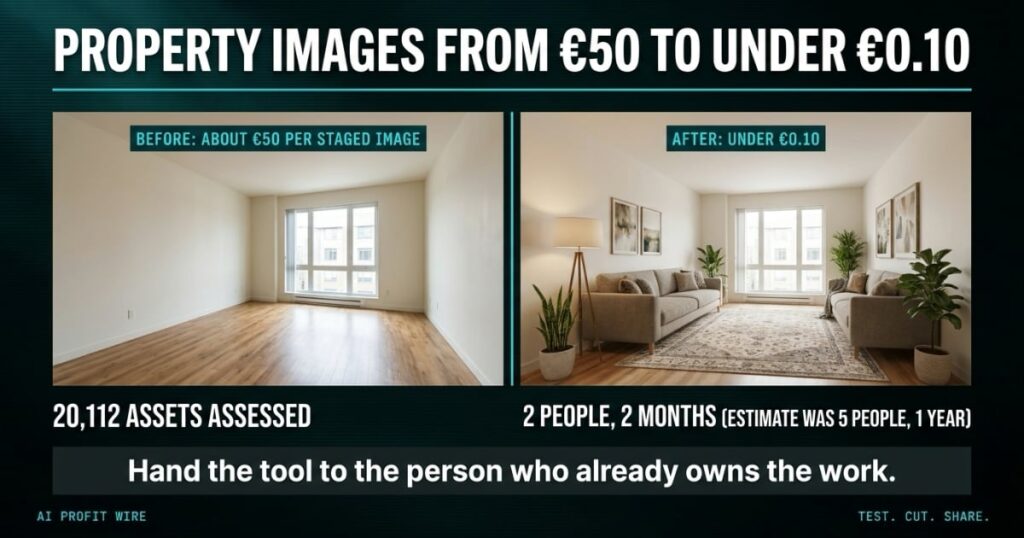
In the Netherlands, the cost of producing a virtually staged property image fell from approximately €50 to less than €0.10, which is a reduction of more than 99 percent. Heimstaden estimates annual savings potential of €130,000 in that market alone.
Pricing recommendations run through ChatGPT Sites, the same case study states, so the letting workflow covers both the images and the numbers attached to them.
The heavier proof point is the analysis work. An environmental sustainability analyst used Codex to assess 20,112 property assets and generate more than 6 million rows of useful data, and the estimated delivery requirement fell from 5 people working for a year to 2 people working for 2 months. “Codex helped us build a solution that would previously have required substantial technical support. We now own the methodology and can continue developing it ourselves,” the analyst, Julia Erlandsen, says in the case study.
Independent coverage of the rollout repeats the same figures, so the numbers are not sitting on a single vendor page.
The image number is the headline, and the €130,000 annual estimate is what a finance lead can put in a forecast.
How is this different from automating one task at a time?
The old playbook buys a tool per task: one app for listing copy, an agency for images, consultants for analysis. Heimstaden started by breaking down its most important business processes and asking where AI could create value.
“We started by breaking down our most important business processes and asking where AI could create value. Letting is a good example: it’s not about automating one task, but improving how the whole process works,” Brammer says.
The pattern reaches into operations, not only the office: in Norway, a caretaker used ChatGPT to assess a neglected apartment and draft a prioritised refurbishment plan. Employees review AI-generated content before sending it and approve decisions themselves, inside data security rules the company sets.
Heimstaden’s own leadership lesson: “AI will not fix a broken process, but it can dramatically scale a good one.”
The €50 line item wears a different label in every business. The photographer’s invoice for a product catalog, the agency retainer rewriting the same listing copy, the analyst days booked against a report 3 people read. Heimstaden’s number for that class of work, less than €0.10 per staged image, is what the line looks like once the person who owns the work runs the tool.
The part worth copying sits past the image. A sustainability analyst with a methodology problem used Codex, produced more than 6 million rows of useful data across 20,112 assets, and kept the methodology when the project closed. There is no handoff deck and no vendor holding the logic.
That is the decision an owner makes this quarter: which 1 process gets rebuilt around the person closest to it, and which keeps its €50 line item. Pick the process where the work repeats every week and the owner already knows the method.
Who is the Heimstaden playbook actually for?
The mechanism generalizes past real estate: any team with repeated content production and repeated analysis can hand the tool to the person who owns the work. The audience that should read this closest is senior software, IT, consulting and financial services teams, because the pattern is a process decision, not a real estate tactic.
If you are weighing which AI agents a small team can stack, this case is the argument for putting the pipeline builder first on that list.
Adoption is the telling number: 50 percent of employees within 2 to 3 months, extending to caretakers, including sceptics, per the case study. A tool nobody uses saves nothing, and this one got used.
Hand the tool to the person who already owns the work, and adoption stops being a rollout problem.
How much does ChatGPT Enterprise cost?
ChatGPT Enterprise has no public price. OpenAI’s pricing page says contact sales for Enterprise, checked November 4, 2026, so treat any third-party dollar figure for the plan as a tracker’s guess.
The self-serve route is public and dated the same day: Codex is included in ChatGPT plans, with Plus at $20 a month, Pro from $100 a month, and Business at $20 a user per month for 2 or more seats on an annual plan, per OpenAI’s pricing and Codex pages. If you are pricing an API build instead, what OpenAI models cost at API prices is the page to check.
The Enterprise page adds admin controls, analytics, compliance tooling and 24/7 support with SLAs, and OpenAI states its business data is not used to train its models by default. OpenAI also claims over 5 million business users across industries on that page.
Test the workflow on a $20 seat, and move to Enterprise when admin controls and compliance reporting, not price, become the constraint.
What is Amplio Estate and what comes next?
Heimstaden is co-developing Amplio Estate, a property management system designed to support AI-powered workflows through MCP, according to the case study. The stated goal is employees using AI such as ChatGPT to retrieve property information and take action in core business systems, with appropriate human oversight.
Closer to today, a Procurement Intelligence Platform is rolling out now: workflow automation combined with OpenAI models accessed through APIs, designed to work across Outlook, SharePoint and Teams on contract analysis, negotiation preparation and contract lifecycle management. Employees keep responsibility for commercial decisions and approvals.
Both systems are in development or rollout as of the November 3, 2026 case study, so treat them as roadmap, not shipped product.
The direction is agents that act in business systems, and the audit trail stays human: people approve what the system does.
What should a small business take from the Heimstaden case?
Pick 1 process with a repeating cost and a clear owner. Map it end to end, give the owner the tool, and measure cost per unit before and after: that is the whole playbook, and it is what Heimstaden did with letting.
The test budget is small and public: $20 a month on Plus or $20 a seat on Business on an annual plan, per OpenAI’s pages as of November 4, 2026. The Enterprise conversation starts when security reviews and admin controls matter more than the per-seat price.
Do not buy seats first and map later. The company’s own stated lesson is that AI will not fix a broken process, and a process map costs a whiteboard session, not a subscription.
Spend the first $20 on the process map, and let the seat count follow the workflow.
Heimstaden’s AI rollout: quick answers
When did Heimstaden start using ChatGPT Enterprise?
September 2025, per OpenAI’s case study. 50 percent of employees were using it within 2 to 3 months of that launch, and adoption extended to real estate caretakers, not only office staff.
How many property assets did Heimstaden assess with Codex?
20,112 assets, generating more than 6 million rows of useful data. The estimated delivery requirement fell from 5 people working for a year to 2 people working for 2 months.
How much does a virtually staged property image cost now?
Less than €0.10 in the Netherlands, down from approximately €50, a reduction of more than 99 percent. Heimstaden estimates €130,000 a year in savings potential in that market alone.
Does Heimstaden review AI output before it goes out?
Yes. Employees use approved tools within data security rules, review AI-generated content before sending it, and approve decisions, per the case study.
Source: OpenAI Blog
