Provides small businesses with free, high-performance open-source AI models to fine-tune local applications without cloud subscription fees.
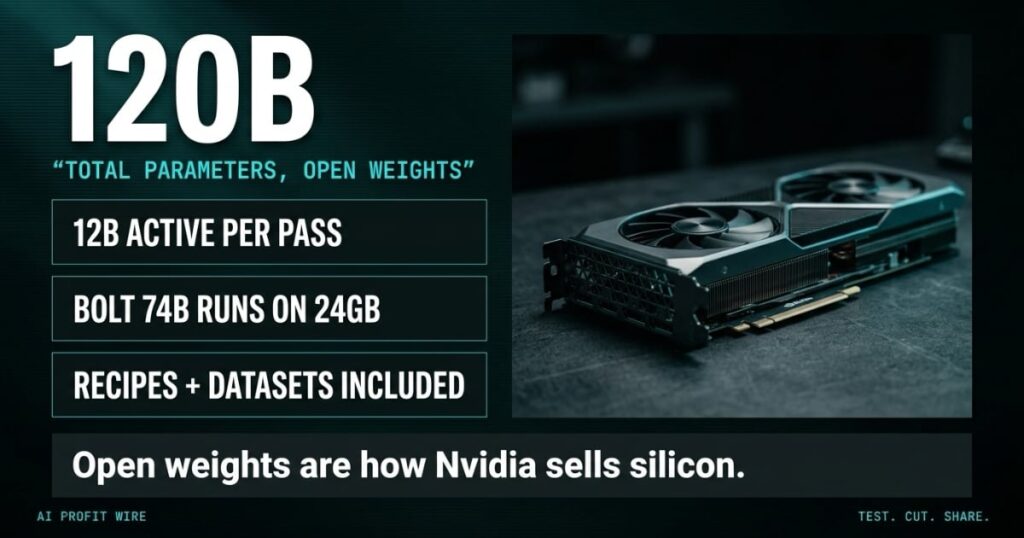
Nvidia released 3 new Nemotron 3.5 models as fully open weights this week, led by a 120-billion-parameter vision-language model. Super VL and the Bolt 74B variant are downloadable on Hugging Face now, and the smaller Bolt E4B lands Oct 23.
What is Nvidia Nemotron 3.5?
Nemotron 3.5 is Nvidia’s open model family, and this release adds Super VL plus 2 Bolt variants. Super VL is a 120-billion-parameter vision-language model with 12 billion parameters active per forward pass, built for reasoning, coding, tool use, document understanding and video understanding.
The Bolt variants trade size for footprint: Bolt 74B-A9B runs local agentic workloads from 24GB of memory using native 2-bit quantization, and Bolt E4B is optimized for conversational agents at 4GB. Nvidia’s announcement lists DGX Spark, DGX Station, RTX PRO workstations and the new RTX Spark laptops among the supported machines.
This is the first Nemotron release since Nvidia open sourced its Run.ai GPU orchestration platform earlier the same week, and it follows the fully open Nemotron 3.5 Lightning from August.
3 fully open models spanning a 4GB to 120B footprint, 2 downloadable today and the small one landing Oct 23.
Does Nemotron 3.5 deliver 8x more users at 85% lower latency?
The 8x and 85% figures come from Nvidia’s own claims for its Dynamo serving stack, so read them as the vendor’s ceiling under favorable conditions. The same goes for the 5x faster throughput Nvidia reports for Super VL on the Artificial Analysis Intelligence Index, and for Bolt 74B-A9B ranking as the #1 open model in its class on PinchBench.
The checkable part is the packaging: weights, training datasets and recipes are published, and the Bolt 24GB model card on Hugging Face documents support for llama.cpp, Ollama, LM Studio, Unsloth and vLLM. Nvidia also says Super VL trained on 26 trillion tokens, which puts the data release in serious territory.
Omdia analyst Alexander Harrowell told AI Business that the Super VL and Bolt architecture enables better memory scaling and a bigger context window, which agentic workflows consume. He named the remaining bottleneck too: enterprises getting used to packaged software running locally again, rather than only in the cloud.
The efficiency numbers are vendor-sourced, but the open packaging is verifiable today on Hugging Face.
Is Nemotron 3.5 good enough to replace a paid model API?
The comparison set moved on from Meta’s 405-billion-parameter Llama generation in 2024 to the current wave of low-cost Chinese open-weight models. Harrowell said he sees developers right now talking about replacing Alibaba’s Qwen 3.6 35B with Nemotron Bolt straight away.
For routine conversational and agentic tasks, the 24GB and 4GB footprints are sized for machines you already own, which removes the per-token meter from the equation. Accuracy on your specific workload is the open question, and only a local benchmark run answers it.
Replace the API where the task is routine and the hardware exists, keep the paid model where accuracy justifies the meter.
The invoice for agent tokens arrives bigger every quarter as workflow volume grows, while a machine in the corner runs background jobs all day on hardware the business already depreciated. Nemotron’s smallest Bolt variant needs 4GB of memory to carry a conversational agent, which is less than the game client half your team leaves open.
The weights are a download now, so the negotiation moves from procurement to the hardware drawer. Check what your current GPU can already carry before you renew anything, because Nvidia’s whole play is to make sure that answer runs on its silicon.
Who is Nemotron 3.5 actually for?
Developers hunting for an open base model for code and customized agents are the audience Harrowell identified, and the 12B active parameter design gives them the bigger context windows agentic work needs. Small businesses get the same release without a license conversation, since the model card permits commercial and non-commercial use.
This release joins the other open weight releases we’ve tracked this month, and the direction of travel is clear: Nvidia’s Nemotron hub documents 10T+ tokens of open training data across the family, with weights, datasets and recipes published for evaluation before any production commitment.
If your agents are routine and your hardware is idle, this release is aimed directly at you.
Should you run Nemotron 3.5 instead of paying for API tokens?
Price the decision in 2 numbers: your monthly per-token spend, and the memory footprint of the smallest model that passes your quality bar. A model that fits existing hardware turns a recurring line item into a download.
The license conversation is already over: commercial use is permitted at $0, so the real cost lines are memory, power, and the hour it takes to run the first benchmark. Keep the closed API for workloads where frontier accuracy pays for itself, and Nvidia open sourced its Run.ai orchestration platform the same week, which signals where it wants the management layer to live.
Run the routine workload locally, keep the meter only for the work that earns it.
Source: AI Business
