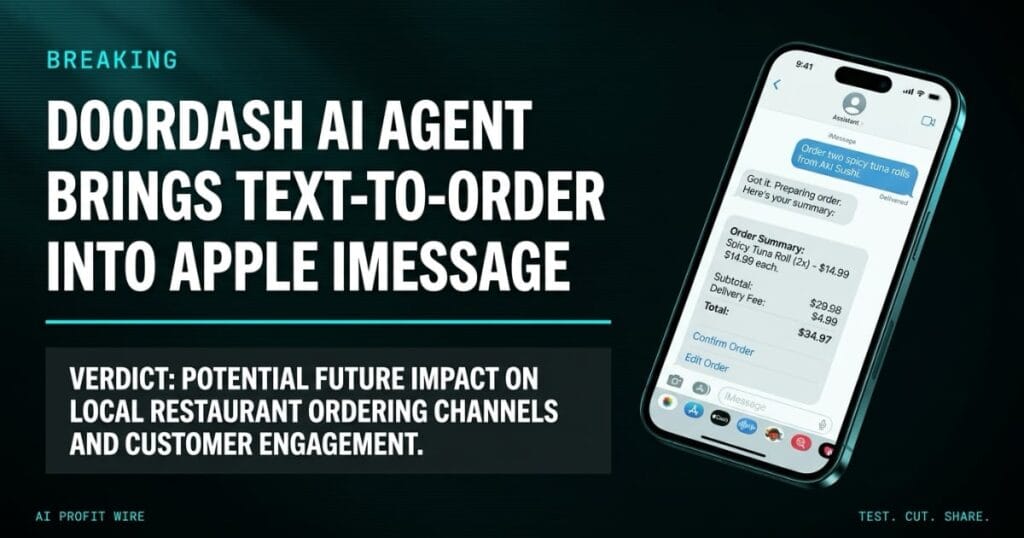
Potential future impact on local restaurant ordering channels and customer engagement.
DoorDash has unveiled an AI agent that takes food orders inside Apple’s Messages app, with a waitlist now open to US-based customers. The agent reads a text like “order my usual protein bowl to the office” and completes the order without the DoorDash app opening.
What Is The DoorDash AI Ordering Agent?
The agent is a text-to-order service built into Apple’s Messages, announced in a statement on September 30 and shown at DoorDash’s Dash Forward event in San Francisco the day before. US customers can join the beta through DoorDash’s Text waitlist while the service moves toward general availability.
The mechanics carry the real change. The agent matches the sender’s phone number to a DoorDash user profile, which gives it the order history and preferences attached to that account, and checkout runs on the stored payment method without the app opening.
Ordering becomes a text message, and the profile, not the app, does the work.
Does The DoorDash Agent Really Work Without The App?
That is DoorDash’s claim, and its own launch announcement spells out the mechanism: text what you want, the agent finds it, builds the cart, and manages checkout inside the thread. A text of “order my usual” pulls the standing order with its modifiers, the skipped cilantro, the extra sauce, straight from account history.
The numbers behind the assistant family say the demand is real. Ask DoorDash, the in-app predecessor, saw users discover more than 40,000 new restaurants in its first 3 months, with almost half of those restaurant orders going to local spots consumers had never tried, and over 30% of its grocery orders are routine restocks. Bloomberg’s report frames the launch as DoorDash stepping up its integration of personal AI assistants ahead of its e-commerce rivals.
The appless order is the claim to watch: profile matching does the work the app interface used to do.
How Is Ordering In Messages Different From The App?
The app path asks the customer to open, search, scroll, configure, and pay, every time, even for an identical reorder. The Messages path assumes the repeat case: the agent already knows the usual order, the delivery address, and the payment, and it asks for confirmation instead of navigation.
That split changes where the transaction lives. A checkout that runs inside an existing conversation competes with every app that demands its own session, and repeat-order volume is where the margin sits in any delivery or subscription business. Co-founder Andy Fang’s framing in the announcement is a personal shopper: managing tasks like ordering lunch or groceries shouldn’t feel like work. The agent also handles group orders with mixed dietary preferences and different quantities in one thread, work the app path forces through separate carts.
The app owns discovery; the conversation owns the reorder.
The counter phone at an industrial supply distributor rings every Tuesday with the same voice ordering the same hydraulic fluid, the same filters, the same case of grease. The rep has the account open before the caller finishes the sentence, because the account number holds the whole history.
DoorDash built that rep into a text thread. “Order my usual protein bowl to the office” works because the phone number carries the account, the same way the rep’s screen does.
The counter never asked the Tuesday caller to download anything. It answered where the call already was.
Who Is The DoorDash Messages Agent For?
On the surface, the agent serves DoorDash’s own repeat customers, and the waitlist is limited to US-based accounts. The signal for anyone running a business is the pattern underneath: the buyer’s identity travels with the conversation, so the transaction no longer requires a destination the seller controls.
For teams selling to businesses, the comparable move is meeting customers in the channel they already use, with account context attached. Putting an AI chat where your customers already write to you is the small business version of the same play, and it does not require building an agent from scratch.
The audience is repeat buyers, and the mechanism is identity attached to an existing conversation.
What Should Small Business Owners Do About AI Ordering Now?
Map your buy path this week. Count the screens between a returning customer wanting your product and paying for it, then mark every screen that exists because your system does not recognize the customer. That count is your friction bill, and the Messages agent sets the reference point for how low it can go.
The practical version for most small teams is not a custom agent. It is connecting the channels you already have, site chat, messaging, and email, to account history so returning customers stop re-introducing themselves at checkout.
Count the screens, and cut the ones that exist only because you do not recognize your own customer.
Source: Bloomberg Tech
