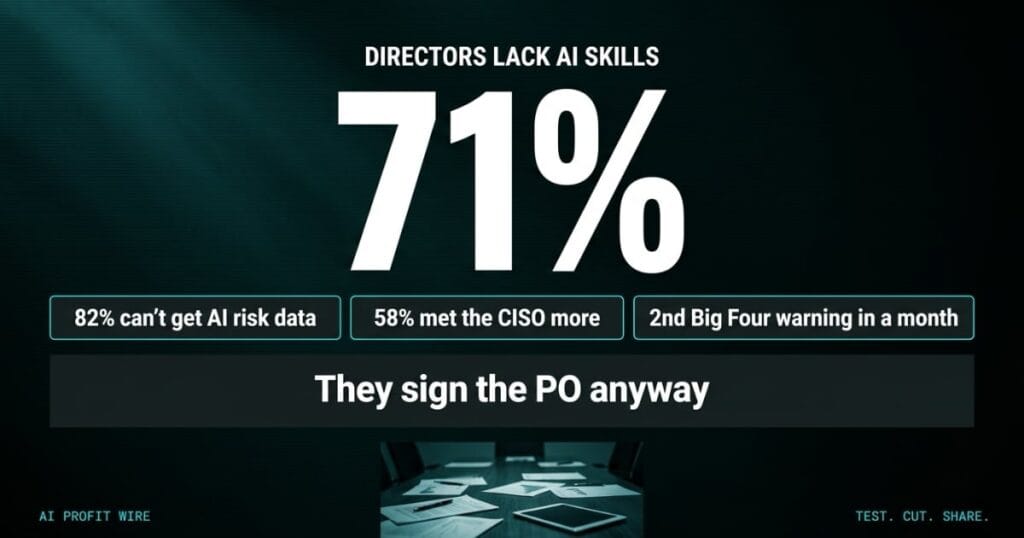
Highlights a critical need for leadership training and risk management before deploying AI tools.
What Is the PwC Directors Survey and Who Did It Poll?
PwC’s 2026 Annual Corporate Directors Survey polled public company board members between March and May 2026, and Bloomberg’s AI Today newsletter led with its sharpest finding: close to 3 quarters of directors say they lack sufficient skills to understand AI issues.
Bloomberg Law’s coverage adds the precision: 71% of directors identified AI as the top skill their boards needed to strengthen, more than twice the second answer, technology and digital transformation. The survey runs through PwC’s Governance Insights Center, the firm’s board research arm, which publishes the directors study every year.
Paul DeNicola, principal at that center, put the finding in operational terms: job one for the board is oversight of strategy, and AI presents what he called daily pivoting points to strategy.
The people accountable for AI oversight have told their own surveyor they can’t read what they’re approving.
Is the AI Skills Gap on Boards Actually That Wide?
The number holds up across the survey’s own breakdowns. 71% name AI as the board capability most in need of strengthening, and 82% of respondents rate the information connecting AI risk to business performance as fair, poor or unavailable.
Board behavior shows the gap is not abstract. 58% of boards increased contact with their chief information security officer over the past year, and more than two-thirds cite cybersecurity, data privacy and intellectual property as their top AI-related concerns.
The pattern is the second Big Four warning inside a month, after an EY survey of corporate AI leaders covered the same shortfall.
Directors reported the gap themselves, and the report came with a number: 71%.
How Does the AI Skills Gap Compare to Other Board Priorities?
AI towers over the rest of the list. 71% of directors put AI at the top of the skills their board needs to strengthen, which is more than double the share citing technology and digital transformation, the second-place answer.
The survey also records where boards turn instead: 58% met their CISO more often over the past year. Bloomberg flags the behavioral ceiling, directors who value getting along over forcing changes around the table, and that instinct shapes what gets challenged in the room.
When the top gap runs at more than double the runner-up, the gap becomes the agenda.
Where Does the AI Skills Gap Show Up First?
It shows up at renewal time. The decision to keep paying for an AI tool lands on the same people who told PwC they can’t evaluate one, and 82% of them rate the risk data they would need as fair, poor or unavailable.
It also shows up in the questions that never get asked: what the tool retains, which model answers, and what happens when it’s wrong. Readers tracking these governance shifts as they land can follow the daily signals log for the pattern across vendors.
The gap costs nothing until the renewal meeting, and then it costs the whole contract.
The renewal lands on a Friday slot nobody prepared for, an AI writing tool the whole team already uses, and the person closest to the contract is the office manager who signed the trial a year ago. The demo looks fine, the price moved up, and nobody in the room can say what the vendor’s model does with the drafts it ingests.
PwC heard the same room at public-company scale: 71% of directors name AI as the skill their board most needs, and the ones who can’t read the risk still sign. The dynamic survives every size reduction, because the approval chair is the chair, whatever the headcount.
The fix at small scale is the motion the survey’s better boards are already making: 58% pulled their security officer closer this year. Pull your one technical reader into the renewal, and the unexamined line item stops being unexamined.
What Should You Do About the AI Skills Gap Now?
The cheapest version of the fix is structural. Route the next AI purchase through one person who can read a model card and a data policy, and give that person a real veto.
Bloomberg Law notes there is no single definition of AI expertise and no one path to building it. The options boards are weighing include outside advisers, training existing directors on AI risk, or nominating new directors with AI expertise, though some board consultants see stacking issue-specific directors as a weak fix.
The second move is borrowed from the 58%: put your security lead in the room before the signature, not after the incident. PwC’s DeNicola frames the board’s job as oversight of strategy, and AI now moves that strategy daily.
The approval step is the cheapest place to close an expensive gap.
Source: Bloomberg AI Today and PwC, 2026 Annual Corporate Directors Survey
