Systeme.io vs ClickFunnels 2026: The Same $97 Buys Two Different Things Intelligence Report
In This Report
Almost every comparison of these two tools frames it the same way: Systeme.io is the cheap one, ClickFunnels is the expensive one. That framing is wrong, and it costs people money in both directions.
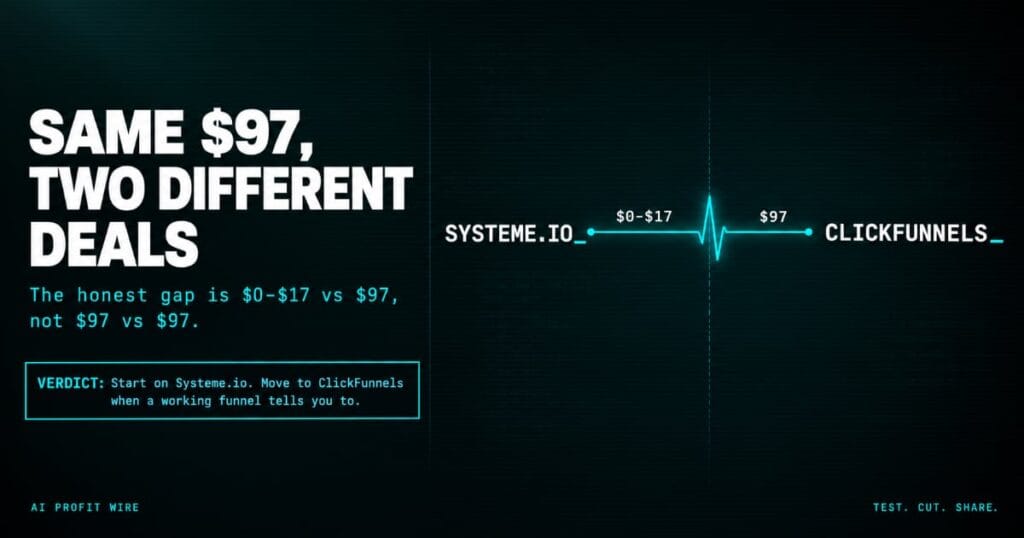
Here is the number that reframes it. Systeme.io Unlimited costs $97 a month. ClickFunnels Launch costs $97 a month. At the top of one product and the bottom of the other, the price is identical. So the real question is not which is cheaper. It is what you get for the same $97, and whether you need to be spending $97 at all.
Systeme.io scores 7.3/10 on the Hype Check. ClickFunnels scores 6.5/10. Both are real products with real users. This page compares them on the four things that actually decide the purchase: year-one cost, what the money buys, conversion performance, and the billing terms each one holds you to.
Disclosure: Metadata Marketer earns a commission if you purchase through links on this page. This does not affect the Hype Check score or editorial assessment.
What does each one actually cost in year one?
This is where the gap is real, and it is at the entry point, not the ceiling.
Systeme.io starts at $0 with a genuine free plan: 2,000 contacts, unlimited email sends, 3 sales funnels, 1 course, and unlimited file storage, with no credit card required. The catch is that the free plan cannot collect payments, because Stripe and PayPal integration is a paid-tier feature. Paid plans are Startup at $17/month, Webinar at $47, and Unlimited at $97.
ClickFunnels has no free plan at all. It runs a 14-day trial, then Launch at $97/month, Scale at $197, Optimize at $297, and Dominate at $5,997 billed annually with no monthly option. Annual billing on Launch drops the effective rate to about $81/month.
Run year one on a solo operator validating a first offer. Systeme.io Startup at $170 billed annually. ClickFunnels Launch at $970 billed annually. That is an $800 difference in the first twelve months, before either has proven it can sell anything.
The honest cost gap is not $97 versus $97. It is $0 to $17 versus $97, because that is where a business actually starts.
Is ClickFunnels worth $97 when Systeme.io Unlimited is also $97?
At matched price, this is the comparison that matters, and the answer depends on which features each pricing page actually puts on the plan.
ClickFunnels’ pricing page checks A/B Testing and Smart Checkout on all 4 plans, Launch included, and its sales funnels page describes upsell and downsell pages as part of the builder. The support documentation shows how to add order bumps to a funnel step, without saying which plans include them. What the pricing page does gate is automation: Automations, the Custom Code Editor, and Webhooks and API start at Scale, $197 a month. The higher tiers also buy contact volume, email volume, team seats, and the Affiliate Center.
That is a genuine point in ClickFunnels’ favor: A/B testing and a checkout built to raise order value come on the entry plan. Anything that runs on Automations means budgeting for Scale at $197, not Launch.
Systeme.io Unlimited at the same $97 removes every cap instead: no contact limit, no funnel limit, no email limit, no automation limit, and 0% transaction fees. It also includes built-in affiliate program management at every tier including the free one, which ClickFunnels gates behind its higher plans. Where it loses is funnel depth and polish, which is why the conversion test below matters.
At $97 you are choosing between unlimited volume with simpler funnels, or capped volume with deeper funnels. Neither is the obvious winner, and that is why the entry price matters more than this tier does.
Which one converts better?
There is one independent test worth citing, and it does not favor the cheaper tool.
A 90-day independent test by BlogRecode measured funnel conversion at 3.2% on Systeme.io versus 4.1% on a premium tool stack. That is a 22% relative drop, and the likely cause is page speed. Systeme.io’s own public roadmap carries an open request to improve loading speed on funnel and blog pages, and a third-party paid tool exists purely to optimize Systeme.io page speed.
ClickFunnels is not immune here either. Forbes Advisor rated it 4.3/5 and listed slow page-load speeds as its top con. So this is a category problem, not a Systeme.io-only problem, but the one measured head-to-head number available favors the premium stack.
Do the math before it changes your mind. On $10,000 of funnel traffic value, a 22% relative conversion drop is real money. But it takes a lot of volume before that gap outweighs an $800 first-year cost difference, and a business validating its first offer does not have that volume yet.
Systeme.io converts measurably worse in the one independent test available, and the savings still win until your funnel is producing enough revenue for a 22% swing to cost more than $800 a year.
What are the billing traps on each one?
Both have them. They are different in kind, and the ClickFunnels ones are more expensive when they fire.
Systeme.io: subscriptions are explicitly non-refundable per Article 3 of the Terms. Crossing a plan’s contact limit triggers 3 warning emails, 1 a day, and a dashboard alert first, then on day 4 an automatic move to the next tier on a paid plan, or paused opt-ins, campaigns and automations on the free plan, per Systeme.io’s help documentation. PayPal upgrades charge the full new price with no proration. And when Startup dropped from $27 to $17 in May 2025, existing subscribers were not moved to the lower rate automatically, they had to switch plans manually.
ClickFunnels: the pricing page displays the annual-billed rate as the headline number, so users who do not toggle can commit to a $970 annual charge instead of $97 monthly, and it lands on day 15 of the trial. Refunds run 30 days, and multiple Reddit users report being refused refunds on annual charges beyond that window, including one reporting an $1,800 annual charge that was not refunded. Email sends above quota cost $0.675 per 1,000, with no explicit warning interface. And there is one that affects nobody but affiliates: if a referred account downgrades below $97/month, the affiliate association is forfeited permanently.
Systeme.io’s traps cost you a plan tier. ClickFunnels’ traps cost you $970 or more in one charge, and the 30-day refund window is the shortest safety net of the two.
Who should choose Systeme.io?
Four profiles, and they cover most of the people asking this question.
Anyone who has not yet sold the thing they are building a funnel for. The free plan lets you build and validate at $0, and $17 turns on payments once someone actually wants to buy. Coaches, consultants, and course sellers who need landing pages, email, and checkout in one place without a WordPress install. Newsletter operators adding a monetization layer behind an existing audience. And anyone currently paying for a ConvertKit plus ClickFunnels plus Teachable stack at $200 to $300 a month, where consolidating to $17 saves roughly $2,800 in year one.
If you have not proven the offer sells yet, Systeme.io is the correct answer, because $0 to $17 is the right amount to risk on an unproven funnel.
Who should choose ClickFunnels?
Three profiles, and they are all past the validation stage.
Businesses already earning from a funnel, where a 22% conversion difference is worth more than $800 a year. Operations that want ClickFunnels’ funnel templates and checkout depth, and are ready to move to Scale at $197 a month once they need Automations, webhooks and API access. And brand-first businesses selling at premium price points, where template polish is part of justifying the price.
One caution worth pricing in: ClickFunnels’ most recent published annual revenue is roughly $170M for 2024 per the Latka database, down from a vendor-cited $265M peak in 2023. That is not a reason to avoid the product, but it is a data point on trajectory that no other review mentions.
Choose ClickFunnels when the funnel is already making money and the funnel mechanics are the constraint, not the software bill.
Systeme.io vs ClickFunnels: the verdict
Start on Systeme.io. Move to ClickFunnels only when a working funnel tells you to.
Systeme.io scores 7.3 and ClickFunnels scores 6.5, and that 0.8 gap is almost entirely the entry price. ClickFunnels builds a deeper funnel and puts A/B testing and Smart Checkout on its $97 plan, though Automations start at Scale. But it charges $970 in year one to find out whether your offer sells, with a 30-day refund window and a pricing page that defaults to the annual commitment. Systeme.io answers the same question for $0, then $170.
The sequence that costs least and risks least: validate free on Systeme.io, upgrade to Startup at $17 when someone pays you, stay there until the funnel is producing real revenue, and only then price out whether ClickFunnels’ funnel depth and conversion edge earn back the $800 difference. Most businesses never reach that point, and the ones that do will know it from their own numbers rather than from a review.
Start Systeme.io free here, no credit card required. For the full 5-dimension breakdown of each, see the Systeme.io Intelligence Report and the ClickFunnels Intelligence Report. For how both fit a complete lean stack, see our best AI marketing platforms for small business roundup. For the methodology behind every Hype Check score, see the Pipeline page. For weekly verified intelligence, subscribe to The AI Profit Wire.
