Dramatically lowers the cost of automated text classification, spam filtering, and content categorization tasks for small businesses.
What is Jev?
Jev is the first model in a category its maker, TypeSafe AI, calls System One models, and it flips the standard LLM contract: unstructured state in, typed probabilistic decisions out. Instead of generating prose, the model returns floating point numbers for categories, ratings, yes/no questions, and confidence scores, with yes/no confidence landing between 0 and 1.
TypeSafe describes it as a frontier-intelligence function call. You compose a state object from a string, an array of strings, or name-value pairs, send it with one or more questions, and get a score back for each.
3 question types exist: yes/no “Noul” questions, which TypeSafe’s CEO confirmed on Hacker News is short for Bernoulli, choice questions that return a probability distribution across options, and score questions along a numeric range you define. Every answer type carries an associated confidence score.
Jev replaces generative text with typed decisions, and that single change rewrites the cost model.
Is Jev cheaper than GPT-5 Nano?
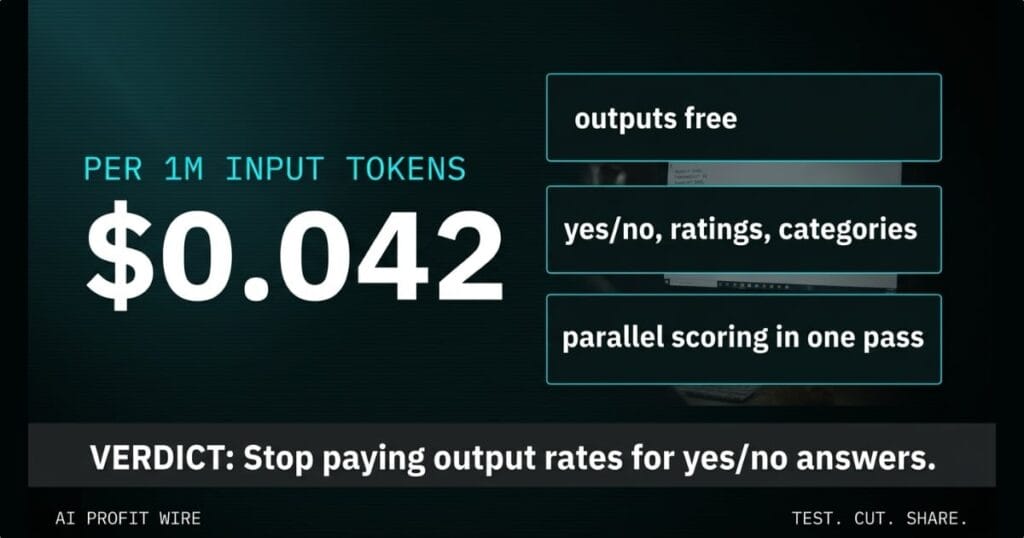
On input pricing, yes. Jev’s first model charges $0.042 per million input tokens, under GPT-5 Nano’s $0.05, and output tokens cost nothing because there is no text to generate.
Regular LLMs bill output at far higher rates than input, and classification work pays that premium for answers that fit in a single number. A spam score carries the same output bill as a full paragraph of generated text.
Speed compounds the price gap. Questions evaluate in parallel against one document inside a single context window, so a batch of 100 questions takes about the time of 1, and TypeSafe positions the model as 2 orders of magnitude faster than comparable LLMs on decision tasks.
For high-volume classification, Jev is a different pricing category rather than a discount.
When is Jev better than an LLM for classification?
Use it when the deliverable is a decision, not an explanation. Spam detection, label suggestion, prioritization, and ranking all fit, and the output price on those workloads drops to zero.
Search reranking is a worked example from Simon Willison’s writeup: fetch 100 candidate results with a cheap BM25 pass, then have Jev score all 100 against the query in one call. That replaces a per-result LLM prompt with a single batched decision.
The trade is explainability. A regular LLM can be asked why it flagged something, and Jev returns a number with no reasoning trail, which pushes the audit burden onto your evals and structured experiments.
Jev wins on volume work where the number is the product, and the LLM keeps anything that needs to show its work.
Who should use Jev decision models?
Engineering teams and founders processing high volumes of text categorization, spam filtering, and data labeling are the natural users. Teams that already run serious evals will integrate it fastest, because the same discipline transfers to scoring outputs instead of reading them.
Bias testing deserves the same seat at the table. Willison flagged job applicant ranking as a use case to avoid until the bias surface is mapped, and his own city test returned Cupertino at the top and East Palo Alto at the bottom with nothing in the output explaining the spread.
If you follow where per-token economics are heading, the running archive of AI pricing and model signals tracks the moves that matter.
High-volume classifiers with an eval habit get the most from Jev on day one.
A billing lead wires a $0.042-per-million classifier into the invoice intake queue, and the first month of sorting costs less than one mis-sorted payment would. The savings report reaches the CFO in week 2, and nobody asks what the model attached to its verdict, because nothing was attached.
By month 3 a vendor payment sits rejected and no one can reconstruct why, since the reasoning trail a generative model would have written never existed. The remediation hours eat the token savings, and the fix is the eval suite that should have shipped with the integration.
The cheap decision stays cheap when the audit exists. Budget the evals as a line item, because the model will not explain itself at any price.
Should you switch text classification to Jev?
Test it before you commit anything, and let the pricing carry the experiment. Running hundreds or thousands of prompts through Jev costs a few cents, so the eval suite is cheaper than the meeting that approves it.
Start with one high-volume classification job that has a measurable accuracy bar, run it beside your current model for 2 weeks, and log every disagreement for human review. Open-weight recreations like Kev, built on Qwen 3.5 in sizes from 0.8B to 9B, already exist if you want a self-hosted comparison point.
At these prices the pilot costs cents, and the evals are the part that matters.
Source: simonwillison.net
