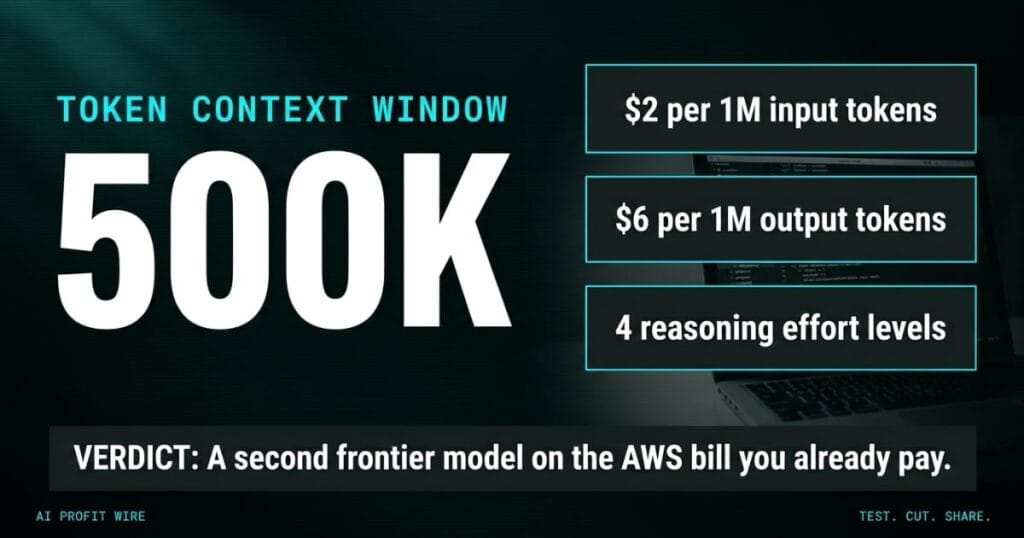
Provides businesses with access to a high-capacity reasoning model directly through existing AWS infrastructure.
What is Grok 4.6 on Amazon Bedrock?
Grok 4.6 is xAI’s frontier model for long-running agents, coding, and knowledge work, and it is now generally available in Amazon Bedrock, AWS’s managed platform for building generative AI applications and agents. The model went live on Bedrock on August 18, 2026, and AWS announced general availability on September 21, 2026.
It offers a 500K token context window and configurable reasoning effort at 4 levels: low, medium, high, and xhigh. You reach it through 2 endpoints, bedrock-mantle and bedrock-runtime, using the Converse API, Chat Completions, or the Responses API.
This is xAI’s second model on Bedrock, after Grok 4.3 opened the relationship as the vendor’s first entry in the catalog. For teams already paying an AWS bill, that means a frontier model option with no new vendor agreement and no separate subscription.
The model accepts text and image input and returns text, and audio, video, and embedding modalities are not supported. Tool calling, structured output, and response streaming carry over from the earlier Grok launch on Bedrock.
Grok 4.6 puts a second frontier model on infrastructure you already pay for.
How good is Grok 4.6 at agent work?
xAI built the model to stay with complex tasks across many steps, including research, codebase analysis, and turning an idea into a polished application. On longer trajectories, xAI reports the model showing more self-testing and verification, which means it checks its own work before moving on.
The benchmark results are xAI-reported for Grok 4.6 High and published August 12, 2026: 61 on the Artificial Analysis Intelligence Index, 69.9% on CursorBench v3.2, and 65.9% on DeepSWE v1.1. Terminal-Bench v3.0 sits at 26%, which is the number to watch if terminal agent work is your use case.
Several of those evaluations come from Artificial Analysis, which also tracks a cost-per-task metric blending input, cache, reasoning, and answer token prices. That metric is the honest lens for a reasoning-heavy workload, because reasoning tokens are a real line item on the bill.
On paper the model is frontier-grade, and the open question is whether quality holds at the cheaper effort levels.
Is Grok 4.6 cheaper than Claude on Bedrock?
On Standard tier pricing, Grok 4.6 lists at $2 per million input tokens and $6 per million output tokens, which xAI’s own launch announcement confirms. Claude Sonnet 4.6 on the same Bedrock catalog runs $3 per million input and $15 per million output.
Output pricing is where agent workloads bleed, because reasoning and answer tokens bill at the output rate. At $6 versus $15 per million output tokens, Grok 4.6 undercuts Claude Sonnet 4.6 by 60% on the line item that dominates agent spend.
2 levers push the number lower on the Bedrock pricing page: the Flex service tier runs at half of Standard for work that is not time-sensitive, and cached input bills at about a quarter of the standard input rate. The cache discount applies to a repeated prefix, so keep stable system prompts at the front of the request and check the cached token count to confirm it lands.
The Priority tier, at 1.75x, is the premium to avoid unless latency is money. Standard is pay-per-token with no commitment, which keeps a 1-week evaluation cheap on the account you already run.
For token-heavy agent work, Grok 4.6 is the cheaper frontier option on Bedrock by a wide margin.
Who is Grok 4.6 on Amazon Bedrock for?
It fits teams already inside AWS who want a second frontier model without adding a vendor, a contract, or a new procurement cycle. The strongest workloads are multi-step agents, code generation, and document-heavy knowledge work that strains smaller context windows.
Region routing matters at integration time. The global.xai.grok-4.6 inference profile routes worldwide at $2.00 per million input tokens, while us.xai.grok-4.6 keeps traffic inside the US for data residency at $2.20, so the global profile is the better default without a residency constraint.
Global inference reaches more than 30 Regions, and the AWS model card carries the current list before you pin one. If you track how model economics shift week to week, the running archive of AI cost and capability signals collects the pricing moves that matter.
Teams on Bedrock hold a stronger hand in every model renewal conversation this year.
A supplier invoice lands on a manager’s desk, and the unit cost on every line item has split into 4 tiers. Rush orders bill at the top tier, standard restocks at the bottom, and the supplier never asks which tier each shipment needed.
That is the structure of Grok 4.6’s 4 reasoning effort levels, and it cuts both ways. Leaving all calls at xhigh burns premium token volume for work that medium would have handled, and generated tokens bill at $6 per million.
The fix is to tag agent calls by difficulty before they ship, so the cheap tier takes the routine jobs and xhigh takes the ones that earn it. Teams that skip that step buy a frontier model and run it like a flat-rate utility.
Should you switch your Bedrock agents to Grok 4.6?
Run the test, and run it through the integration you already have. Pick one production agent workflow, route it to Grok 4.6 at medium effort through the Converse API, and compare output quality and token spend against your current model for 1 week.
The switching cost sits near zero because the cross-Region inference profiles slot into an existing Bedrock code path. Amazon Bedrock Guardrails and model invocation logging are supported on bedrock-runtime, so unattended agent runs keep a policy boundary and an audit trail.
A week of side-by-side data beats another quarter of single-vendor pricing.
Source: AWS Machine Learning Blog
