Dramatically cuts the token and compute costs of automating routine business software tasks and classifications.
What Is Jev?
Jev is a new transformer-based model from TypeSafe AI, released this week by Diogo Almeida, a former OpenAI researcher who helped build ChatGPT and invent RLHF. It is not a large language model, and the difference is the point.
Jev produces no text. It returns probabilities, what TypeSafe calls calibrated decisions, with outputs defined in advance, which the company says leaves no room for hallucination.
The design targets software automation: unstructured input in, typed probabilistic decisions out, at a price built for pipelines rather than conversations. The model is named for William Stanley Jevons, the 19th-century economist whose paradox describes how cheaper commodities get consumed more, and TypeSafe calls Jev a System One model built for intuition rather than reasoning.
Jev is a frontier-intelligence function call aimed at the work software does, minus the prose.
Does Jev Actually Deliver on Speed and Cost?
The early numbers come from teams that shipped it. Vercel replaced an OpenAI model running a safety classifier with Jev and got results 5 to 18 times faster with greater accuracy. Training runs on synthetic data through a method Almeida calls reinforcement learning from calibrated decisions, and he claims owning that subfield beats the launch itself in value.
Bryo AI tested Jev against Gemini for classifying business emails and found Gemini held a small accuracy edge but ran 10 to 20 times more expensive, while Jev handed back real probability scores for automation thresholds.
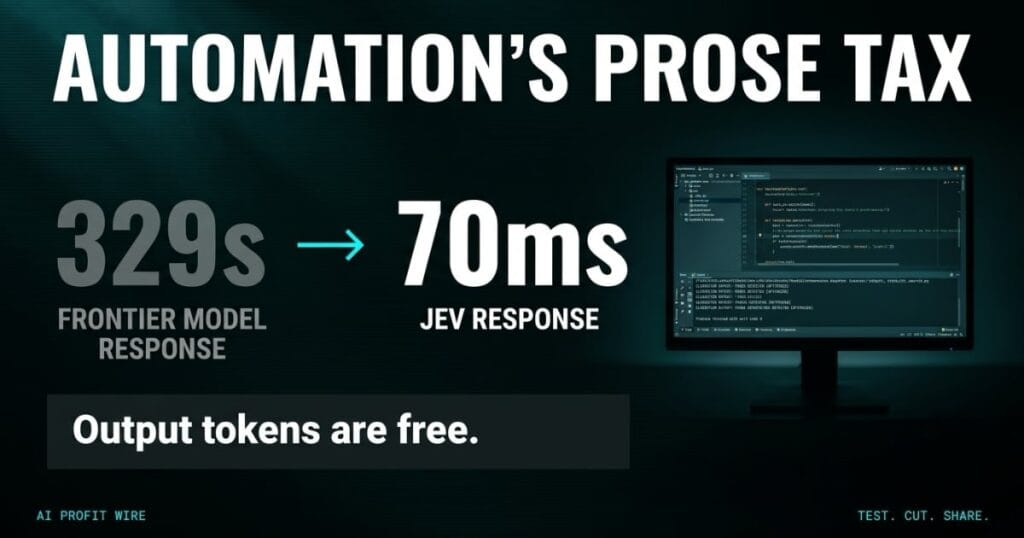
The vendor’s own benchmarks frame the gap: end-to-end response times of 70 to 500 milliseconds against 3 to 329 seconds for frontier models, which TypeSafe positions as 40x to 200x faster on decision-shaped queries.
Two production tests and one benchmark set agree on the direction, and none of the gaps are subtle.
Jev vs LLM APIs: Which Is Better for Automation?
For high-volume classification, routing, and scoring where only software reads the answer, Jev’s economics win on paper. Output tokens are free, and input tokens run $0.042 per million.
For anything a human reads, the LLM stays. Text generation is the product in chat, drafting, and copilot work, and Jev gives that up on purpose.
The pattern Vercel and Bryo AI used is the reusable one: keep the LLM where language is the interface, and move the decision calls where a probability with a confidence score drops into ordinary code.
Audit which calls in your stack have a human audience, and that audit decides the split.
Who Is Jev Actually For?
Developers running high-volume automation: safety classifiers, email routing, moderation checks, model routing, and monitoring agents for jailbreaks. Almeida’s framing is smart software distributed everywhere, closer to the early internet than to mega apps.
The demand signal is real. TechCrunch reports demand ran high enough in launch week that TypeSafe lost the ability to serve API users for a stretch.
Earendil CTO Armin Ronacher, whose company builds the open source model harness Pi, frames the trade without the marketing gloss: a 50% probability is a coin toss you discard, 95% is something your software can act on. He also sees model routing as a natural fit, because predicting which model a workload needs is a decision problem an LLM handles at needless expense. That threshold discipline is the adoption skill, and it is the same one we push across the automation cases we cover.
Jev fits teams whose bills scale with volume, and the threshold discipline travels with the model.
The billing alert fires because your classifier chewed 40 million tokens writing explanations your code strips back into one field. The software never wanted the prose, and you paid for it anyway.
Jev’s answer is structural: $0.042 per million input tokens, free outputs, and a probability your code branches on in 70 to 500 milliseconds. For the calls where only software reads the answer, the prose was overhead with a monthly invoice attached.
Vercel’s 5 to 18x speed gain on a safety classifier is the pattern: find the calls where only software reads the answer, and stop paying for an audience of zero.
Should You Move Classification Workloads to Jev?
If you run high-volume classification or routing, the test is cheap. Pull last month’s token spend for those calls, price the same volume at $0.042 per million input with free outputs, and compare.
Set a confidence threshold from day one. Ronacher’s 50% discard and 95% act is a reasonable starting rule, and you should log every low-confidence case so you can tune the threshold against outcomes.
Check the early-access constraints in the documentation before you commit, since TypeSafe is building new versions in new modalities and outside observers suspect an open-weight base model.
Move the machine-facing calls first, keep the human-facing ones on the LLM, and read the invoice before moving more.
Source: TechCrunch AI
