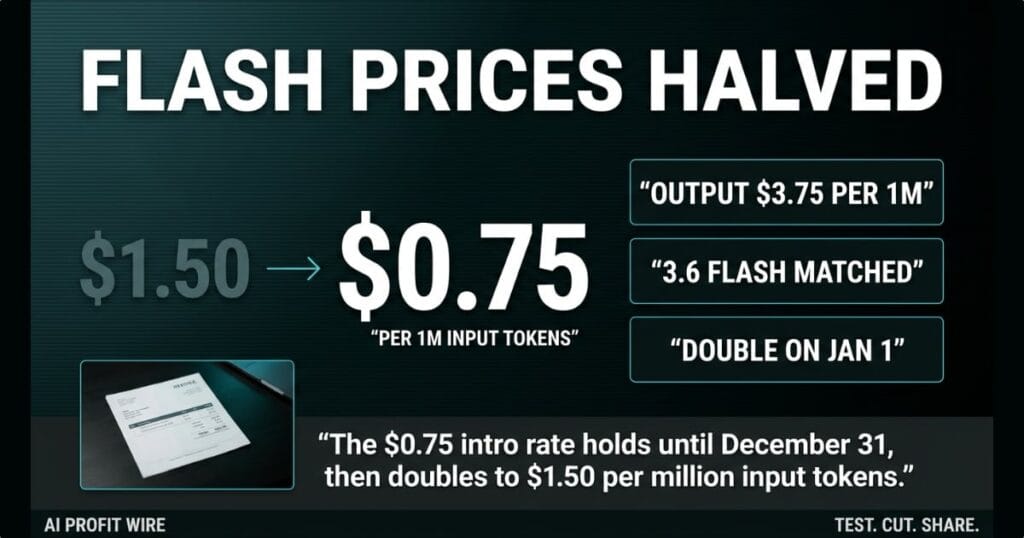
Reduces operational costs for AI-powered apps by 50% and provides high-end marketing video tools for small teams.
What is Gemini 3.7 Flash?
Gemini 3.7 Flash is Google’s newest workhorse model for coding and agents, released in August 2026, 3 weeks after 3.6 Flash shipped. It carries an introductory price of half the original 3.6 Flash cost per million tokens.
Google positions the model across software engineering, knowledge work, and web development workflows, with agentic workflows as the headline use case. That’s the profile of most small business automation: multi-step tasks handled end to end.
The launch landed alongside the Pixel 11 series, Pixel 11, Pixel 11 Pro, Pixel 11 Pro XL, and Pixel 11 Pro Fold, whose Google Tensor G6 chip runs the latest Gemini Nano on-device for faster local responses.
It’s Google’s volume model, priced to run your automation instead of your budget.
Is Gemini 3.7 Flash good for coding and agents?
Google claims substantial improvements over 3.6 Flash across software engineering, knowledge work, and web development, and calls 3.7 Flash its most intelligent workhorse model yet for coding and agents.
The model is tuned for agentic workflows, where software handles multi-step tasks with less hand-holding. For a small business, that’s the difference between an AI feature and an AI employee.
Independent confirmation is thin this early, which is why this signal rates 7 out of 10 on the hype scale: the model is real, and the scoreboard is still Google’s own.
The coding and agent gains are Google’s claim, and the intro price makes them cheap to test on your own tasks.
Gemini 3.7 Flash vs 3.6 Flash: which one costs less?
Neither, as of today: Google applied 3.7 Flash’s introductory rate to 3.6 Flash, so both bill $0.75 per million input tokens and $3.75 per million output. At launch the intro price was half the original 3.6 Flash cost, which is where the 50% headline came from.
Both rates expire on December 31, 2026, and Google’s pricing page confirms $1.50 input and $7.50 output starting January 1, 2027. Context caching doubles the same day, from $0.075 to $0.15 per million tokens.
So the honest comparison isn’t 3.7 against 3.6 at all. It’s December’s rate card against January’s.
Pick the stronger model at the same price, then budget around the expiry date.
The scent of ozone from an old laser printer fills the room as a partner at a boutique law firm opens the research service invoice she’s been putting off since the 1st. The cost is a metered leak: a few hundred dollars here, a few there, quietly compounding into a margin hit over 6 months. Token spend behaves the same way, except Google printed the date on this leak: the intro rate expires December 31 and doubles on January 1.
Rerun the budget in September and the doubling is a line item. Discover it in February and it’s a conversation with your accountant about 6 weeks of invoices that billed at $1.50 while your model assumed $0.75.
The firms that treat the deadline as a budget line keep automating. The ones that don’t, eat the increase and blame the model.
Who should use Gemini 3.7 Flash?
If you run coding assistants, customer-facing agents, or high-volume document workflows, this model family is Google’s default recommendation for exactly that workload. The 1 billion monthly users on the Gemini app, 63% of them talking to it directly and busy parents 43% more likely to use it for everyday tasks, tell you the infrastructure isn’t experimental.
The August wave around it matters too: Gemini 3.5 Transcribe delivers real-time, context-aware transcription for voice agents, live captioning, and post-call analytics, ignoring the noise and jargon that break conventional models. Gemini Omni 1.1 Flash adds studio-quality video generation with 4K upscaling, scene extension, and first-and-last-frame interpolation.
Small businesses are already power users here, crafting marketing materials with Gemini’s all-in-one image, video, and audio output. Teams that need brand-consistent design at volume pair that output with a dedicated design tool like Kittl.
This wave is built for teams running AI daily, not for the once-a-month user.
Should you switch to Gemini 3.7 Flash?
Switch if you’re running any Flash-class workload, because 3.7 Flash is the strongest model in the tier and the intro rate is the cheapest this tier has been. Test on the Gemini API free tier first, where input and output are free of charge, then move production volume before December 31.
Context caching at $0.075 per million tokens through December 31 softens repeated-prompt workloads, then doubles to $0.15 on January 1. Price recurring agent prompts against the cached rate, because that’s where agent margins usually live.
Run your 2027 budget at the doubled rate, $1.50 input and $7.50 output, and treat the months before the expiry as runway to prove the workload earns its place at full price. Anything that only clears at the intro rate is a project with a deadline attached.
Switch now, budget for January, and let the expiry date discipline the decision.
Source: Google AI Blog
