Increases operational efficiency for farmers by transforming raw machine data into actionable business decisions.
What is John Deere’s JD AI assistant and what does it do?
JD is John Deere’s AI assistant, introduced on September 1, 2026, and embedded directly in the Operations Center platform the company has run for more than a decade. It’s a conversational layer over the data a farm already generates.
The assistant answers questions from a farm’s own field, machine, and operational records. Deere’s examples read like the questions that actually decide a season: how fuel use during tillage compared with the last 3 years, how planter singulation varied across fields and what it did to yield, which member of the crew covered the most acres per hour with the sprayer, and when historical trends suggest harvest should begin.
Deere’s chief technology officer Jahmy Hindman framed the problem plainly. Farmers have more data available than ever before, but the value comes from using it in the moments that matter, and JD changes the experience from navigating through a sea of data to simply asking it a question.
The company says answers arrive tailored to the specific farm in a matter of seconds, and group product marketing manager Jackson Baca described JD as built to extract more value from the data that already exists in an Operations Center account.
JD is a question box for your own farm data, built into the Operations Center account you already run.
Does John Deere’s JD assistant actually work?
The evidence is vendor-supplied, credible, and early, because no independent benchmark of JD exists yet.
At the introduction press conference, a live demo asked JD why a certain field was seeing more weeds than usual. The assistant returned 5 possible answers in short order, drawing on years of data for that plot plus the season’s crops and chemical applications.
The plumbing behind it is specific. JD pulls planting variety and density records, combine yield monitor readings, weed heat maps generated by See and Spray sprayers, and even old equipment owner’s manuals, then answers from that record set.
What’s under the hood is a large language model, though Deere declined to name which one or which company it’s working with. The tool has already run on some farms and continues through an Early Access Program with select U.S. farms, so real-world feedback is part of the loop.
The claim holds up in Deere’s own demo, and nobody outside the company has stress-tested it yet.
Is John Deere’s JD good enough to replace digging through Operations Center reports?
The old way is dashboard archaeology, opening individual reports one at a time, cross-referencing seasons, and doing the math yourself. Deere’s own CTO called the alternative navigating through a sea of data, and JD’s pitch is asking 1 question instead.
The trade you accept is scope. JD answers only from your operation’s records and won’t pull in the general knowledge of the LLMs it’s built on, so it runs deep on your farm and is useless for anything else.
Against the status quo most small operations actually run, which is nobody analyzing the data at all, a free assistant that answers in seconds isn’t a replacement question anymore. It’s an upgrade over doing nothing with data you already paid to collect.
JD replaces the hours of report digging, not the judgment, and the hours are the part nobody has.
Who is John Deere’s JD assistant actually for?
Right now, JD is for select U.S. agricultural customers through a staged Early Access release that began September 1, with eligible Operations Center users able to express interest. Deere’s digital solutions director of product management Kevin Seidl confirmed the wider rollout comes later this year through Operations Center.
That broader release covers web and mobile first, with in-cab displays on the equipment itself planned eventually. Deere also intends to extend the assistant to turf, construction, roadbuilding, and forestry customers, which tells you the farm version is the first of several.
The natural fit today is the small or mid-size operation already logging data in Operations Center, sitting on multiple seasons of records, and running without an analyst on payroll. Launches like this one land in every AI move we’ve tracked that touches a small operation’s bottom line, if you want the surrounding context.
If your data already lives in Operations Center, you’re the target, and if it doesn’t, JD is the reason to start feeding it.
Six seasons of yield maps sit on the farm office desktop, and the last time anyone opened them was planting week. The question that decides this harvest, why field 4 keeps underperforming, has an answer buried in 3 years of chemical applications and yield data, and nobody has 4 hours to dig it out before the sprayer rolls.
At the JD demo, that exact type of question came back with 5 possible causes in a matter of seconds, pulled from data the farm already generated. The gap was never the data, it was the analyst, and most operations don’t have one on payroll.
When the analysis is free and the data is already yours, running another season on gut feel stops being a limitation and starts being a choice. That’s the part that should sting a little.
Can you actually use John Deere’s JD assistant right now?
Partially, and that’s the honest state of it. JD entered a staged Early Access release on September 1 for select U.S. customers, and Deere hasn’t published a timeline for general availability.
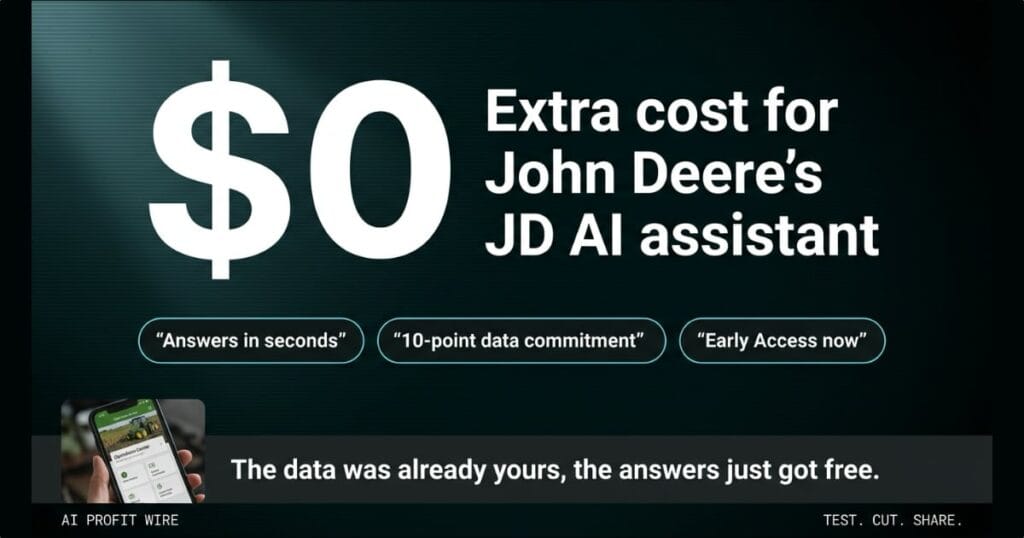
The cost side is settled for now: JD is built straight into Operations Center and won’t command any extra cost or subscription fee. Deere is demonstrating the assistant at the Farm Progress Show through September 3 at Outdoor Lots 144 and 153, and the company posts details at Deere.com/YourData alongside its 10-point Farmer Data Commitment.
The practical move depends on where you stand. Operations Center users should request Early Access now and run 1 real question through it this season, because free analysis on data you already own is the cheapest test in ag tech.
Everyone else should audit whether their machine data is being captured at all, since that’s the raw material JD runs on.
Use it if you can get in, feed your data either way, and revisit when the in-cab version ships.
Source: Bloomberg Tech
