Saves significant setup time and technical headaches for small businesses wanting to automate tasks across their existing software stack using AI.
What is the n8n MCP server update and what changed?
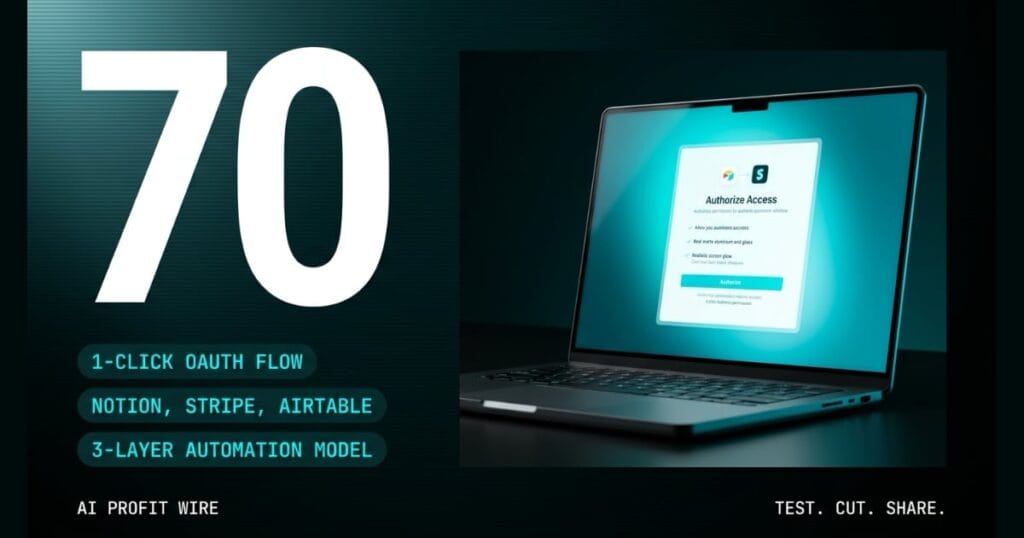
n8n now provides a 1-click OAuth flow to connect AI agents to nearly 70 MCP servers. This update eliminates the complex API configurations previously required to link external software tools.
Users can connect to services like Notion, Stripe, Airtable, and GitLab directly from the Node panel. The system also supports connections to custom MCP endpoints for servers not yet officially listed.
Additional servers are currently in development, prioritizing tools that support OAuth and Dynamic Client Registration. This expansion means the platform will continue to broaden its native connectivity over time.
The core change is a massive reduction in integration friction for automated workflows.
What is the evidence behind the n8n MCP server update?
The platform documented the launch on August 10, 2026 alongside specific use cases like connecting Notion to an AI agent. The previous process required contacting an admin, creating an internal integration, and configuring multiple distinct tools.
The new flow condenses that setup into a single OAuth click. Once connected, an agent can search pages, draft content, and update databases without requiring manually built tools for each operation.
The Notion example is concrete. Before this update, wiring Notion to an agent meant creating an internal integration, sharing pages with it, and configuring multiple Notion tools with different operations. Now it is just an OAuth click, and an agent can pull meeting notes for context, draft a page from a conversation, and update a database when something happens elsewhere.
New additions include Airtable, Grafana, New Relic, Jotform, and PandaDoc, joining existing connections like Notion, Stripe, GitLab, Apify, Linear, monday.com, and Hugging Face.
The evidence shows a direct elimination of manual configuration steps for nearly 70 services, with concrete Notion, Stripe, and Airtable examples documented.
How does n8n compare to the alternatives, and what background do small business owners need?
n8n categorizes automation into 3 distinct layers: native nodes, agent tools, and MCP servers. Native nodes are the right call for deterministic workflows where you need an exact API call at a specific step.
Agent tools give the AI limited discretion over fixed actions, which results in fewer LLM calls. MCP servers give the agent a broader surface to reason over, allowing it to decide which tools to use and when.
You can mix all 3 methods in a single workflow depending on the required precision. This flexibility prevents founders from being locked into 1 approach for every automated task.
Small business owners need to map their specific task requirements to the correct integration layer.
How does the n8n MCP server update affect day-to-day operations for small businesses?
This update directly reduces the technical overhead required to deploy automated workflows. You can explore workflow automation signals to see how this connectivity impacts daily productivity.
Instead of waiting on a developer to untangle API permissions, founders can click once and deploy. This shift moves the bottleneck from technical configuration to strategy.
Agents can now pull context from meeting notes, generate drafts, and update databases across nearly 70 connected services. This capability allows small teams to automate multi-step processes that previously required manual data entry.
Day-to-day tasks become faster to automate and significantly cheaper to maintain.
The SaaS subscription list on your finance dashboard keeps growing, and half of the tools do not talk to each other without a custom Zapier workaround.
You connect Airtable, Notion, and Stripe to n8n with 1-click OAuth, and your AI agent pulls customer data across all 3 in a single workflow. The agent searches pages, drafts records, and updates databases without you building a separate tool for each operation.
The integration bottleneck shifts from chasing admins for API permissions to deciding which of nearly 70 connected services your agent should reason over. Your stack stays the same, but the connective tissue between tools finally works without a developer on retainer.
What is the final verdict on the n8n MCP server update?
The 1-click OAuth integration for nearly 70 MCP servers removes a massive technical barrier for small business owners. It eliminates the need for custom API development and lets founders deploy AI agents across their existing software stack immediately.
By categorizing automation into native nodes, agent tools, and MCP servers, the platform provides clear boundaries for LLM reasoning. This structure keeps operational costs predictable while expanding agent capabilities.
The Notion example proves the point. What used to require admin permissions, internal integrations, and multiple tool configurations is now a single OAuth click that unlocks search, draft, and update capabilities for the agent.
Founders can now automate complex cross-platform tasks without hiring specialized developers to manage individual integrations. This capability is accessible directly from the Node panel, and additional servers are on the way.
This update is a practical win for founders who need deep software automation without the SaaS fluff, with nearly 70 services connected on day 1.
Source: blog.n8n.io
