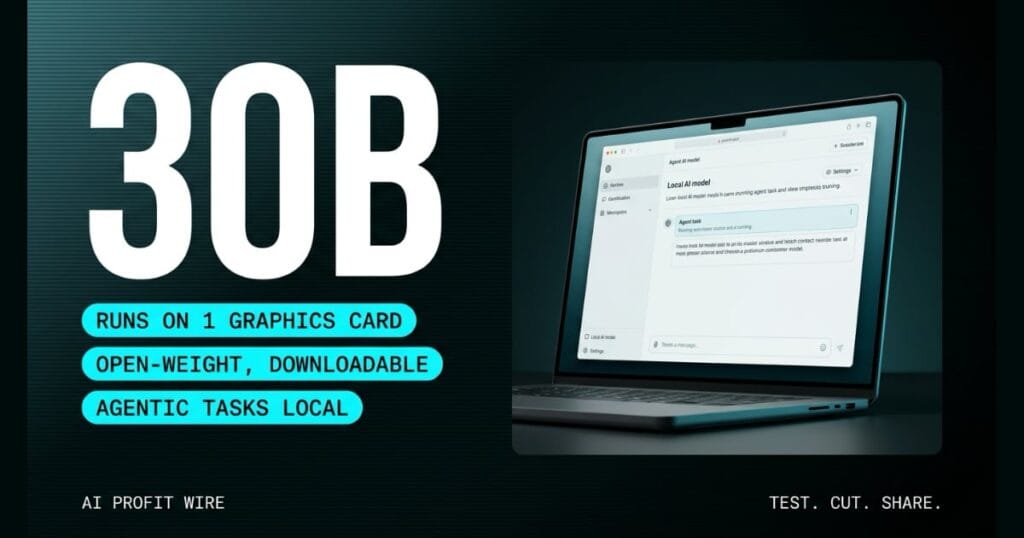
Small business owners can cut recurring cloud API fees by running AI locally on consumer hardware. The open-weight model also keeps sensitive business data on-premise instead of routing through third-party endpoints.
What is Muse Glimmer and what changed?
Muse Glimmer is a 30B parameter open-weight AI model released by Meta Superintelligence Labs on August 10, 2026. It is designed to run locally on a Mac or PC with a single graphics card, without requiring cloud access.
The model is a distilled version of Meta’s Muse Spark, the company’s most powerful AI model. Meta trained Glimmer using distillation, where a smaller model learns from a larger teacher model.
Muse Glimmer is a 30B open-weight model that runs on a single consumer graphics card.
What is the evidence behind Muse Glimmer?
The evidence comes from Meta’s announcement and reporting by USA Today and Business Insider. Meta Superintelligence Labs, led by former Scale AI CEO Alexandr Wang, built and released the model under a permissive license.
Muse Glimmer can perform complex reasoning and handle a broad range of agentic tasks while running on a consumer device. Meta said it “performs strongly for its size class” on several benchmarks for large language models.
The model can break a task, such as coding or admin work, into steps. Zuckerberg also published a 6,500-word essay titled “The Future Is for Everyone” advocating for open-weight AI.
Muse Glimmer is confirmed by Meta, USA Today, and Business Insider as a 30B open-weight model running on consumer hardware.
How does Muse Glimmer compare to the alternatives, and what background do small business owners need?
Leading AI models from OpenAI, Anthropic, and Google are closed-source and require paid API access. Muse Glimmer is open-weight, which means users can download and modify it to run locally instead of in the cloud.
Open-weight models are typically cheaper than closed-source frontier models. The tradeoff is that the latest version still trails the strongest models from Anthropic and OpenAI on overall benchmarks, though it is competitive on several.
Chinese labs currently lead the open-weight race, with Moonshot’s Kimi K3, Alibaba’s Qwen3.8-Max, and DeepSeek’s V4-Flash delivering performance that rivals top US systems. Muse Glimmer is Meta’s answer to that competition.
Meta also plans to release an open-weight version of Muse Spark, its most powerful model, in the near future. You can read more about AI cost-cutting signals for small business owners in our signals archive.
Muse Glimmer is the first credible open-weight model from a US lab that runs on a single consumer graphics card.
How does Muse Glimmer affect day-to-day operations for small businesses?
Small business owners currently pay per-token API fees to run AI workloads through cloud providers. Muse Glimmer shifts that cost to a one-time hardware purchase, since the model runs on a single graphics card.
The model handles agentic tasks like coding and admin work, which means founders can automate workflows without sending sensitive business data to a third-party API.
Open-weight customization also means businesses can fine-tune the model for specific operational tasks. The data privacy benefit is significant for founders handling customer records or proprietary processes.
Zuckerberg’s 6,500-word essay framed the release as a push for open access to superintelligent AI, arguing that restricting it to a handful of companies would be wrong on safety grounds. The policy angle matters because US labs face training data restrictions that Chinese competitors do not.
Muse Glimmer moves AI costs from recurring API fees to a one-time hardware investment, with data privacy as a secondary unlock.
The recurring API line item on your monthly PnL has crept up quarter after quarter, and your bookkeeper flags it as the fastest-growing software expense outside payroll.
You download Muse Glimmer, install the 30B model on a workstation with 1 graphics card, and run agent tasks locally. The model handles coding and admin work without sending customer data to a third-party endpoint.
The API line item drops to a one-time hardware purchase. Your customer data stays on-premise, and the model itself is free to modify for your specific workflow.
What is the final verdict on Muse Glimmer?
Muse Glimmer is a credible open-weight alternative to closed-source AI APIs for small business owners who want to cut recurring costs. The 30B model runs on a single graphics card and handles agentic tasks locally.
Founders with sensitive data or high API spend should test Muse Glimmer on a workstation before committing. The model is free to download, and the hardware requirement is a single consumer graphics card.
The tradeoff is real: Muse Glimmer still trails the strongest models from Anthropic and OpenAI on overall benchmarks. Founders who need frontier-level reasoning for complex tasks should keep their cloud API, but those running repetitive coding or admin workflows can shift those locally.
Meta’s plan to release an open-weight version of Muse Spark means this is the first wave, not the last. Small business owners who test the local-AI workflow now will be ready when the more powerful model drops.
Muse Glimmer is the first practical open-weight model for small business owners who want local AI without cloud API fees, with a more powerful version on the way.
Sources: Bloomberg Tech, USA Today, Business Insider
